
Best Gel Moisturiser for Oily Skin in India Under ₹500
Some links here may be affiliate links. Where they are, a purchase can earn Aryeva a commission at no extra cost to you — it never affects the picks. Prices and formulations change; everything below was checked against the brands’ own ingredient listings at the time of writing.
Short answer: Sebamed Clear Face Care Gel is the pick for oily skin in humid weather, with no actives and the shortest ingredient list here. For the best value with ceramides, choose The Derma Co 5% Nia-Ceramide Mattifying. For niacinamide with no fragrance or colourant, choose Hyphen 2% Cica Exosomes. All thirteen below are under ₹500, and “oil-free” on the front tells you far less than the list on the back.
How this list was checked. Each ingredient list was read from the brand’s own product page. Six products were added on 30 September 2026, and prices for all thirteen were re-checked on 24 October 2026, on the brands’ own sites or on Amazon. This is a reading of labels, not a wear test. The full method is under “What I looked at” below.
“Oil-free” is the most common phrase on the front of a gel moisturiser sold in India, and it is not a formulation category. No rule defines it. No standard sets a threshold. In practice it means one thing: the formula contains nothing a shopper would recognise by name as an oil.
Silicone passes that test. So does a hydrogenated hydrocarbon. So does an ester built in a reactor from a fatty acid and an alcohol. All three sit on skin and do the job an oil does — they fill the gaps between surface cells, smooth the texture, and slow the rate at which water leaves. A formula can be built almost entirely out of them and still, accurately and legally, say OIL-FREE in capitals on the tube.
I read the ingredient list for every product below off the brand’s own current page rather than a marketplace listing or a decoder site, because both go stale. What that reading turned up is that the thirteen moisturisers here are built in genuinely different ways, and the label does not tell you which one you are holding.
Everything is at or under ₹500 for a standard tube. That band is not arbitrary — it is where this category actually sits. Below it, the shelf is crowded. Above it, there is almost nothing until you reach imported names at roughly double the money.
What “oil-free” actually means
Here is the clearest example I found, and it is not a bad product. That is the point.
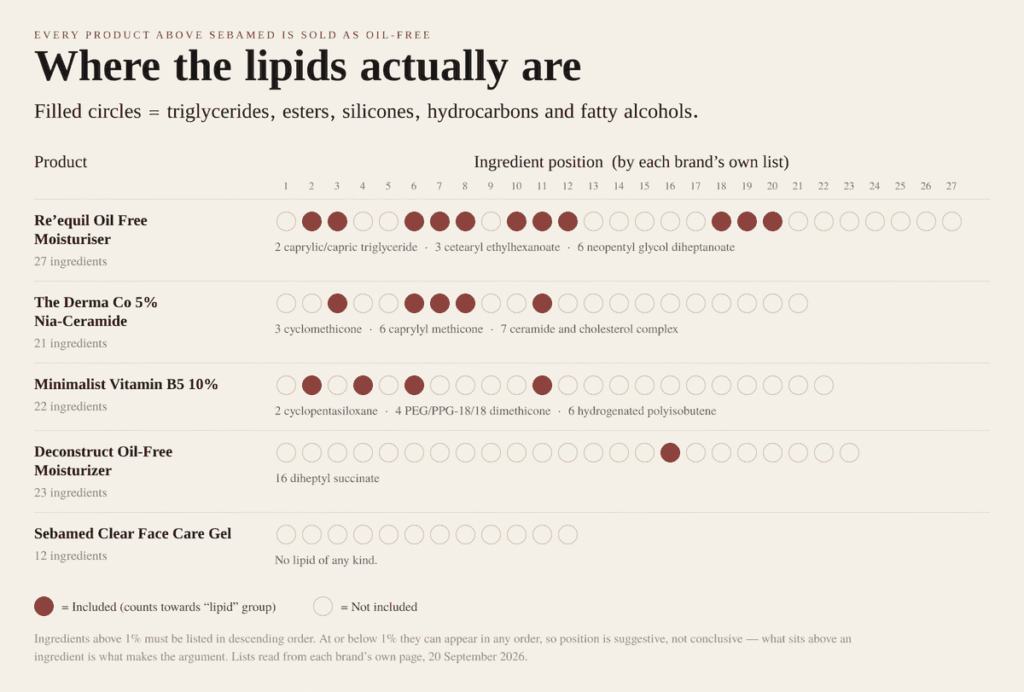
Re’equil’s Oil Free Moisturiser is well reviewed, fragrance-free, and sold for normal to oily skin. The first seven ingredients on its own page are water, caprylic/capric triglyceride, cetearyl ethylhexanoate, glycerin, propanediol, neopentyl glycol diheptanoate and octyldodecyl myristate.
Four of those seven are lipids. Caprylic/capric triglyceride is fractionated coconut oil. The other three are esters — the same chemistry as an oil, assembled deliberately so the texture is lighter and the shelf life longer. The product is called Oil Free Moisturiser, and the name is defensible, because not one of those four is an ingredient anyone recognises as an oil.
It is a lotion rather than a gel, which is why it is not one of the thirteen below. It is here because it shows the term doing exactly what the term does, and two of the products below, both sold as oil-free, do the same thing more plainly.
The same pattern runs through the gels. Minimalist’s Vitamin B5 10% lists cyclopentasiloxane second, a silicone-glycol surfactant fourth, and hydrogenated polyisobutene sixth — silicone, silicone, hydrocarbon, three of the top six. The Derma Co’s 5% Nia-Ceramide lists cyclomethicone third and caprylyl methicone sixth, with squalane shortly after. Dot & Key’s Cica + Niacinamide has a hydrocarbon solvent third, dimethicone fifth, and a silicone blend seventh.
None of this is a scandal, and none of these brands is being dishonest. Silicones are often the smarter choice for oily skin — they sit lighter than a plant oil, they do not oxidise, and they are poor at clogging pores compared with the heavy butters that “natural” gels sometimes lean on. The problem is only that the label implies an absence which is not there, and a reader who has been told by a dermatologist to keep lipids off their face has no way of knowing that from the front of the tube.
Two of the thirteen genuinely are built without any of it, and a third comes close. Those three come first.
What a moisturiser is actually doing
Three jobs, and every product does some mix of them.
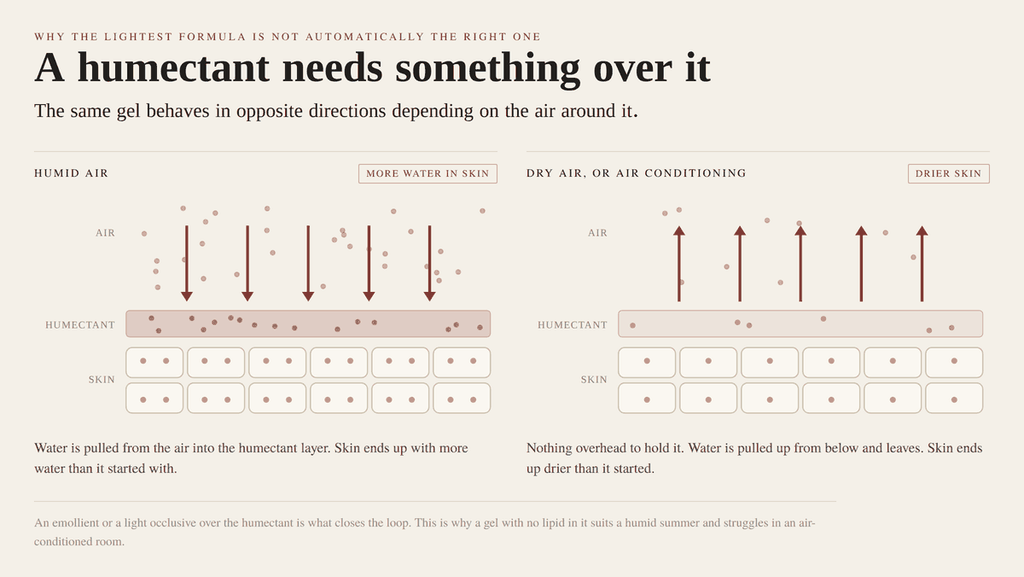
Humectants pull water — from the air when it is humid, from the deeper layers of your skin when it is not. Glycerin, sodium hyaluronate, panthenol, betaine, sodium PCA, amino acids. They are cheap, they work, and they make up the bulk of every gel here.
Emollients fill the microscopic gaps between surface skin cells. This is what “smooth” feels like. Esters, squalane, light silicones, plant oils.
Occlusives slow water leaving the skin. Heavier silicones, waxes, hydrocarbons, petrolatum.
A gel is a texture, not a category. What makes something a gel is the thickener and the water content, not what else is in it — which is why one gel can be nothing but humectants and the next can be a third silicone, and both feel light going on.
The practical consequence is the part worth remembering. A humectant with nothing over it is unstable in dry air. It draws water towards the surface, and if there is no emollient or occlusive holding that water in, it leaves — sometimes taking more with it than it brought. Through a humid Indian summer this rarely matters. In an air-conditioned office, or anywhere in the north in January, it matters a great deal.
Which is why the lightest possible formula is not automatically the right answer for oily skin. Oily skin makes sebum, and sebum is not water. Skin can be greasy and dehydrated at the same time, and usually is when someone has been attacking it with a strong cleanser and an acid.
What I looked at
Thirteen moisturisers, most of them gels, all sold in India, all at or under ₹500 for a standard tube. Six were added on 30 September 2026. For each one I read the ingredient list off the brand’s own product page on the day this was written, and where a brand publishes concentrations I have said so, because most of this category does not.
They are not ranked. They are grouped by how they are built, because that is the thing that actually decides which one suits you.
| Product | Built on | Worth knowing |
|---|---|---|
| Sebamed Clear Face Care Gel | Humectants only | Twelve ingredients, no lipid at all |
| Deconstruct Oil-Free Moisturizer | Humectants, one light ester | Publishes its percentages |
| Pilgrim 5% Niacinamide Oil-Free Gel | Humectants, no silicone | Glycolic acid and perfume, neither in the name |
| The Derma Co 5% Nia-Ceramide | Silicone, with ceramides | Niacinamide second; the largest tube |
| Minimalist Vitamin B5 10% | Silicone and hydrocarbon | Panthenol third, at 10% |
| Hyphen 2% Cica Exosomes Oil-Free | Niacinamide and panthenol, on silicone | No fragrance, no colourant |
| Dot & Key Cica + Niacinamide | Silicone, with ceramides | Contains tea tree and peppermint oil, and two colourants |
| Dot & Key Watermelon Cooling Icy Gel | Silicone, with ceramides | Two cooling agents, peppermint oil and fragrance |
| Foxtale Oil Balancing | Silicone, with azelaic acid | Contains fragrance and four colourants |
| Mamaearth Tea Tree Oil-Free | Gel base, one hydrocarbon | Tea tree extract, not oil; fragrance |
| Dr. Sheth’s Ceramide & Vitamin C Oil-Free | Fractionated coconut oil, second | Labelled oil-free, with an oil second in the list |
| Aqualogica Radiance+ Oil Free | Triglyceride and esters | Isopropyl myristate fourth; fragrance and titanium dioxide |
| Pond’s Super Light Gel | Not published | No ingredient list on the brand’s page |
Sebamed Clear Face Care Gel
Water, aloe juice, propylene glycol, glycerin, hydrogenated starch hydrolysate, panthenol, sodium hyaluronate, allantoin, carbomer, citric acid, sodium hydroxide, phenoxyethanol.
That is the entire list. Twelve ingredients: no silicone, no ester, no oil, no fragrance, no colourant. Humectants, two soothing agents, a thickener, a pH adjuster, and one preservative. It is the most straightforward formula in this post by a wide margin and the closest thing here to a gel in the technical sense.
The brand’s position is the pH — 5.5, matched to the skin’s own surface, which is mildly acidic. That is a reasonable thing to build a product around and a claim Sebamed has made consistently for decades.
Who it suits: humid weather, skin that is oily but not irritated, and anyone who wants the shortest ingredient list they can find.
Who should skip it: anyone in dry air or on actives. There is nothing in this to hold the water it attracts. It is also the smallest tube here for the money, which is the tax on a German import.
Deconstruct Oil-Free Moisturizer for Oily Skin
One of two products in the set where “oil-free” describes the formula rather than the marketing.
After water comes calendula extract, then a long run of humectants — betaine, sodium PCA, sodium lactate, PCA and seven amino acids, which together are the 3% NMF complex on the front. NMF stands for natural moisturising factor, the mix of water-binding compounds skin makes for itself. Glycerin follows. The only emollient in the whole formula is a pair of light esters, and there is no silicone, no triglyceride, and no hydrocarbon anywhere in the list.
Deconstruct also publishes its percentages — 3% NMF complex, 0.2% panthenol. Most of this category does not, and it is the easiest way a brand can show it has nothing to hide.
Who it suits: oily skin that wants hydration with no slip at all, and readers who want to be able to check what they are buying.
Who should skip it: anyone who wants a moisturiser to feel cushioning. This one does not, and it is not trying to.
Pilgrim 5% Niacinamide Oil-Free Gel Moisturizer
Built the way the two above are, with one ingredient the name leaves out.
Pilgrim publishes its list as a table rather than a single line. Water, niacinamide, saccharide isomerate, citric acid, sodium citrate, butylene glycol, a plant extract, then glycolic acid, followed by more plant extracts, betaine, propanediol, glycerin, sodium hyaluronate, panthenol and, last, perfume. There is no silicone, no triglyceride and no hydrocarbon, only a single light ester near the bottom, so on construction it belongs with the Sebamed and the Deconstruct.
Two things to know. Glycolic acid is an exfoliating acid, and the product name does not mention it; if you already use an acid serum, this is a second one. And the table does not read like a list in descending order. Glycerin sits twenty-first, behind citric acid and several extracts, which is not where glycerin usually sits in a gel. So I would not lean on the positions here, only on what is present, and that includes perfume.
Who it suits: humid weather, oily skin that is not on any other acid, and anyone who wants niacinamide without silicone.
Who should skip it: anyone already using an AHA or BHA, anyone avoiding fragrance, and anyone whose skin is currently stinging.
The Derma Co 5% Nia-Ceramide Mattifying Moisturizer
On 24 October 2026 this was out of stock on The Derma Co’s own site, but still sold on Amazon. The “Daily Hydrating” Nia-Ceramide that the brand’s site now shows instead is a different formula, not a rename.
Niacinamide is the second ingredient, which is consistent with the 5% on the front — at that concentration it belongs high in the list, and it is there. Cyclomethicone is third and caprylyl methicone sixth, with a five-ceramide complex, squalane, panthenol, allantoin, witch hazel, and zinc PCA further down.
It is silicone-led, and the finish is genuinely matte; that is what the silicones and the silica are for. The ceramides are the interesting inclusion, because a barrier roughed up by acids is a real problem for this reader, and ceramides are the sensible answer to it. Witch hazel is the one thing I would rather was not in there on already-irritated skin, though it sits low in the list.
It also comes in one of the largest tubes in this post, which makes it one of the better values per gram here.
Who it suits: anyone who wants a matte finish, a real dose of niacinamide, and a lot of product for the money.
Who should skip it: anyone whose skin reacts to witch hazel, and anyone already using a niacinamide serum, who would be paying twice for the same ingredient.
Minimalist Vitamin B5 10%
Water, cyclopentasiloxane, panthenol, a silicone-glycol surfactant, glycerin, hydrogenated polyisobutene, then betaine, sodium hyaluronate, allantoin, copper gluconate, zinc gluconate and magnesium salts.
Panthenol at 10% in third position is a real dose of a genuinely useful ingredient — a humectant that also has decent evidence behind it for soothing and for supporting barrier repair. Everything around it is built for slip and a fast, dry finish.
This is the one to hand someone whose skin feels raw from an active. It is also a clear illustration of the gap between the label and the list: a product sold on being lightweight and oil-free whose second, fourth, and sixth ingredients all do the job a lipid does.
Who it suits: skin that is irritated rather than congested, and anyone who likes a silicone finish under makeup or sunscreen.
Who should skip it: anyone avoiding silicones, for whatever reason. There is no point buying this one and then resenting it.
Hyphen 2% Cica Exosomes Oil-Free Moisturizer
The most straightforward list among the newer names here.
Water, niacinamide, panthenol, cyclopentasiloxane, glycerin, then the centella, a thickener, zinc PCA, and a mix of zinc, copper and magnesium salts. A light hydrocarbon and two more silicones appear further down.
Niacinamide second and panthenol third are useful positions for both, although the brand does not print a niacinamide percentage; the 2% in the name refers to the cica. Structurally it sits close to the Minimalist, with panthenol and zinc salts carried on a silicone, plus the niacinamide. There is no fragrance and no colourant anywhere in the list.
Who it suits: oily, congested skin that wants niacinamide and something soothing in the same step, without fragrance.
Who should skip it: anyone already using a niacinamide serum, for the same reason as the Derma Co: you would be paying twice for the same ingredient.
Dot & Key Cica + Niacinamide Oil-Free
Water, glycerin, a hydrocarbon-based thickener system, niacinamide fourth, dimethicone fifth, dicaprylyl ether, a silicone blend, then centella, green tea, a ceramide complex and hyaluronic acid.
Niacinamide in fourth position is a meaningful placement, and the ceramide complex is a genuine inclusion rather than a dusting. On composition alone, this is one of the better-built gels in the set.
Two things to know before buying. It contains tea tree leaf oil and peppermint oil — both are literally oils, both are fragrant volatiles, and peppermint in particular is a common cause of stinging on skin already broken by acne or by an acid. And it carries two colourants, a yellow and a blue, which together make the green the product comes out as. Neither is doing anything for your skin.
Who it suits: calm, oily, congested skin that wants niacinamide and ceramides together.
Who should skip it: anyone whose skin stings easily. On a compromised barrier, the peppermint oil is the most likely thing in the tube to be felt.
Dot & Key Watermelon Gel Moisturizer With Hyaluronic
Dot & Key now sells this as the Watermelon Gel Moisturizer With Hyaluronic; it was the Watermelon Cooling Icy Gel Moisturizer when this guide was first written. The ingredient list on its page was re-read on 24 October 2026: the two cooling agents, the peppermint oil and the fragrance are all still there.
A gel whose name tells you more about how it feels than about what it does.
Water, glycerin, then two silicone blends, niacinamide fifth, a third silicone blend, hyaluronic acid, the watermelon extract, and then two cooling agents, menthyl PCA and ethyl menthane carboxamide. A ceramide complex, aloe, peppermint oil and fragrance follow.
The icy feeling is the cooling agents. It is a sensation, not a sign that anything is working. On top of that there is peppermint oil, the same one flagged in Dot & Key’s Cica gel above, and fragrance.
One more thing, from the brand’s own page: it says the ingredient list “is currently undergoing a transition” and may differ from the product you receive. So read the tube.
Who it suits: very oily skin in hot, humid weather that likes the cooling feel and is not on actives.
Who should skip it: anyone whose skin stings, anyone on a retinoid or an acid, and anyone avoiding fragrance. The Cica version above does the same job with fewer extras.
Foxtale Oil Balancing Moisturizer
Water, glycerin, dimethicone third, propanediol, niacinamide fifth, then glyceryl glucoside, propylene glycol, dicaprylyl carbonate, centella and betaine, with azelaic acid and a second silicone further down.
Niacinamide fifth with azelaic acid present is a good pairing on paper for the marks acne leaves behind. But two things in this list deserve naming.
The brand describes this as fragrance-free while the ingredient list carries “allergen free fragrance”. Fragrance with the known allergens removed is still fragrance. This is the second Foxtale product where that same phrase does that same work, so it reads as house style rather than an oversight, and it is a fragrance dressed up as an absence.
The list also contains mica and three colourants, one of them titanium dioxide. The brand’s own page promises a “pearl-like glow” and a “matte-pearl finish”, and this is where that comes from. It is a cosmetic effect sitting on top of your skin, not an effect on your skin. There is nothing wrong with wanting it. It is worth knowing that this is what you are looking at afterwards.
Who it suits: oily skin working on post-acne marks that also wants an immediate finish.
Who should skip it: anyone avoiding fragrance, and anyone who would rather judge their own skin without a pigment on top of it.
Mamaearth Tea Tree Oil-Free Face Moisturizer
A true gel, and the tea tree story again.
Water, the copolymer that makes it a gel, xanthan gum, glycerin, an emulsifier and vitamin E, then hydrogenated polyisobutene ninth, the same light hydrocarbon that sits in the Minimalist. After the preservatives come tea tree extract and salicylic acid, then oat and soybean extracts, and fragrance last.
The tea tree is extract, not the oil the acne studies used, which is the same distinction the face wash post draws. The salicylic acid sits after the preservatives, with no percentage stated, which puts it most likely under 1%. And the fragrance is labelled “IFRA certified allergen free fragrance”, which is still fragrance.
Who it suits: oily skin in humid weather that wants a light gel at a low price and does not mind fragrance.
Who should skip it: anyone buying it to treat acne. For salicylic acid that stays on the skin, a leave-on serum with a stated percentage does the job this cannot.
Dr. Sheth’s Ceramide & Vitamin C Oil-Free Moisturizer
The plainest example on this page of what “oil-free” allows.
The second ingredient, after water and ahead of glycerin, is caprylic/capric triglyceride: fractionated coconut oil, the same ingredient that opens the Re’equil list above. Coconut alkanes, another coconut-derived emollient, sit fifth, and dimethicone sixth. Further down are amla, Kakadu plum, a vitamin C derivative, a five-ceramide complex and ashwagandha. No fragrance and no colourant.
Nothing in that list is a problem. Triglyceride is a light, well-tolerated emollient, and the ceramides are a genuine inclusion. But if a dermatologist has told you to keep oils off your face and you are choosing by the words on the front, this is where the instruction and the label point in opposite directions most clearly: the second-largest ingredient is an oil in everything but name.
Dr. Sheth’s also sells a Haldi & Hyaluronic Oil-Free Moisturizer that goes the other way: twelve ingredients, humectants only, much like the Sebamed. If you like the brand and want the lighter build, that is the one.
Who it suits: oily skin in dry or air-conditioned air, which needs something to hold water in, and anyone who wants ceramides without fragrance.
Who should skip it: anyone keeping lipids off their face on medical advice, and anyone in a humid summer who wants the lightest possible feel.
Aqualogica Radiance+ Oil Free Moisturizer
Sold as oil-free, and built on lipids.
Water, glycerin, then caprylic/capric triglyceride third and isopropyl myristate fourth, with niacinamide fifth. Isopropyl palmitate, an ester from the same family, appears later.
Isopropyl myristate is worth a sentence. It turns up on most lists of pore-clogging suspects because it scored high in old rabbit-ear tests. Those tests are a poor guide to human skin, and I would not treat that as a verdict. But if you get closed comedones easily and are trying to work out why, it is one of the first things worth checking for, and this label gives you no hint that it is there.
The list also contains titanium dioxide, a white pigment, which is likely part of where a “radiance” moisturiser’s instant glow comes from, and “IFRA certified allergen free fragrance”.
If you like the brand, its Hydra Melt Gels are much closer to what this post is about: dimethicone-led gels in a 100 g tub for less money. The two I read carry colourants, and the Glow+ version perfume as well.
Who it suits: oily skin in dry or air-conditioned conditions that wants niacinamide and a soft finish, and does not break out easily.
Who should skip it: anyone prone to closed comedones, anyone avoiding fragrance, and anyone who picked it because of the word oil-free.
Pond’s Super Light Gel
The default gel moisturiser in India, sold in every chemist and kirana, and among the cheapest per millilitre in this post.
I have assessed it differently from the others, and you should know why. Pond’s does not publish a full ingredient list on its Indian product page — it names hyaluronic acid, vitamin E and glycerine and describes what they do, but there is no panel to read. Every other product here was judged on its list. This one I can only judge on what the brand states, so I am not going to make claims about what is in it.
What is true: it is a humectant-led gel, it absorbs quickly, it costs a fraction of what the actives brands charge for less product, and for a great many people with oily skin who are not using actives and simply want their face not to feel tight, it does the job.
Who it suits: anyone who wants hydration and nothing else, at one of the lowest prices here.
Who should skip it: anyone who wants to know exactly what they are applying. If you already own it and it is working, though, there is no argument in this post for replacing it.
Two other popular gels are missing for a similar reason. Plum’s Green Tea Oil-Free Mattifying Moisturizer shows only its key ingredients on its own page, green tea and, notably, glycolic acid, with no full list. Mamaearth’s Oil-Free Moisturizer with Apple Cider Vinegar shows no list at all. Without one, I cannot compare them with anything here.
Where the moisturiser goes
Morning: cleanser, any leave-on active, moisturiser, then sunscreen. Evening: cleanser, active, moisturiser.
Sunscreen goes over the moisturiser, not under it, and it is not optional. If you are using any acid or any retinoid, your skin is more sensitive to UV than it was, not less. That is covered properly in the sunscreen post.
If your face feels tight after cleansing, the cleanser is the problem, not the moisturiser. A gel moisturiser cannot undo a stripping wash, and no amount of hydration compensates for a surfactant taking the barrier apart twice a day. The face wash post goes through which ones do that.
And if niacinamide is already in your serum, there is no benefit in also buying a moisturiser built around it — you will simply be paying twice for the same ingredient. The niacinamide serum post covers what a sensible dose looks like.
If you only want one answer
For humid weather, no actives, and the shortest list you can get: Sebamed. To be able to verify exactly what you are putting on: Deconstruct. For the best value and ceramides with it: The Derma Co. For skin left raw by an active: Minimalist. For niacinamide with no fragrance or colourant: Hyphen. And if you already own the Pond’s and it is working, keep it.
The ones I would think hardest about are the ones carrying fragrance, colourants, cooling agents or fragrant oils, and on this page that is six of the thirteen. Not because they are badly made — on formulation several are competitive — but because those ingredients are there for the experience of using the product rather than the result of using it, and on skin that is already unhappy they are the things most likely to make it unhappier.
Common questions
Does oily skin need a moisturiser at all?
Yes. Sebum is oil; hydration is water. Skin can produce plenty of the first and be short of the second, and the tight, squeaky feeling after washing is the short-of-water kind. Skipping moisturiser while using acne actives is also how most people end up with a compromised barrier.
Is “oil-free” the same as “non-comedogenic”?
No, and neither term is regulated. “Non-comedogenic” has no legal definition, no required test, and no threshold a product must meet before using it. Both are marketing claims. Read the list.
Gel or gel-cream — does the difference matter?
The words are used loosely and interchangeably by brands. What actually differs is how much emollient is in there. A gel-cream usually has more, which in dry air is an advantage rather than a compromise.
Will a gel moisturiser clog my pores?
Comedogenicity is a property of specific ingredients at specific concentrations, not of texture or of oiliness in the abstract. A gel can break you out, and a cream can leave you clear. If one product reliably gives you closed comedones, compare its list against one that does not and look at what sits in the top eight.
Can I use my sunscreen as my moisturiser?
In the morning, often yes, if the sunscreen is a hydrating one — you are applying it thickly enough that whatever humectants it contains do real work. The sunscreen post says which ones those are. At night you still want something.
Which gel moisturiser is best for oily, acne-prone skin?
Start with one that has no fragrance, colourant or cooling agents, because those are the ingredients most likely to add irritation to skin that is already breaking out. On this page that sets aside six of the thirteen. Of the rest, Hyphen adds niacinamide and Sebamed keeps the list shortest.
Prices and ingredient lists were read from each brand’s own product page in September 2026. Formulas change without announcement, and so do prices — if a list here does not match the tube in your hand, trust the tube.