Best Niacinamide Serum in India Under ₹700
Some links here may be affiliate links. Where they are, a purchase can earn Aryeva a commission at no extra cost to you — it never affects the picks.
Short answer: Deconstruct Clearing Serum is the best niacinamide serum in India under ₹700 for most oily, acne-prone skin. It pairs 5% niacinamide with 2% alpha arbutin and a stable vitamin C derivative, so it works on marks by three routes instead of relying on one big number. If oil and shine are the main problem, pick Minimalist 10% + Zinc. If your skin is already irritated, pick Dot & Key Cica + 10%.
In a hurry — the nine, ranked:
- Deconstruct Clearing Serum (5%) — the most useful bottle of the nine
- Hyphen Golden Hour (5%) — the Deconstruct idea, with barrier support added
- Minimalist 10% + Zinc — the one with real oil-control chemistry behind it
- Dot & Key Cica + 10% — for skin that is already irritated
- Foxtale 7% Brightening Complex — ceramides and licorice, but with fragrance
- Plum 10% + Rice Water — squalane high in the list, unusual for a serum
- The Derma Co 10% + 2% Zinc — the plainest formula, and India’s answer to The Ordinary
- Pilgrim 10% + Zinc — two exfoliating acids the name leaves out
- Minimalist 5% + Hyaluronic Acid — the gentlest starting point
All nine were under ₹700 when prices were last checked on the brands’ own sites, on 24 October 2026. The reasoning for each is below.
How this list was checked. Each ingredient list was read from the brand’s own product page rather than marketplace listings, which lag. I haven’t used all nine myself, so this is a reading of labels, not a wear test. The full criteria are under “How I ranked them” below. To check a label yourself, see how to read an Indian skincare label.
What the percentage on the bottle actually tells you
Less than the packaging implies. Niacinamide is sold in India on a ladder — 5%, 10%, and higher — and the ladder is a pricing structure, not a dosing one.
Here is what the published studies actually used.
What the research tested
- 2% produced a significant reduction in sebum excretion and pore size.
- 4% performed comparably to 1% clindamycin for acne.
- 5% performed comparably to 2% clindamycin, and over twelve weeks improved pigmentation, texture, blotchiness, and fine lines.
- 2–4% produced measurable improvement in hyperpigmentation.
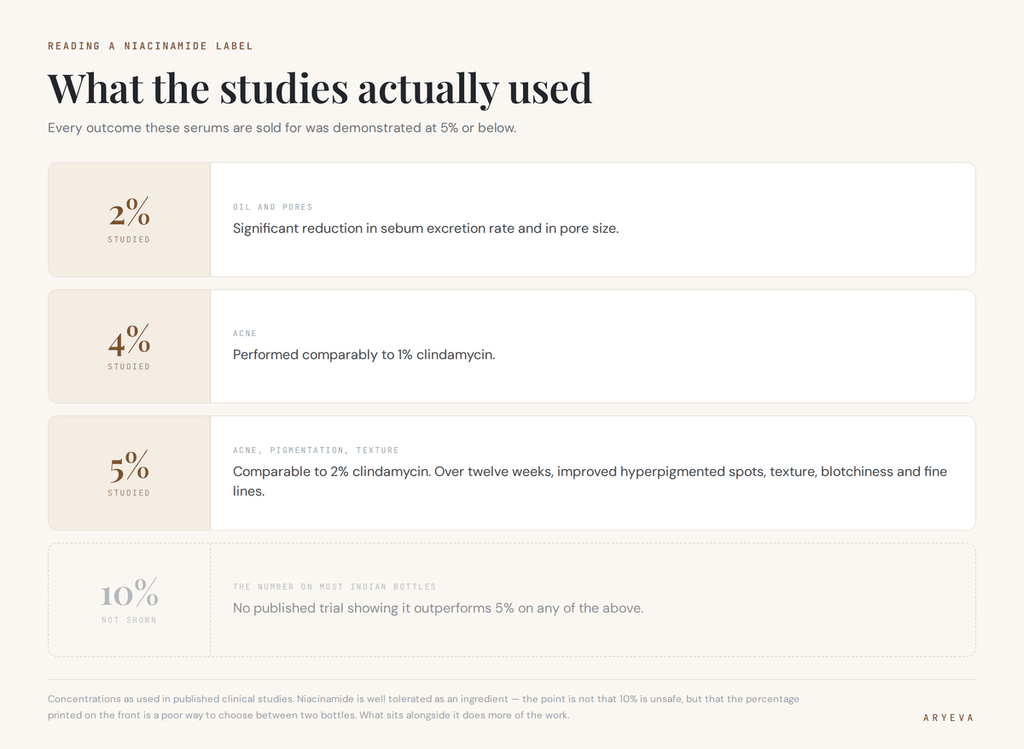
Every outcome these serums are sold for — oil control, acne marks, dark spots, tone — was demonstrated somewhere between 2% and 5%. I could not find published evidence that 10% outperforms 5% on any of them.
That does not make 10% bad. It makes the number on the front of the bottle a poor way to choose between two bottles.
The brand selling you 10% will tell you this itself
Minimalist sells both a 10% and a 5%. Their own product page describes the 5% as being for people who find the 10% “a little strong.” That is the company with the most to gain from the bigger number, telling you the bigger number is harsher.
Niacinamide is genuinely well tolerated. But the flushing, tingling, and low-grade redness people report when they start almost always comes from going straight to the highest number on the shelf.
What actually varies between two niacinamide serums
Three things, none of which are printed on the front.
- The supporting cast. Alpha arbutin, vitamin C derivatives, and zinc salts do different jobs. A 5% serum carrying 2% alpha arbutin is doing more work than a 10% serum carrying 0.3%.
- What supports the barrier. Ceramides, oat, panthenol, and hyaluronic acid decide whether a serum is comfortable on skin that is already inflamed.
- pH. Niacinamide is stable and comfortable around pH 5–6. Every serum here that publishes a pH sits in that range, which is worth knowing because it is the one specification most brands leave out.
One more thing the bottle will not tell you: niacinamide does very little for pigmentation if you are not also wearing sunscreen. UVA drives the pigment that niacinamide is trying to fade. If you are buying this for dark spots or melasma, the serum is the smaller half of the answer — I went through the label-reading for the other half in the sunscreen guide.
How I ranked them
Ranked for someone starting niacinamide on oily or combination, acne-prone skin — change that reader and the order changes.
The criteria, in the order they mattered:
- The supporting cast — what else in the bottle is doing measurable work.
- Concentration honesty — whether the number on the front is matched by what sits behind it. A high percentage is not a penalty here; it just is not a bonus.
- Barrier support and irritant load — what is there to keep already-inflamed skin comfortable.
- Texture and layering — whether it sits under sunscreen without pilling.
- Cost per millilitre — because this is a product you use daily for months.
No product’s position here reflects commission.
The formulas at a glance
I have not used all nine of these myself. What follows is a reading of the ingredient lists each brand publishes, checked against their own product pages rather than marketplace listings, which lag. Ingredient order tells you a great deal about a formula and nothing about how it behaves on one particular face.
| Serum | Niacinamide | Supporting actives | Barrier support | Fragrance |
|---|---|---|---|---|
| Deconstruct Clearing | 5% | 2% liposomal alpha arbutin, 3-O-ethyl ascorbic acid | Minimal | None |
| Hyphen Golden Hour | 5% | 1% alpha arbutin, Kakadu plum, peptides | Ceramides, panthenol, hyaluronic acid | None |
| Minimalist 10% + Zinc | 10% | Zinc PCA, zinc glycinate, Matmarine, acetyl glucosamine | Allantoin, sodium hyaluronate | None |
| Dot & Key Cica + 10% | 10% | Alpha arbutin, centella, licorice | Ceramides, cholesterol, oat | None |
| Foxtale 7% Brightening | 7% | Glabridin, licorice, acetyl glucosamine | Ceramides, cholesterol, panthenol | Yes |
| Plum 10% + Rice Water | 10% | Rice ferment, caffeine, licorice | Squalane | None |
| The Derma Co 10% + Zinc | 10% | 2% zinc PCA | Minimal | None |
| Pilgrim 10% + Zinc | 10% | Zinc PCA, salicylic acid, gluconolactone, white lotus | Panthenol, hyaluronic acid | None |
| Minimalist 5% + HA | 5% | Bifida ferment lysate | Oat kernel extract, hyaluronic acid | None |
Only one of the nine contains fragrance, the Foxtale, and not one carries alcohol denat. The benzyl alcohol in two of them is a preservative, not the drying kind. Both are worth noting, because “serums are full of drying alcohol” is a line that does not survive contact with these nine labels.
1. Deconstruct Clearing Serum
The lowest percentage on the list, and the bottle I would reach for first.
What it is. 5% niacinamide with 2% liposomal alpha arbutin, in a short, water-light formula.
What the label tells you. The full list runs to fifteen ingredients. Alongside the niacinamide sit 2% alpha arbutin in liposomal form, 3-O-ethyl ascorbic acid — a stable vitamin C derivative, and the same form most Indian vitamin C serums rely on — and tocopheryl acetate. Deconstruct publishes a pH of 5–6. Fragrance-free.
Why it ranks first. Alpha arbutin and a vitamin C derivative both act on pigment by a different route than niacinamide. Three mechanisms at sensible strengths are a better proposition than one mechanism at a headline number.
Who it suits. Anyone buying niacinamide for acne marks and uneven tone rather than oiliness specifically.
Who should skip it. Anyone who has reacted to sulfites — the formula contains sodium metabisulphite, used to keep the vitamin C derivative stable. It is a small group, but it is a real one.
The comparison worth making. Deconstruct also sells a 10% Brightening Serum at the same price. That one carries 0.3% alpha arbutin instead of 2%, and no vitamin C derivative. You would be paying the same money for a larger number and a thinner formula. If you are choosing between the two Deconstruct serums, this is the one.
2. Hyphen Golden Hour Glow Serum
The celebrity-brand bottle, and on the label it is better than the marketing needs it to be.
What it is. 5% niacinamide with 1% alpha arbutin, a ceramide set and five peptides.
What the label tells you. On Hyphen’s own list, the niacinamide sits fourth, behind Kakadu plum extract in second place. That is less alarming than it looks: botanical extracts are usually supplied already diluted in water or glycerin, so an extract’s position says as much about its carrier as about the fruit. After the niacinamide come aloe, ceramides 1, 2, 3, 4 and 6, alpha arbutin, trehalose, five peptides, panthenol and hyaluronic acid. Fragrance-free. Lactic acid appears near the end, in a small amount.
Why it ranks second. It is built on the same idea as the Deconstruct, 5% niacinamide plus a second pigment active, and then adds barrier support the Deconstruct does not have. The alpha arbutin is 1% against the Deconstruct’s 2%, which is why it sits just behind.
Who it suits. Acne marks and uneven tone on skin that is also a little sensitised.
Who should skip it. Anyone whose main complaint is oil. Nothing here targets sebum the way zinc does; Minimalist’s 10% and The Derma Co’s 10% are built for that.
3. Minimalist 10% Niacinamide + Zinc
The one everybody has heard of, and a 10% that comes with chemistry that earns its place.
What it is. 10% niacinamide with two zinc salts and a marine ferment, at pH 5.5–6.5.
What the label tells you. Zinc PCA and zinc glycinate both appear, along with Matmarine — the trade name for Pseudoalteromonas ferment extract — and acetyl glucosamine. Allantoin and sodium hyaluronate round it out. Fragrance-free and essential-oil-free.
Why the zinc matters. Zinc salts have their own evidence for sebum regulation, separate from niacinamide. If your actual complaint is oil and midday shine rather than marks, this is the formula on the list built most fully for that.
Who it suits. Oily skin where shine and congestion are the main problem.
Who should skip it. Anyone managing malassezia folliculitis — lecithin sits in this formula. And anyone new to niacinamide who would rather not start at the top of the ladder; Minimalist’s own 5% exists for exactly that reason and costs the same.
4. Dot & Key Cica + 10% Niacinamide
The barrier-repair pick of the list, and one of only two with cholesterol alongside its ceramides.
What it is. 10% niacinamide with alpha arbutin, centella, and a ceramide complex.
What the label tells you. Ceramides 1, 2, 3, 4 and 6 appear together with cholesterol and hydrogenated lecithin — a proper barrier-repair combination rather than a token inclusion. Centella, oat extract, licorice root and allantoin sit alongside. Fragrance-free; preserved with benzyl alcohol.
Who it suits. Skin that is already irritated — from actives, from acne treatment, from over-exfoliating — and needs the niacinamide to arrive with something soothing attached.
Who should skip it. Anyone managing malassezia folliculitis; hydrogenated lecithin carries the same caution as the lecithin in the Minimalist serum.
One label discrepancy worth knowing. Some listings for this serum mention 3% tranexamic acid. The ingredient list Dot & Key publishes on its own product page does not include tranexamic acid. If that ingredient is the reason you are buying, check the panel on the bottle in front of you before you commit.
5. Foxtale 7% Niacinamide Brightening Complex
The trending brand’s niacinamide serum, with one ingredient that holds it back.
What it is. 7% niacinamide in a light emulsion, with a five-ceramide set and licorice.
What the label tells you. On Foxtale’s own list, ceramides EOP, NG, NP, AS and AP appear together with cholesterol, the same barrier logic as the Dot & Key above it. Acetyl glucosamine, panthenol, allantoin and glabridin, the licorice compound studied for pigment, sit alongside. The base is an emulsion: isoamyl laurate, dimethicone and phenyl trimethicone are all high in the list, so it feels more like a light lotion than a water-thin serum.
Why it is not higher. The last ingredient is “allergen free fragrance”. That means the declared allergens have been left out. It does not mean fragrance-free, and this is the only pick on the list with fragrance in it. On skin you are trying to calm, that is the one thing I would rather not see.
Who it suits. Combination or drier skin that wants niacinamide and barrier support in one step, and has no history of reacting to fragrance.
Who should skip it. Sensitive or fragrance-reactive skin; the Dot & Key does the same barrier job without it. And very oily skin that wants the thinnest possible layer.
One thing to know. Uvinul A Plus, a sunscreen filter, appears low in the list. At that position it is protecting the formula from light, not your skin, so it is not a substitute for sunscreen.
6. Plum 10% Niacinamide + Rice Water
The one with squalane doing real work, which is rare in a water-light serum.
What it is. 10% niacinamide with rice extract, rice ferment filtrate, and squalane.
What the label tells you. Squalane sits high in the list, which is unusual at this price, and does useful work on the barrier. Rice ferment filtrate, caffeine, licorice root and tocopheryl acetate follow. Fragrance-free, preserved with benzyl alcohol and hydroxyacetophenone rather than phenoxyethanol.
Why it is here. Squalane this high in the list does useful barrier work without making the serum heavy, and the rice ferment and caffeine are gentle additions. When this guide was first written it was also the cheapest per millilitre. At the prices on Plum’s own site in late October 2026 that is no longer true, so it now ranks on the formula alone.
Who it suits. Combination skin that wants a little softness from its serum without adding a separate oil.
Who should skip it. Anyone whose main goal is fading dark spots. The actives beyond niacinamide here — rice ferment, caffeine — are supporting players rather than pigment-fading ones; the Deconstruct is better aimed at that, and the dark spot serum guide covers the serums built for it.
7. The Derma Co 10% Niacinamide + 2% Zinc PCA
The plainest formula on the list, and India’s closest match to The Ordinary’s famous serum.
What it is. 10% niacinamide with 2% zinc PCA, in a short water-based formula.
What the label tells you. Seventeen ingredients on The Derma Co’s own page: niacinamide, glycols, glycerin, zinc PCA, dimethyl isosorbide, gums and preservatives. Nothing else is doing active work. Fragrance-free.
The comparison worth making. Put this next to The Ordinary’s Niacinamide 10% + Zinc 1%, the serum much of this shelf is modelled on, and the architecture is almost the same: niacinamide, a glycol, zinc PCA, dimethyl isosorbide, ethoxydiglycol and gums. The Derma Co’s carries twice the zinc. The two sell for about the same price in India, so there is no reason to pay extra for the import.
Why it ranks below the Minimalist. Minimalist’s 10% carries two zinc salts, acetyl glucosamine and a marine ferment. This carries one zinc salt and nothing else.
Who it suits. Oily skin that wants niacinamide and zinc and nothing extra.
Who should skip it. Anyone buying for dark spots. There is no pigment active here beyond the niacinamide itself.
8. Pilgrim 10% Niacinamide + 1% Zinc PCA
A reasonable formula with two ingredients the name leaves out.
What it is. 10% niacinamide with zinc PCA, white lotus extract and hyaluronic acid.
What the label tells you. Pilgrim’s own ingredient table lists gluconolactone fifth and salicylic acid sixth, both above the zinc PCA the product is named after. Gluconolactone is a PHA, a gentle exfoliating acid. Salicylic acid is the BHA used for acne. Neither appears in the product name. Panthenol, allantoin and betaine sit further down. Fragrance-free.
Why that matters. A little exfoliating acid in a niacinamide serum is not a problem on its own. It becomes one if you already use a salicylic face wash, a glycolic toner or a retinoid, because you are then exfoliating more than you realise.
Who it suits. Oily, congested skin with no other acid in the routine.
Who should skip it. Anyone already using an acid or a retinoid, and anyone who has been told to avoid salicylic acid.
9. Minimalist 5% Niacinamide + Hyaluronic Acid
The right first bottle for a lot of people, sold as if it were the lesser option.
What it is. 5% niacinamide with oat kernel extract, bifida ferment lysate, and two forms of hyaluronic acid.
What the label tells you. A short list, fragrance-free, pH 5.5–6.5. Minimalist states it is suitable from age 16 and safe in pregnancy and lactation.
Why it ranks last and not higher. Not because of the 5%. Because the supporting cast is among the thinnest on the list: oat and hyaluronic acid soothe and hydrate, but nothing else here works on pigment. It is a clean, comfortable niacinamide serum and not much more.
Who it suits. Reactive or easily-flushed skin, and anyone who has tried a 10% and found it stung.
Who should skip it. Anyone whose main complaint is oil rather than marks — Minimalist’s own 10% with zinc is built for that, and costs the same.
The honest note. It costs the same as Minimalist’s 10%. You are not paying less for less active — you are choosing a gentler formula at the same price, which is a better deal than the shelf makes it look.
The one I’d leave on the shelf
Everything above is a recommendation. This one is here to show you how to read the rest of the shelf yourself.
Mamaearth’s Skin Correct Face Serum is one of the most visible niacinamide serums in India, sold for acne marks and scars, with “Niacinamide and Ginger Extract” in its name.
The percentage is missing. Every other serum in this guide prints its niacinamide strength. Mamaearth’s own product page does not, so there is no way to tell from the label whether you are buying a low or a high concentration.
The ginger is near the bottom. Ginger extract is fourteenth of sixteen ingredients: after the preservative, after the thickeners, and after the fragrance. Whatever it is doing, it is doing it in a very small amount.
And the base will look familiar. Niacinamide, a glycol, glycerin, zinc PCA and ethoxydiglycol (listed here as diethylene glycol monoethyl ether) are the same core as The Derma Co’s 10% serum above. Both brands belong to the same parent company, Honasa. On the label, the differences are that this one adds fragrance and does not tell you its strength.
None of this makes it a bad product. It is a sensible niacinamide-and-zinc base with fragrance added. The point is narrower: the name sells you ginger, and only the back of the bottle tells you how little of it there is.
The part almost everyone gets wrong
Niacinamide is not a product you judge in a week. The studies that produced those results ran for four to twelve weeks. If you have been using something for ten days and seen nothing, that is the expected result, not a failure.
Three things that matter more than which bottle you picked:
- Apply it to slightly damp skin, before moisturiser. Most of these are water-light serums; they go on early in the routine.
- Start every other day. Particularly at 10%. If nothing happens after a week, move to daily.
- Wear sunscreen, or skip the serum. If you are treating pigmentation, unprotected sun undoes the work faster than the niacinamide does it.
If a serum stings, flushes you red, or leaves skin tight, that is not it working. Drop to a lower percentage or a gentler formula — there is no evidence you are giving anything up by doing so.
Questions people actually ask
Is 10% niacinamide better than 5%?
Not in the published evidence. The outcomes niacinamide is sold for were demonstrated between 2% and 5%, and I could not find a study showing 10% does more. Higher percentages are more likely to sting on skin that is not used to them.
Can I use niacinamide with vitamin C?
Yes. The old warning about the two cancelling each other out came from studies on raw ingredients at high heat, not finished products at normal temperatures. Modern formulas routinely combine them — the Deconstruct serum here does exactly that.
Morning or night?
Either. If you are using it alongside a retinoid, morning is simpler — not because they conflict, but because it spaces out how much your skin deals with at once.
How long before I see anything?
Four weeks for oil and texture, closer to eight to twelve for marks and pigmentation. Judging it sooner than that will just make you buy another bottle unnecessarily.
Do I still need it if my moisturiser has niacinamide?
Probably not. If niacinamide appears in the first third of your moisturiser’s ingredient list, a separate serum is largely duplication. Check the panel before you buy both.
Which niacinamide serum is best for oily skin?
If oil and midday shine are the main complaint, Minimalist 10% + Zinc. It carries two zinc salts, zinc PCA and zinc glycinate, which have their own evidence for sebum regulation separate from niacinamide. If the marks breakouts leave behind bother you more than the shine, start with the Deconstruct instead.
The short version
Buy the formula, not the percentage. Look at what sits alongside the niacinamide — alpha arbutin, zinc, ceramides — because that is where the actual difference between two bottles lives. Start every other day. Give it eight weeks. Wear sunscreen while you do. If your skin is dry, the dry-skin sunscreen guide covers which ones suit it.
The number on the front is the easiest thing to print and the least useful thing to compare.
And if you are wondering whether a face wash with niacinamide in it would save you the step, it will not. Contact time is the reason, and I went into it properly in the face wash guide.
And if it’s dark circles you’re hoping niacinamide will help with, the skin under your eyes needs a different product. The under-eye cream guide covers which eye creams contain it, and which kind of dark circles it can help with.
Prices move. Everything here sat under ₹700 at the time of writing — check the current price before you buy.
This is a guide to reading skincare labels, not medical advice. If you are treating acne, melasma, or any other skin condition, your dermatologist’s advice comes first.