Best Sunscreen for Dry Skin in India Under ₹600
Some links here may be affiliate links. Where they are, a purchase can earn Aryeva a commission at no extra cost to you — it never affects the picks. Prices and formulations change; everything below was checked against the brands’ own ingredient listings at the time of writing.
Short answer: if your skin is properly dry, the best sunscreen in India under ₹600 is Plum Squalane and Vitamin E Dewy-Bright, as long as you accept its PA+++ rating. If you want one product instead of moisturiser plus sunscreen, try Hyphen All I Need, and add a moisturiser if your face feels tight by mid-afternoon. If you already have a moisturiser you like, Deconstruct Fluid Brightening is the lightest and cheapest to layer on top.
How this list was checked. Each ingredient list was read from the brand’s own product page, not a marketplace listing. Prices and stock for all ten were re-checked on the brands’ own sites on 24 October 2026. This is a reading of labels, not a wear test. The full method is under “What I looked at” below.
Dry skin has a particular problem with sunscreen. Most of the sunscreens that fill Indian shelves are built for the opposite complaint: matte, oil-free, dry-touch, made for humid summers and shiny foreheads. Put one of those on skin that already feels tight after washing, and by afternoon it can look flaky, patchy, and older than it is.
So the obvious move is to buy a sunscreen labelled for dry skin. The trouble is that the phrase doesn’t mean very much. While researching this post, I found one company selling what is largely the same sunscreen under two brands, pitched as a moisturiser under one and described as formulated for oily skin under the other. I found a sunscreen whose name used to say “for dry skin” and now says “all skin types”. And I found a product page that can’t decide which skin type its own sunscreen is for.
This post does what the last seven did. Every product here was checked against the brand’s own current ingredient list, and the picks were chosen from what is actually in the tube, not from the words on the front. Ten made the list, all under ₹600.
“For dry skin” is a label, not a formula
If you read the gel moisturiser post on this site, this will sound familiar. There, the phrase was “oil-free”, and it turned out to mean only that nothing in the tube looks like an oil to a shopper.
“For dry skin” on a sunscreen works the same way. There is no formula a product has to meet to use it. It is a positioning choice, made by the marketing team, and it can change without the formula changing.
What makes a sunscreen kinder to dry skin is the same thing that makes a moisturiser work. DermNet, the dermatology reference, sorts moisturising ingredients into three groups. Humectants, such as glycerin and hyaluronic acid, attract water into the top layer of skin. Emollients, such as the esters and fatty alcohols you’ll see in these ingredient lists, soften and smooth it. Occlusives, such as dimethicone, form a thin layer on top that slows water escaping. Dry skin generally does best with the second and third groups, not only the first.
The American Academy of Dermatology puts it more simply: for dry skin, creams do more than lotions, and ointments do more than creams. A thin, watery gel sunscreen sold as “hydrating” can be mostly humectant, which is fine, but it isn’t the same as moisturising.
So the useful question isn’t what the front says. It’s what sits near the top of the ingredient list.
One company, one base, two different pitches
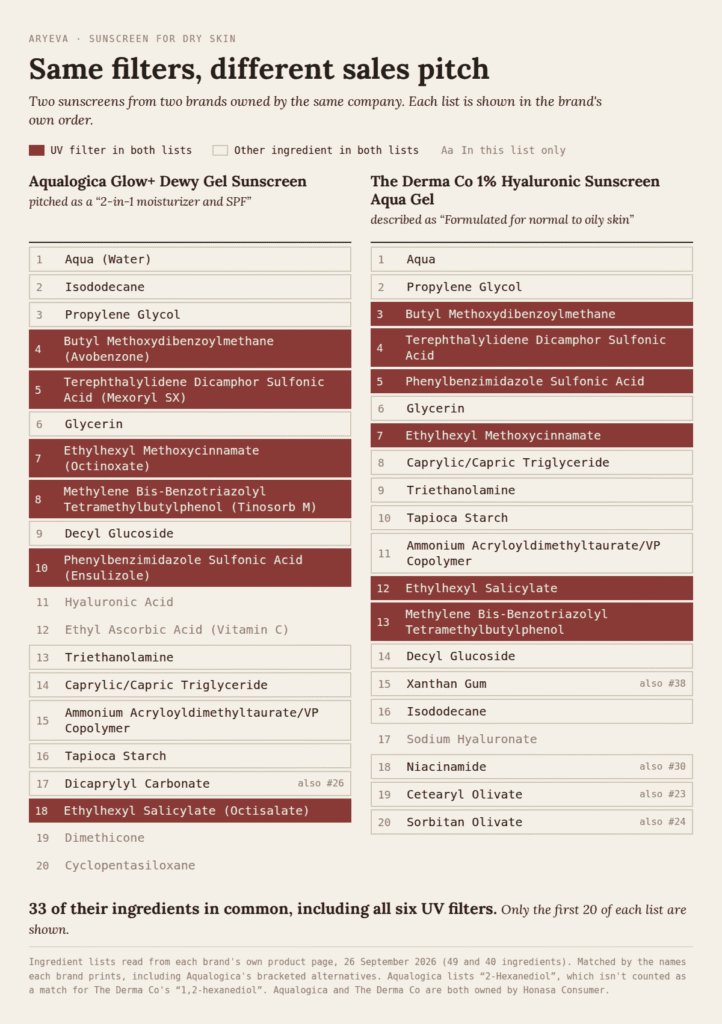
Aqualogica’s Glow+ Dewy Gel Sunscreen is sold for all skin types, including dry, and described on its page as a 2-in-1 moisturiser and SPF. The Derma Co’s 1% Hyaluronic Sunscreen Aqua Gel is described on its page as formulated for normal to oily skin. Both brands are owned by the same company, Honasa Consumer, which also owns Mamaearth and Dr Sheth’s.
Lay the two ingredient lists side by side, and they share the same six UV filters and 33 ingredients in all. Both have water, propylene glycol, and the same two UVA filters among their first five ingredients, and both have glycerin in sixth place. The Aqualogica version moves isododecane, a lightweight solvent, up to second place (it is sixteenth in The Derma Co’s list), and adds two silicones and a small group of ceramides near the end. The Derma Co version adds a different humectant blend.
They are not identical, and I’m not saying either is mislabelled. But they are clearly built on the same foundation and pitched in different directions. The Derma Co’s page doesn’t even agree with itself: the product name says all skin types, the description says it was formulated for normal to oily skin, and the FAQ says it suits dry skin too. That is the clearest demonstration I can give you that the skin type on a sunscreen is a marketing decision. Neither one made my list. The Derma Co version is described as formulated for oily skin, and the Aqualogica version, for all its moisturiser claims, is built much like it.
Can a sunscreen replace your moisturiser?
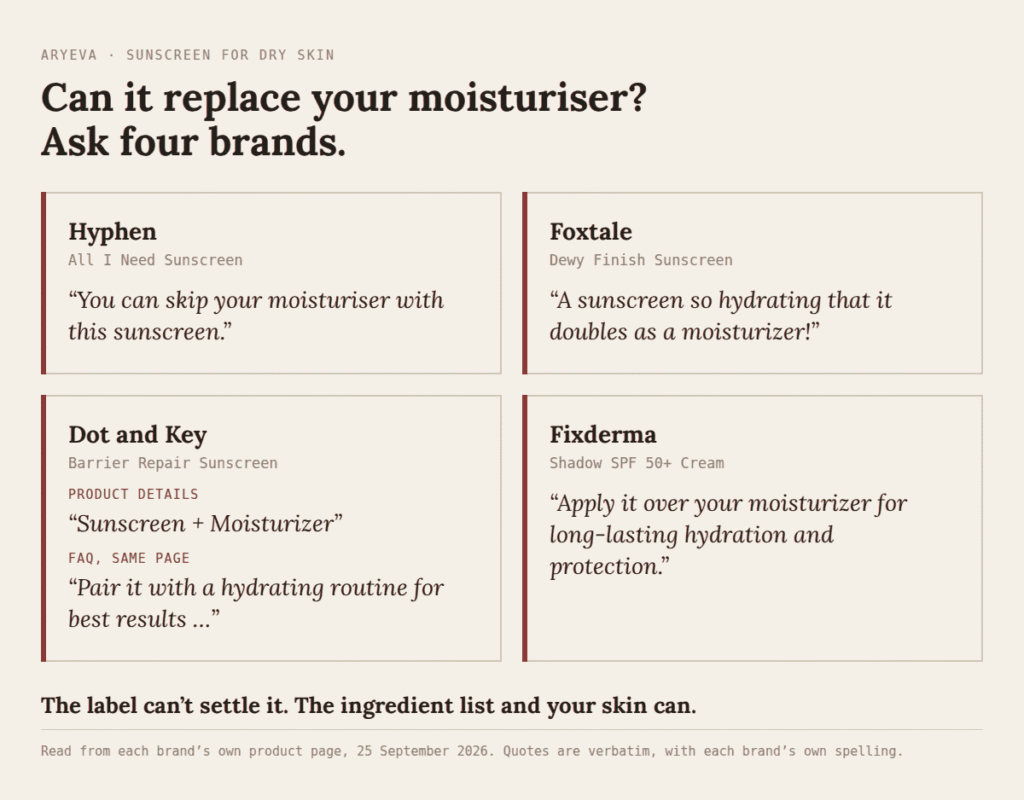
The brands in this post don’t agree. Hyphen’s page says you can skip your moisturiser with its sunscreen. Foxtale says its sunscreen is so hydrating it doubles as one. Dot and Key calls its sunscreen “Sunscreen + Moisturizer”, and then, in the FAQ on the same page, tells you to pair it with a hydrating routine. Fixderma, whose sunscreen I couldn’t assess, tells you to apply it over your moisturiser.
I couldn’t find evidence that settles it either way, and the American Academy of Dermatology’s advice on dry skin treats moisturiser and sunscreen as separate steps. So here is a practical test instead. Look at what sits near the top of the ingredient list. If the first few ingredients after water include esters, silicones or fatty alcohols, the sunscreen is doing some of a moisturiser’s job. Then look at your face mid-afternoon. If it feels tight, or the sunscreen has started to look flaky around your nose and mouth, put a moisturiser underneath tomorrow. Your skin will tell you faster than any label will.
What each tube actually contains
Here is every pick, what the brand says it’s for, and what leads the ingredient list.
| Sunscreen | Brand says it’s for | What leads the list | UVA rating | Also worth knowing |
|---|---|---|---|---|
| Plum Squalane and Vitamin E Dewy-Bright | dry, normal to dry, sensitive | emollients and a silicone, no glycerin | PA+++ | fragrance-free |
| Minimalist SPF 60 + Silymarin | all skin types | a light emollient and UV filters, then a fatty alcohol | PA++++ | fragrance-free, no glycerin |
| Hyphen All I Need | normal to dry | a UV filter, a silicone, glycerin, an emollient | PA++++ | contains kojic acid |
| Foxtale Dewy Finish | normal to dry | an emollient and two silicones | PA++++ | contains fragrance |
| Mamaearth Ultra Light | all skin types | emollients, then a mineral filter | PA++++ | contains essential oils |
| Dot and Key Barrier Repair | all skin types | a UV filter blend and glycerin | PA++++ | ceramides near the end |
| Dot and Key Strawberry Dew Tinted | all skin types | a UV filter blend with emollient esters | PA++++ | tinted, fifteen shades |
| Dot and Key Vitamin C + E | all skin types | the same filter blend, then emollients and glycerin | PA++++ | contains vitamin C and niacinamide |
| Aqualogica Hydrate+ | all skin types | mineral filters and glycerin | PA++++ | possible white cast |
| Deconstruct Fluid Brightening | all skin types | an emollient carrying the UV filters | PA++++ | the lightest here |
Only three of the ten are sold specifically for dry skin. The other seven are sold for all skin types but have ingredient lists that suit dry skin well enough to earn a place, which is the point of reading the list rather than the label.
One rating needs explaining. PA measures protection from UVA, the rays behind tanning and long-term damage. PA++++ is the highest grade, and PA+++ is one step below. Plum is the only PA+++ pick, and that’s worth knowing before you choose it.
What I looked at
Every sunscreen I could find sold in India under ₹600 that is marketed for dry skin, or for all skin types with a dewy or moisturising finish, with a full ingredient list on the brand’s own website. I looked more widely this time than in earlier posts, across the big mass-market names, the newer online brands and the pharmacy brands, rather than only the handful of brands that fill most “best of” lists.
Ten made the list, from eight brands. Two of those brands share a parent company, and Dot and Key has three picks. I added three of the ten after this post first went up, because they are among the most-bought sunscreens in their category and their lists hold up for dry skin. They are not ranked. The order below runs roughly from the most moisturiser-like to the lightest, judged from the top of each ingredient list.
Plum Squalane and Vitamin E Dewy-Bright Sunscreen
Sold for dry and sensitive skin, and the most moisturiser-like list here. After water come an emollient ester, a UV filter, dimethicone, glyceryl stearate and, a few places later, hydrogenated polydecene. Those are the emollients and occlusives the dry-skin advice asks for.
The squalane in the name is fifteenth, below the thickeners, so it is a supporting ingredient rather than the base. More surprising is what’s missing: there is no glycerin anywhere in the list. This sunscreen works the other way round from the watery “hydrating” gels. It leans on softening and sealing ingredients, not water-attracting ones.
The UV filters include no octinoxate or avobenzone, and Plum says it is fragrance-free. The one real compromise is the PA+++ rating, one step below most of the picks here.
Who it suits: properly dry or sensitive skin that wants a sunscreen that feels like a cream.
Who should skip it: anyone who wants the highest UVA grade on the label.
Minimalist SPF 60 + Silymarin Sunscreen
Sold for all skin types, and the closest thing here to a cream that isn’t sold as a moisturiser. After water comes isododecane, a light, quick-drying emollient, then two UV filters, then arachidyl alcohol, a fatty alcohol that gives a cream its body. Further down are three more emollient esters, glyceryl stearate and behenyl alcohol, the same kind of softening ingredients that put Plum at the top of this list.
The UV filters include no octinoxate or avobenzone, one of them is a mineral filter, and Minimalist says it is fragrance-free. Silymarin, the milk thistle extract in the name, sits about halfway down, with sodium hyaluronate and allantoin after it. There is no glycerin, and nylon-12, a soft-focus powder, sits fairly high, so expect a smoother, less dewy finish than Plum’s.
One practical note: its full price sits right at the top of this band, so even a small price rise would take it out.
Who it suits: dry to normal skin that wants a creamy texture without shine.
Who should skip it: very dry skin that relies on glycerin for comfort. This one has none.
Hyphen All I Need Sunscreen
Sold for normal to dry skin, and the brand says outright that you can skip your moisturiser with it. The list backs that up better than most. Dimethicone is third, glycerin fifth, and an emollient ester sixth, which is a moisturiser’s structure with UV filters built in.
Ceramides appear three times, at fourteenth to sixteenth place, after the plant extracts. That’s normal for ceramides, which are used in small amounts, but don’t read the word on the tube as a sign that there are a lot of them.
Two ingredients aren’t in the name. Kojic acid, a brightening ingredient, is thirteenth. And the second ingredient is octinoxate, an older UV filter. The concern about octinoxate, raised in the oily-skin sunscreen guide, is that it can break down avobenzone, another filter. Hyphen doesn’t contain avobenzone, so that concern doesn’t apply here. No fragrance is listed.
Who it suits: normal to dry skin that wants one product in the morning instead of two.
Who should skip it: anyone avoiding brightening actives.
Foxtale Dewy Finish Sunscreen
Sold for normal to dry skin, with the claim that it’s hydrating enough to double as a moisturiser. The top of the list is an emollient ester in second place and a silicone in fourth, with a second silicone at tenth. Glycerin is twentieth. So the dewy finish comes mostly from emollients and silicones, not from humectants.
The UV filters are three modern ones, with no octinoxate or avobenzone. Niacinamide is in the list too.
The drawback for dry skin is fragrance. It’s listed last, as “allergen free fragrance”, which is Foxtale’s own description rather than a regulated term. The American Academy of Dermatology’s dry-skin advice is to use fragrance-free products, and dry skin is often more easily irritated.
One more thing to check when you buy it. Foxtale also sold an SPF 70 version of this sunscreen, and some retailers still list it. The brand’s own page now shows the SPF 50. Buy from the brand or check which one you’re getting.
Who it suits: normal to dry skin that likes a glowy finish and doesn’t react to fragrance.
Who should skip it: sensitive or easily irritated skin.
Mamaearth Ultra Light Indian Sunscreen
A widely bought sunscreen, sold for all skin types, and a better fit for dry skin than its “ultra light” name suggests. The second and third ingredients are emollients, with more further down, and glycerin is fourteenth. It is a lotion rather than a cream, which, by the dermatology advice above, puts it a step behind the richest picks, but it is far from a mattifying gel. Mamaearth is also owned by Honasa, the company behind the two sunscreens compared earlier.
Three things to know.
It uses octinoxate and avobenzone together, tenth and eleventh. That’s the pairing the oily-skin sunscreen guide flags, because octinoxate can break avobenzone down. Octocrylene, which comes next, is often included to help stabilise avobenzone, but I can’t tell from an ingredient list how well it does that here. The ingredient list also calls octinoxate by its trade name, Parsol MCX. If you were scanning for “octinoxate” or “ethylhexyl methoxycinnamate”, you wouldn’t find it.
The last two ingredients are cananga and orange oil. They’re essential oils, and they act as fragrance. By the same standard as Foxtale, sensitive dry skin should know they’re there.
And titanium dioxide, a mineral filter, is fourth. That can leave a white cast on deeper skin tones.
Who it suits: normal to dry skin on a tight budget that wants a soft lotion rather than a gel.
Who should skip it: sensitive skin, anyone avoiding essential oils, and deeper skin tones that show a cast.
Dot and Key Barrier Repair Sunscreen
Sold for all skin types, and marketed at dryness in particular. Its page calls it “Sunscreen + Moisturizer” but also advises pairing it with a hydrating routine. I’d follow the second piece of advice.
The list opens with a blend of three UV filters: avobenzone, octinoxate, and octocrylene. That is the same octinoxate and avobenzone pairing as in Mamaearth, flagged for the same reason. Glycerin is fourth, a mineral filter sits in a blend with silica and dimethicone, and there’s a second silicone further down.
The barrier-repair claim rests on a blend of ceramides and cholesterol near the end of the list. They’re present, and that’s where ceramides usually sit, but they’re not the main event. No fragrance is listed.
Who it suits: normal to mildly dry skin that will use a moisturiser underneath.
Who should skip it: very dry skin looking for one product to do both jobs.
Dot and Key Strawberry Dew Tinted Sunscreen
Sold for all skin types, and the only tinted sunscreen in this post. Dot and Key sells it in fifteen shades, which makes it worth a look if you skip foundation on most days and want something that evens out tone as well as protecting.
It is a different formula from Barrier Repair, not a tinted version of it. The list opens with a pre-mixed blend of UV filters and esters, with no octinoxate or avobenzone, and Dot and Key’s own title calls them “New-Age UV Filters”. After that come isododecane, glycerin, two silicones and a run of emollients: caprylic/capric triglyceride, isononyl isononanoate and dicaprylyl carbonate. Panthenol and sodium hyaluronate sit near the end. The colour comes from iron oxides and titanium dioxide, and no fragrance is listed.
Corn starch, a mild mattifying ingredient, appears late in the list, so don’t expect it to feel as rich as Plum.
Who it suits: dry to normal skin that wants light coverage and would otherwise layer foundation over sunscreen.
Who should skip it: anyone who can’t find their shade, and very dry skin that wants a moisturiser-like base.
Dot and Key Vitamin C + E Sunscreen
Sold for all skin types, and one of the most-bought sunscreens in India, which is why it is here. It isn’t marketed at dry skin, but its list is kinder to dry skin than most bestsellers in this category.
It opens with the same pre-mixed filter blend as the Strawberry tint, so it has the same filters and no octinoxate or avobenzone. Then come isododecane, caprylic/capric triglyceride, dicaprylyl carbonate and glycerin, a reasonable mix of softening and water-attracting ingredients. The vitamin C is ascorbyl glucoside, a stable form, alongside blood orange and Kakadu plum extracts, niacinamide, and vitamin E near the end. If you already use a niacinamide or vitamin C serum, you don’t need them here, as with Deconstruct.
A note that applies to all three Dot and Key picks. The brand’s product pages currently say that its ingredient lists are “undergoing a transition”, and that the list on the page may not match the product you receive. Barrier Repair’s page still lists octinoxate and avobenzone, while the two newer products are sold with new filters. Check the list on the carton against the one described here before you rely on it.
Who it suits: normal to mildly dry skin that wants a light everyday sunscreen and uses a moisturiser underneath.
Who should skip it: properly dry skin. The richer picks above will do more.
Aqualogica Hydrate+ Dewy Sunscreen
The mineral pick. Titanium dioxide is second and zinc oxide sixth, with glycerin between them. If you prefer mineral filters, and Minimalist’s own guide to dry skin leans towards them, this is the only mineral-led option I found in the band.
Mineral filters come with a white cast, and with titanium dioxide this high, the cast is likely on deeper skin tones. Melanin appears at the very end of the list. It may be there to tint the formula and soften the cast, but the page doesn’t say, so I won’t guess.
The list has a quirk worth pointing out. The third ingredient is “Suncat DE”, which is a supplier’s trade name, not a standard ingredient name. “Ceramide 11” and “Coconut Water” aren’t standard names either. You can’t look any of them up the way you can the rest of the list, which is the kind of thing a label should make easy.
One disagreement with the page. It suggests reapplying every six hours. The American Academy of Dermatology says every two hours when you’re outdoors, and I’d follow that.
Who it suits: normal to dry skin that prefers mineral filters, and lighter skin tones.
Who should skip it: deeper skin tones that dislike any cast.
Deconstruct Fluid Brightening Sunscreen
The lightest pick and the cheapest, and here for a slightly different reason from the rest. Its filters are carried in an emollient ester, and it has no silicones and no glycerin at all. Deconstruct describes it as giving “light hydration without heaviness” and makes no claim that it replaces a moisturiser.
This one has a history. The title in your browser tab on Deconstruct’s own page, and many shop listings, still call it “for Dry Skin”. The name on Deconstruct’s own page now says “All Skin Types”. I don’t know whether the formula changed, because I can’t compare it with an older list from the brand. The label on the front did change.
Niacinamide is listed, and the brand’s title puts it at 5%, the ingredient at the centre of the niacinamide serum post. If you already use a niacinamide serum, you don’t need more here.
Who it suits: dry skin that already uses a good moisturiser and wants a light sunscreen with no listed fragrance on top.
Who should skip it: anyone hoping a sunscreen will be their only morning step.
Four I couldn’t assess, and a few I left out
The True Therapy’s Dewy Sunscreen, Lotus Herbals’ Safe Sun Daily Multi-Function, Fixderma’s Shadow Cream, and Dr Sheth’s Ceramide and Vitamin C Sunscreen are all sold for dry skin or for all skin types, and all are within the band. None of them publish a full ingredient list on their own website. They list a few key ingredients, which isn’t enough to say anything useful. That doesn’t mean they’re bad. It means I can’t read them, and this post only recommends what it can read. Lotus also rates its sunscreen PA+++, and The True Therapy’s Amazon listing shows PA++.
A few more didn’t make it for simpler reasons. The Formularx’s Ceramide Silk Hydrating Sunscreen is above the band. Plum’s Oat and Ceramide Mineral Sunscreen and Neutrogena’s Hydro Boost Fluid are above the band too. Nivea’s Protect and Moisture is a body lotion, and its brand page rates it PA++.
Popular, but not on this list
Some of the most-bought sunscreens in India aren’t here, and it’s fair to ask why. I checked rating counts on a large Indian beauty retailer to see which sunscreens people actually buy, then read each one the same way as the picks.
Neutrogena’s Ultra Sheer has more ratings than anything else I looked at, but it is above the band. Plum’s 2% Niacinamide and Rice Water sunscreen is hugely popular, but it is pitched mainly at oily and acne-prone skin, and its filters include octinoxate, avobenzone and oxybenzone, the opposite of what this post looks for. Dr Sheth’s Ceramide and Vitamin C, covered above, and Biotique’s Sandalwood sunscreen are both bestsellers, but neither publishes a full ingredient list. Minimalist’s Multi-Vitamin SPF 50 is already a pick in the oily-skin sunscreen guide.
Within the band, the most-rated sunscreen in a search for dry skin was Aqualogica’s Glow+, the one in the side-by-side comparison near the top of this post.
If your skin is combination
If your cheeks are dry but your forehead and nose get shiny, you’re not really the reader this post is for, and you’re not the reader of the oily-skin sunscreen guide either. You’re both.
Two approaches work. Use one of the lighter picks here, such as Deconstruct or Dot and Key, all over, with moisturiser only on the dry areas. Or use a lightweight pick from the oily-skin guide all over, with moisturiser underneath on your cheeks. What doesn’t work is choosing the richest sunscreen here for your whole face and hoping your T-zone copes.
How to use sunscreen on dry skin
Apply moisturiser first if you need it, and give it a minute or two to settle. Sunscreen goes on last in the morning, before makeup.
Use enough. Most people use far less sunscreen than the amount the SPF on the label was tested with. The two-finger rule is the easiest way to get close: squeeze a line of sunscreen along the length of your index and middle fingers, and use it all on your face and neck.
Apply it about fifteen minutes before you go out, and reapply every two hours when you’re outdoors, as the American Academy of Dermatology advises.
Dry skin shows flakes most around the nose, mouth and eyebrows. If a sunscreen starts to pill or flake there, the problem is often the layer underneath rather than the sunscreen. Try less moisturiser, or give it longer to absorb, before you give up on the sunscreen.
If you’ve started a retinoid, as in the retinol for beginners post, daily sunscreen isn’t optional. Retinoids make skin more sensitive to the sun and often drier as well, which makes the sunscreens in this post a natural partner.
If you only want one answer
If your skin is properly dry, buy Plum’s Squalane and Vitamin E, and accept the PA+++ rating.
If you want one product instead of moisturiser plus sunscreen, try Hyphen, and add a moisturiser if your face feels tight by mid-afternoon. If you want mineral filters and don’t mind a possible cast, buy Aqualogica Hydrate+. If you already have a moisturiser you like, buy Deconstruct and put it on top. If you want a tint, try Dot and Key’s Strawberry Dew.
And whichever you choose, read the ingredient list rather than the skin type on the front.
Common questions
Is a dewy finish the same as moisturising?
No. A dewy finish describes how a sunscreen looks on your skin, and it can come from silicones or light oils that add shine without doing much for dryness. Check the ingredient list for emollients and occlusives near the top.
Should dry skin use a mineral or a chemical sunscreen?
Either can work. Mineral filters, such as zinc oxide and titanium dioxide, are often recommended for easily irritated skin, but they can leave a white cast. Most of the picks here use modern chemical filters and are easier to wear on deeper skin tones.
Do I still need sunscreen in winter or on cloudy days?
Yes. UVA, the rays behind tanning and long-term damage, is present all year and passes through clouds. Winter is also when dry skin is at its driest, so a sunscreen that doesn’t dry you out matters more then, not less.
Can I use a body sunscreen on my face?
It’s better than nothing, but face sunscreens are usually formulated to sit better under makeup and around the eyes. Some body lotions also carry lower UVA ratings.
Is hyaluronic acid enough for dry skin?
Not on its own. It’s a humectant, which draws water in. Dry skin generally also needs emollients and occlusives to keep that water from escaping, which is why the moisturiser-like picks here lead with them.
What should I look for in a sunscreen for dry skin?
Read the ingredient list, not the skin type on the front, because “for dry skin” has no formula behind it. Look for emollients such as esters near the top as well as humectants like glycerin or hyaluronic acid, since a thin, watery gel sold as hydrating can be mostly humectant. If your skin is easily irritated, skip fragrance too.
Nothing in this post is sponsored, and nothing here was tested on my own skin. This is not medical advice. If you have a skin condition, speak to a dermatologist. Every ingredient list was read from the brand’s own website on 25 September 2026, and formulations change without notice. If a list has moved since, the brand’s page is right, and I am wrong. Sources: DermNet, “Emollients and moisturisers”; American Academy of Dermatology, “Dermatologists’ tips for relieving dry skin”, “How to pick the right moisturizer” and “How to apply sunscreen”; Honasa Consumer, “Know our brands”.