

Best Under-Eye Cream for Dark Circles in India Under ₹600
Some links here may be affiliate links. Where they are, a purchase can earn Aryeva a commission at no extra cost to you — it never affects the picks. Prices and formulations change; everything below was checked against the brands’ own ingredient listings at the time of writing.
Short answer: the best under eye cream for dark circles depends on what kind you have. For brown circles, Plum’s Rice Water and Niacinamide cream plus daily sunscreen under your eyes. For morning puffiness, a caffeine serum such as The Derma Co’s or Pilgrim’s roll-on. For blue-purple circles or fine lines, Minimalist’s retinal cream, used slowly. If the shadow is a hollow, a concealer will do more than any cream.
How this list was checked. Every main pick costs ₹600 or less; the one stretch pick is marked. I read each full ingredient list on the brand’s own page and noted where the key ingredients sit and what percentages the brand states. Prices and stock were re-checked on 24 October 2026 on brand sites or Amazon. This is a reading of labels, not a wear test, and it isn’t medical advice. The details are under How I chose.
Dark circles are the one skin concern almost everyone has, and the one where a cream can do the least.
That isn’t the message on the box. Under-eye creams in India promise to fade dark circles, depuff, brighten, and smooth, usually all at once, often in a few weeks. Some of them do help. But “dark circles” isn’t one problem. It’s at least three different ones that happen to look similar, and a cream can only touch some of them.
So before the products, this post does something most lists skip: it helps you work out which kind of dark circles you have. Then it reads the ingredient list of every eye cream I could find under ₹600, from the mass-market brands, the online brands, and a few you’ll see at the chemist, and says what each one is actually built to do.
The short version is that most of these creams are built for puffiness and fine lines, not for dark circles themselves. A few are built for pigment. And several names promise an ingredient that turns out to be a small part of the formula.
First, work out which kind of dark circles you have
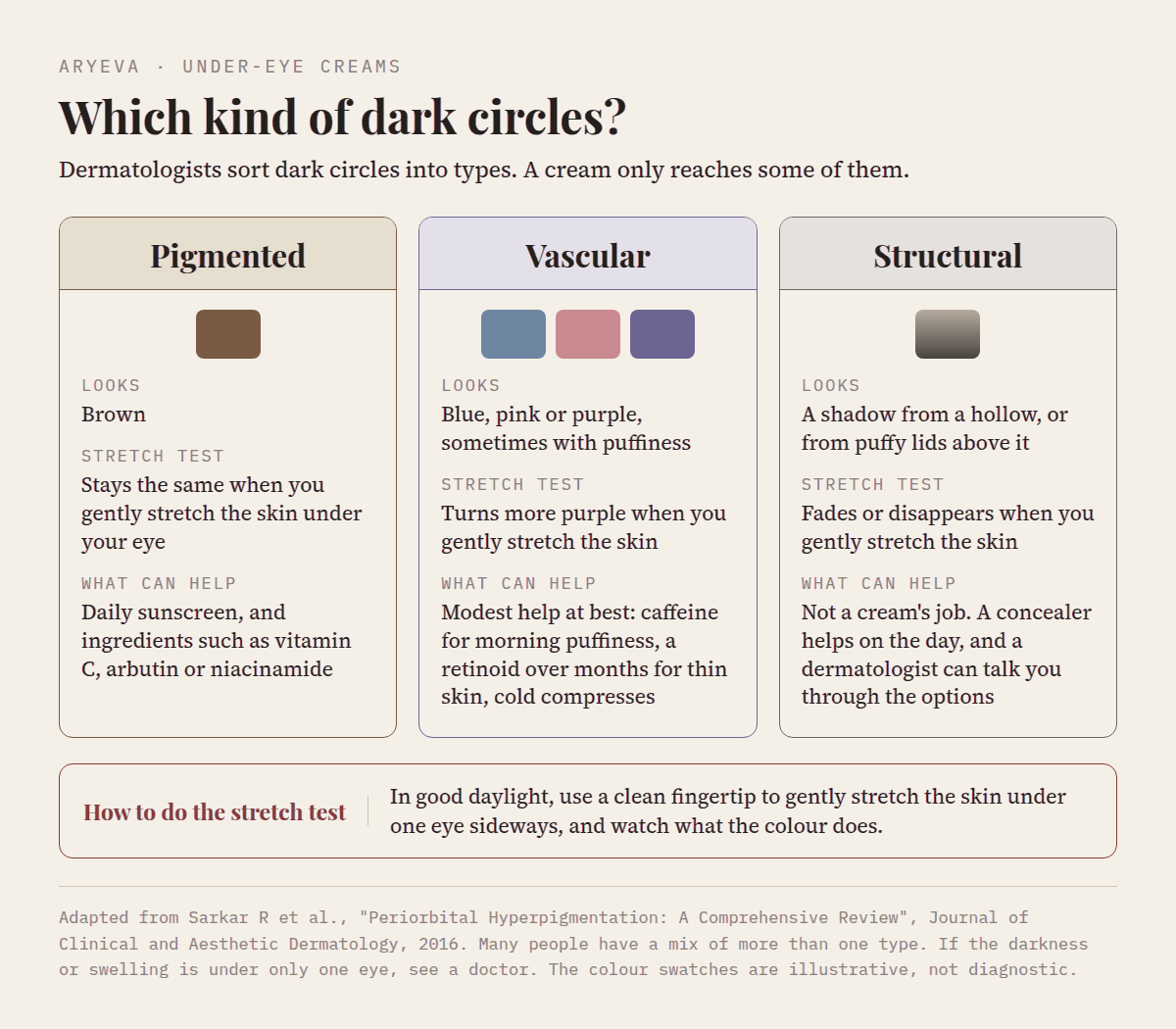
Dermatologists usually sort dark circles into types. A 2016 review in the Journal of Clinical and Aesthetic Dermatology, written by Indian dermatologists, describes four.
Pigmented circles look brown. They’re caused by extra melanin in the skin under the eye, and they’re common in brown skin. Vascular circles look blue, pink, or purple. The skin under the eye is thin, and you’re seeing blood vessels through it, sometimes with puffiness. Structural circles aren’t a colour at all. They’re shadows, cast by a hollow under the eye or by puffy lower lids above it. And mixed circles are a combination.
The same review gives a simple way to tell them apart at home. Gently stretch the skin under your eye with a fingertip, in good light. If the darkness stays the same, it’s pigment. If it fades or disappears, it’s mostly shadow. If it turns more purple, it’s thin skin showing the blood vessels underneath.
Two more causes are worth knowing. Mayo Clinic lists eczema and rubbing or scratching your eyes as causes of dark circles. If your eyes itch, treating the itch will do more than any eye cream. And if you have a dark circle or swelling under only one eye, Cleveland Clinic advises seeing a doctor, because it can point to something else going on.
What a cream can and can’t do
Once you know your type, the shopping gets simpler.
A cream can’t fill a hollow. If your stretch test says shadow, no eye cream on this list will change it much. That’s structural, and the options for it are in a dermatologist’s clinic, not on a shelf. A good concealer will do more for you than a cream.
For pigmented circles, the review points to two things: ingredients that target pigment, such as vitamin C and arbutin, and sunscreen. It says plainly that pigmentation “can be improved with sunscreen alone.” That’s the most useful sentence in this post, and it costs nothing extra if you already wear sunscreen.
For vascular circles and puffiness, the realistic goals are smaller: a little depuffing in the morning, some hydration, and, with retinoids, perhaps slightly thicker skin over time so the vessels show less. These are modest effects. Be suspicious of any eye cream that promises more.
Sunscreen goes under your eyes too
Most people stop their sunscreen short of the eye area, because it stings or because they never thought to go there. If your dark circles are brown, that’s the gap that matters most.
Apply your usual sunscreen gently up to the bony rim below your eye, not onto the lid. If your face sunscreen stings, a mineral or gentler formula around the eyes is worth trying. The sunscreen guide for oily skin and the one for dry skin cover how to choose one.
What each cream actually contains
Here is every cream in this post, the ingredients that lead its list, and three things worth knowing before you buy: whether it contains a retinoid, whether it contains fragrance or essential oils, and whether the ingredient list can be read in order.
| Cream | Lead ingredients | Retinoid | Fragrance or essential oils | List readable in order |
|---|---|---|---|---|
| Plum Rice Water and Niacinamide 3% | niacinamide, caffeine, alpha arbutin | no | no | yes |
| Plum 3% Vitamin C, Peptide and Caffeine | vitamin C, caffeine, peptide | no | no | yes |
| Minimalist Vitamin K + Retinal 1% | niacinamide, caffeine, vitamin K oxide, retinal | yes, retinal | no | yes |
| The Derma Co 5% Caffeine | caffeine, niacinamide, retinol | yes, retinol | no | partly, written in blends |
| Dot and Key Pomegranate + Retinol | caffeine, retinol, brightening blend | yes, retinol | no | yes, but changing |
| Pilgrim Squalane Roll-On | caffeine, niacinamide, bakuchi oil | no, despite the name | yes, three essential oils | yes |
| Foxtale Brightening | UV filter, niacinamide, light-reflecting pigments | no | no | yes |
| Chemist at Play Under Eye Cream | ferment, green tea, pomegranate and caffeine blend, quinoa | no | no | yes |
| Mamaearth Bye Bye Dark Circles | daisy and hawkweed extracts, peptides | no | yes, fragrance | no |
| mCaffeine, Himalaya, Biotique | key ingredients only | not stated | not stated | no full list |
| The Ordinary Caffeine 5% (stretch) | caffeine, green tea derivative | no | no | yes |
The pattern is clear. Caffeine is everywhere, and pigment-targeting ingredients are rare. Only a few of these creams are built around what the review says helps brown circles.
What the names leave out
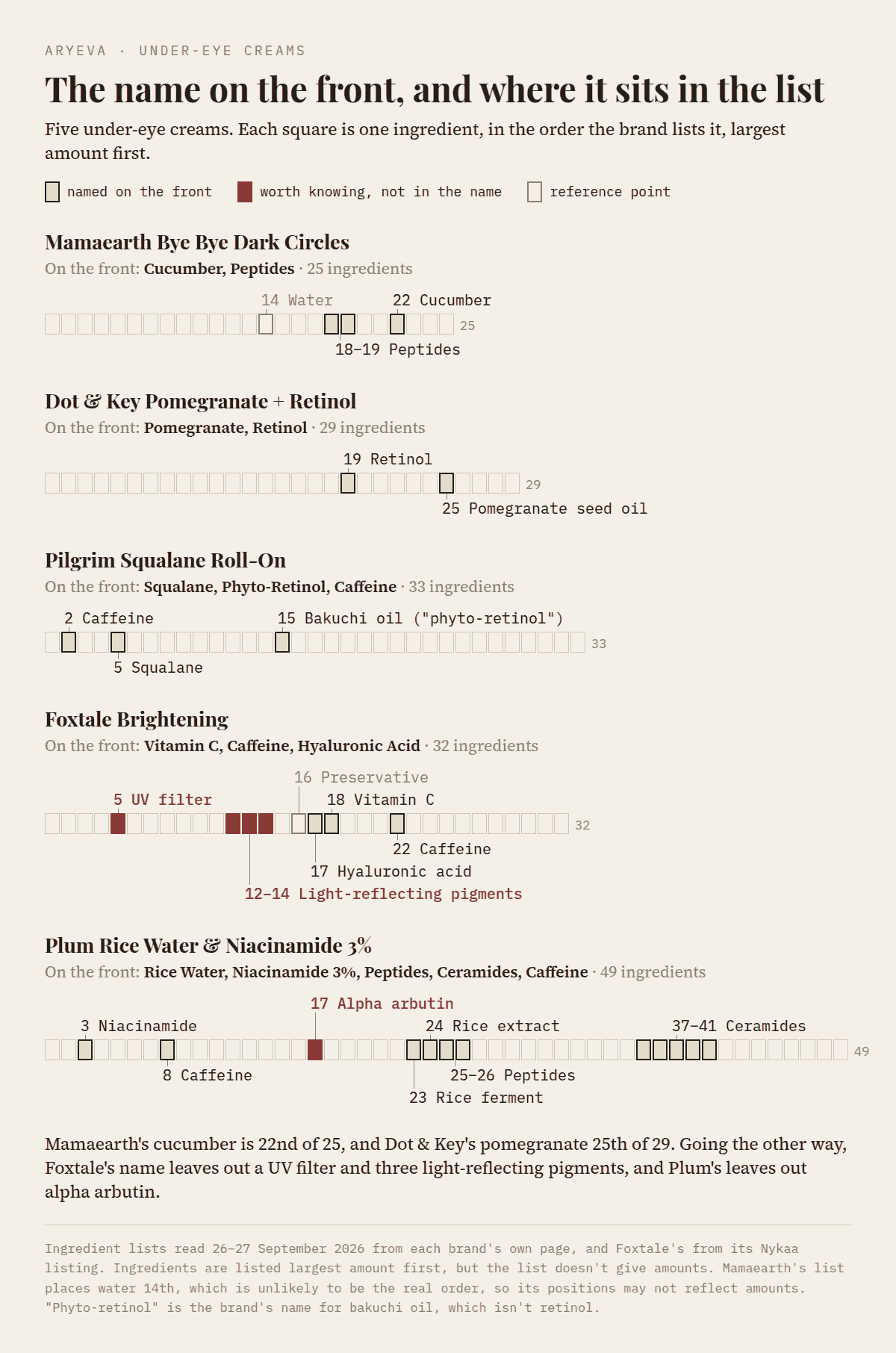
The most useful thing I found in these ingredient lists is how often the name on the front is a small part of what’s inside.
Mamaearth’s Bye Bye Dark Circles cream is sold on cucumber. Cucumber is twenty-second in its list. Dot and Key’s cream is named for pomegranate and retinol. The retinol is nineteenth, and pomegranate seed oil is twenty-fifth. Pilgrim’s roll-on says “phyto-retinol” on the front. That turns out to be bakuchi oil, fifteenth in the list, a plant oil the brand itself calls “a natural plant-based alternative to retinol.” It isn’t retinol. And Foxtale’s brightening cream is sold on vitamin C and caffeine, which sit eighteenth and twenty-second, after the preservative.
It works the other way too. Plum’s Rice Water cream is named for rice water and niacinamide, but its list also includes alpha arbutin, which targets pigment and isn’t mentioned in the name at all. If you have brown circles, that’s the more interesting ingredient.
None of this means these creams don’t work. It means the name tells you what the brand wants you to notice, and the list tells you what you’re buying.
How I chose
I checked every under-eye cream I could find sold in India under ₹600, across the mass-market brands (Himalaya, Biotique, Lotus, Lakmé, Neutrogena, Pond’s, Nivea, Garnier and Olay), the online brands, and the chemist brands. Lakmé’s and Neutrogena’s eye creams sell above the band. I couldn’t find a Pond’s, Nivea, Olay, or Garnier eye cream on Indian shelves. A few good products were out of stock everywhere I looked, and one brand’s page had no products listed, so they’re not here.
Three of the most popular creams, from Himalaya, Biotique, and mCaffeine, publish only their key ingredients, not a full list. They’re included because readers will ask about them, but I’ve made no claims about what’s in them.
Two of the brands here, Mamaearth and The Derma Co, are owned by the same parent company, Honasa Consumer. Chemist at Play belongs to a different group, Innovist.
The picks aren’t ranked. They’re grouped by what they’re built to do.
For brown circles: Plum Rice Water and Niacinamide 3% Under-Eye Crème
Stock note, 24 October 2026: this cream was out of stock on Plum’s own site but available on Amazon.
The best-aimed list in this post if your circles are brown. Niacinamide is third, right after water and a solvent, and Plum states 3%. Caffeine is eighth. Alpha arbutin, a pigment-targeting ingredient the name doesn’t mention, is seventeenth. Licorice extract, often used for pigment, is last. There’s also a set of ceramides and cholesterol for the skin barrier, and a metal tip for applying it.
There’s no fragrance in the list and no oil apart from squalane.
Who it suits: brown, pigment-type circles, and anyone who wants a gentle cream with no retinoid.
Who should skip it: anyone looking for a strong anti-ageing cream. This is a gentle, steady product.
For a little of everything: Plum 3% Vitamin C, 3% Peptide and 3% Caffeine Under Eye Cream
One of the few creams here whose list matches its name. Plum states 3% of each of the three ingredients in the title, and the list backs it up: a stable form of vitamin C, ethyl ascorbic acid, is fourth, caffeine sixth, and the peptide eighth. The mandarin in the name is an extract, not an essential oil, and Plum describes it as fragrance-free.
Vitamin C is one of the ingredients the 2016 review discusses for pigmented circles, which makes this a reasonable choice for mixed circles.
Who it suits: mixed circles and anyone who wants vitamin C and caffeine without a retinoid.
Who should skip it: anyone already using a vitamin C serum around the eyes. The vitamin C serum guide explains the ingredient.
The strongest: Minimalist Vitamin K + Retinal 1% Eye Cream
This is the most active cream in this post, and the one to be most careful with. Retinal is a retinoid, one step closer to the form the skin uses than retinol, and 1% is a high strength for the thin skin under the eye. Niacinamide is third in the list and caffeine sixth. The “vitamin K” is vitamin K oxide, fourteenth. Near the end, there’s a group of peptides and plant flavonoids.
Minimalist’s own directions are sensible: patch-test first, avoid applying it very close to the eyes, and don’t use it if you’re pregnant or breastfeeding. The list also contains sweet almond oil.
The case for it is that a retinoid is the one ingredient here that can gradually thicken thin skin, which is the problem behind blue-purple circles and fine lines. The case against is that it’s easy to overdo. Read the section on retinoids below before buying it.
Who it suits: adults with thin skin, blue-purple circles or fine lines, who have used a retinoid before.
Who should skip it: anyone pregnant or breastfeeding, anyone new to retinoids, and those with very sensitive or eczema-prone skin.
For puffiness: The Derma Co 5% Caffeine Under Eye Serum
The highest stated caffeine strength under the band. Caffeine is third in the list, and the brand states 5%. Niacinamide is seventh. The Derma Co also states 1% retinol and 1% peptide.
That retinol figure needs a caveat. The list places retinol fourteenth, after alcohol and lecithin, which suggests the 1% refers to a retinol ingredient as supplied to the brand, already diluted, rather than 1% pure retinol. I can’t tell you the real amount, and the label doesn’t say. The list is also written in supplier blends, so the positions are approximate.
It contains alcohol, eleventh in the list. That helps a serum feel light and dry quickly, but it can sting skin that’s already irritated.
Who it suits: morning puffiness, and anyone who likes a light serum rather than a cream.
Who should skip it: anyone pregnant or breastfeeding, because of the retinol, and anyone whose under-eye skin stings easily.
For fine lines, gently: Dot and Key Pomegranate + Retinol Eye Cream
A richer cream with retinol nineteenth in the list and caffeine near the top, as part of a blend. Twenty-first is a brightening blend with arbutin, glutathione, and a form of vitamin C, which is aimed at pigmentation. There are five plant oils, from rosehip to argan, which make it a richer cream than most here.
One warning. Dot and Key’s own page says its ingredient list is “currently undergoing a transition” and may differ from the product you receive. So check the box, and treat the positions above as the version I read.
The page also says 93% of users saw firmer under-eye skin and 97% saw less puffiness in four weeks. The small print explains that this was a self-assessment study of 36 people. That means participants judged their own results. It’s a satisfaction figure, not a measurement.
Who it suits: drier under-eye skin with fine lines, and anyone who wants a gentle retinol cream.
Who should skip it: anyone pregnant or breastfeeding, and anyone whose eyes react to rich creams. Heavy creams near the eyes can cause small white bumps in some people.
A good list with a misleading word: Pilgrim Squalane Roll-On Under Eye Serum
Caffeine is second in the list, right after water, and niacinamide third. That’s one of the most caffeine-led lists on the shelf, in a roll-on that’s easy to use in the morning.
The word to ignore is “phyto-retinol”. It’s bakuchi oil, fifteenth on the list. There’s some research on bakuchiol, a compound found in the same plant, as a gentler alternative to retinol. But the oil contains other things too; the list doesn’t say how much bakuchiol is in it, and none of it is retinol.
The last three ingredients are rose, tuberose, and bergamot oils. Some forms of bergamot oil can make skin more sensitive to sunlight, and the list doesn’t say which kind this is. For a roll-on you might use in the morning, that’s worth knowing. Wear sunscreen over it.
Who it suits: morning puffiness and anyone who likes a roll-on.
Who should skip it: anyone sensitive to essential oils, and anyone buying it for the retinol.
Instant brightening: Foxtale Brightening Under Eye Cream
The most interesting list in this post. Fifth is Uvinul A Plus, a UV filter. Twelfth to fourteenth are titanium dioxide, mica, and tin oxide, which reflect light. Niacinamide is eighth. Vitamin C and caffeine, the ingredients in the name, come later, after the preservative.
What that means in practice is that part of the brightening you see is optical. The pigments reflect light the moment you apply the cream, a little like a very sheer concealer. That’s not a flaw. For shadowy circles, a light-reflecting cream is one of the few things that visibly helps. But it’s worth knowing that the instant effect is cosmetic, and that the UV filter isn’t a substitute for sunscreen.
Who it suits: shadowy or mixed circles, and anyone who wants a visible difference on the day.
Who should skip it: anyone looking for a treatment rather than a brightener.
A gentle, richer cream: Chemist at Play Under Eye Cream
A soft cream sold on caffeine and green tea. The brand’s list writes four ingredients as a single blend, joined by ampersands: a lactobacillus ferment, green tea extract, pomegranate extract and caffeine, fifth in the list. That may be what the front of the pack calls “2% Revital Eye”, but the brand doesn’t say so, so I won’t assume it. Quinoa extract is sixth. Shea butter and olive oil make it a richer cream, and rice and konjac ceramides sit near the end.
The brand’s page shows two results: 97% of users seeing a reduced eyelid fold and 99% seeing reduced bags and puffiness in 30 days, and says underneath that the claims are “based on consumer trials”. It doesn’t say how many people took part or how the results were measured.
Chemist at Play is owned by Innovist, which also owns Bare Anatomy and Sun Scoop.
Who it suits: dry under-eye skin that wants a simple, comfortable cream.
Who should skip it: anyone prone to small white bumps from rich creams, and anyone who wants a targeted active.
The bestseller with a puzzling list: Mamaearth Bye Bye Dark Circles Eye Cream
One of the most reviewed eye creams on Nykaa, and the hardest list here to read. Ingredients are normally listed from largest amount to smallest. Mamaearth’s list puts propanediol first and water fourteenth, after daisy and hawkweed extracts. In a cream, that’s very unlikely to be the order of amounts, so the positions can’t tell you much.
What the list does tell you is what’s in it: daisy and hawkweed extracts, two peptides, and cucumber extract, twenty-second. It also contains fragrance, listed as “IFRA Certified Allergen Free Fragrance”. That wording describes a fragrance without certain listed allergens. It’s still a fragrance.
Mamaearth is owned by Honasa Consumer, which also owns The Derma Co.
Who it suits: anyone who wants a simple, fragrant cream from a familiar brand.
Who should skip it: anyone who avoids fragrance, and anyone who wants to know how much of anything is in the jar.
Popular, but without a full list: mCaffeine, Himalaya and Biotique
These three are among the most bought eye creams in India, so readers will ask about them. None of the three publishes a full ingredient list on its own website, only key ingredients, so I can’t tell you what they’re mostly made of.
mCaffeine’s Coffee Under Eye Cream is one of Nykaa’s bestselling eye creams. Its page names coffee, caffeine, white water lily, vitamin E, sweet almond oil, and hyaluronic acid, and says that 94% of users saw a reduction in dark circles, without saying how many users or how it was measured. Himalaya’s Under Eye Cream names three plant ingredients and cites clinical trials without providing details. Biotique’s Morning Nectar cream names morning nectar, neem and wild turmeric.
They may be perfectly pleasant creams. But without a list, the claims on the front are all you have to go on, and on this site, that isn’t enough to recommend them over creams that show their full ingredient lists.
Worth the stretch: The Ordinary Caffeine Solution 5% + EGCG
This sits above the band, so it’s a stretch pick. It’s here because it’s the clearest caffeine product you can buy in India. Caffeine is second on the list, right after water. A green tea derivative is sixth. There are no oils and no fragrance, and the bottle is twice the size of most creams here, so it lasts longer.
It’s a thin, watery serum, not a cream. Its one oddity is melanin, tenth on the list.
If you’ve read this far and decided that your circles are mostly puffiness, and you want caffeine without anything else getting in the way, this is the one to try.
Who it suits: puffiness and anyone who wants the simplest possible list.
Who should skip it: anyone with brown circles. Caffeine isn’t aimed at pigment.
Retinoids near your eyes: go slowly
Three creams here contain a retinoid: Minimalist (retinal), The Derma Co (retinol), and Dot and Key (retinol). Retinoids are the best-studied anti-ageing ingredients in skincare, and they can gradually improve thin skin and fine lines. They’re also the ingredients most likely to irritate, and the skin under your eyes is the thinnest on your face.
Start two or three nights a week, at night only, with a small amount. Pat it onto the bony area below your eye, not onto the eyelid or the lash line. If your skin turns red, flaky, or stings, stop for a few days and restart less often. Wear sunscreen every morning, because retinoids make skin more sensitive to the sun.
Don’t use a retinoid eye cream if you’re pregnant or breastfeeding. And if you already use a retinoid on your face, don’t add a second one around your eyes without thinking about it. The beginner’s guide to retinol covers how to start a retinoid safely.
How to use an eye cream
Use a small amount, about the size of a grain of rice for both eyes. Pat it onto the bone below your eye with your ring finger, which presses the lightest. Don’t rub, and don’t take it up onto the lid unless the brand says you can.
Apply it after serums and before sunscreen in the morning. At night, it goes after serums and before a moisturiser.
Keeping a caffeine cream or roller in the fridge can make it feel more depuffing in the morning. Cold itself helps puffiness, which is why a chilled spoon has been doing this job for free for a long time.
Patch-test anything new, and give it at least a month before you judge it. If your eyes water, itch, or sting, stop.
If you only want one answer
If your dark circles are brown, buy Plum’s Rice Water and Niacinamide cream, and wear sunscreen under your eyes every day. That combination is aimed at the kind of circles common in brown skin.
If your problem is morning puffiness, buy The Derma Co’s caffeine serum or Pilgrim’s roll-on, or stretch to The Ordinary for the cleanest caffeine list. If your circles are blue-purple or you’re seeing fine lines, and you’ve used a retinoid before, Minimalist’s retinal cream is the strongest choice here, used slowly.
And if the stretch test showed a hollow, save your money. A concealer will do more.
Common questions
Can any cream get rid of dark circles completely?
Usually not. Creams can help pigmented circles fade a little over time, and can reduce puffiness. They can’t fill a hollow or change the thin skin you were born with. Set your expectations there, and you won’t be disappointed.
Do dark circles run in families?
Yes, often. Mayo Clinic lists genetics as one of the causes.
Does sleep fix dark circles?
Tiredness can make them more noticeable, according to Mayo Clinic, but it isn’t usually the cause. More sleep will help you look less tired, and it won’t change pigment or bone structure.
Can I use my face serum under my eyes?
Sometimes, carefully. Many face serums are too strong for the thin skin under the eye, especially acids and high-strength retinoids. Gentle ones, like a niacinamide serum from the niacinamide serum roundup, can be used under the eyes by some people. Patch-test first.
Do dark spot serums work on dark circles?
Some of the same ingredients are used for both, such as niacinamide, arbutin, and vitamin C. But most face serums aren’t tested around the eyes. The dark spot serum guide covers those ingredients for the face.
When should I see a doctor?
If the darkness or swelling is under only one eye, if your eyes itch a lot, or if the circles appeared suddenly. A dermatologist can also help with the hollows and deep pigment that creams can’t reach.
Which eye cream is best for dark circles in India?
There isn’t one best cream, because there isn’t one kind of dark circle. Brown circles from pigment, common in Indian skin, respond best to pigment ingredients like niacinamide and alpha arbutin, plus sunscreen. Puffiness responds to caffeine. Blue-purple circles from thin skin respond, slowly, to retinoids. Work out your type with the stretch test at the top of this post, then pick from the matching section.
Nothing in this post is sponsored, and nothing here was tested on my own skin. This is not medical advice. If you have a skin or eye condition, are pregnant or breastfeeding, or are using prescription treatment, speak to a doctor before starting a new active. Every ingredient list was read on 26 September 2026, from the brand’s own website except where stated, and formulations change without notice. If a list has changed since then, the box is right, and I am wrong. Sources: Sarkar R et al., “Periorbital Hyperpigmentation: A Comprehensive Review”, Journal of Clinical and Aesthetic Dermatology, 2016; Mayo Clinic, “Dark circles under eyes: Causes”; Cleveland Clinic, “Dark Circles Under Eyes”.