Best Vitamin C Serum in India Under ₹800
Some links here may be affiliate links. Where they are, a purchase can earn Aryeva a commission at no extra cost to you — it never affects the picks. Prices and formulations change; everything below was checked against the brands’ own ingredient listings at the time of writing.
Short answer: for most people, the best vitamin C serum in India under ₹800 is Minimalist Vitamin C 10% in its smallest bottle. It is a well-made derivative serum from the only Indian brand that publishes both its pH and how much of its derivative is actually vitamin C, and a small bottle gets finished while it is still fresh. If you want L-ascorbic acid and your skin is not oily, pick Foxtale 15%. For the plainest fragrance-free bottle for the least money, pick Chemist at Play 10%.
How this list was checked. Each ingredient list was read from the brand’s own product page, not a marketplace listing. Prices and stock were re-checked on 24 October 2026, on the brands’ own sites, or on Amazon where the brand site could not be read. This is a reading of labels, not a wear test. The full method is under “What I looked at” below.
Every serum in this post says vitamin C on the front. Almost none of them say which vitamin C.
That sounds like pedantry, and it isn’t. “Vitamin C” on a skincare label can mean at least four different molecules, each with a different amount of evidence behind it, a different shelf life, and a different idea of what the percentage on the front is measuring. The ingredient list tells you which one a brand chose. The front of the bottle almost never does.
So this post does what the last five did. It reads the panel. Every product here was checked against the brand’s own current page, not a marketplace listing and not an ingredient decoder.
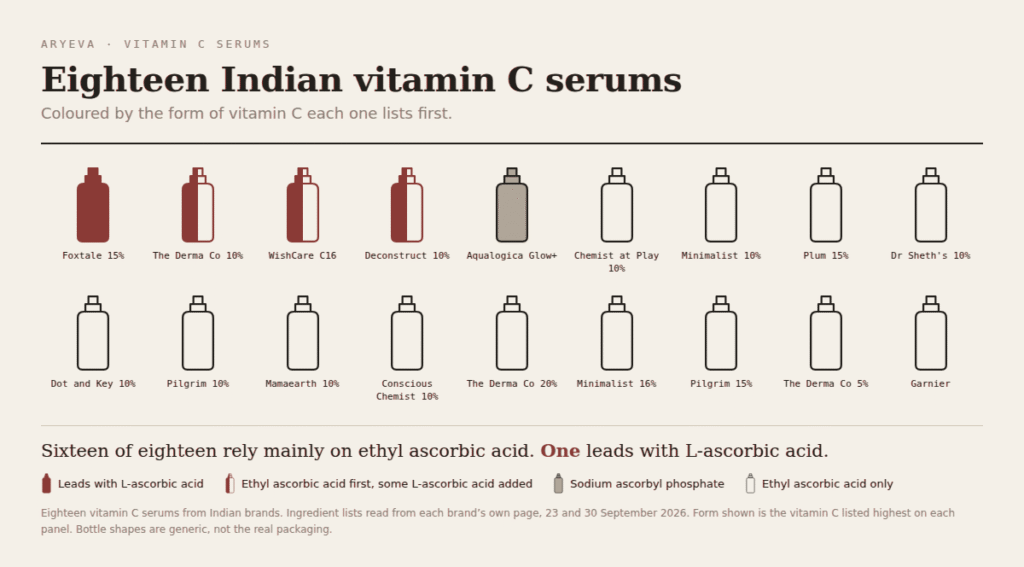
Doing that for eighteen Indian vitamin C serums turned up something none of the ranking lists mention. Sixteen of them rely mainly on the same form of vitamin C, and it is not the one most of the research is about. Fourteen of those serums are worth recommending under ₹800 anyway, and one more costs a little above the band and earns its place. The most familiar name on the shelf did not make the list, and the reason is in its own ingredient list.
Four molecules sold under one name
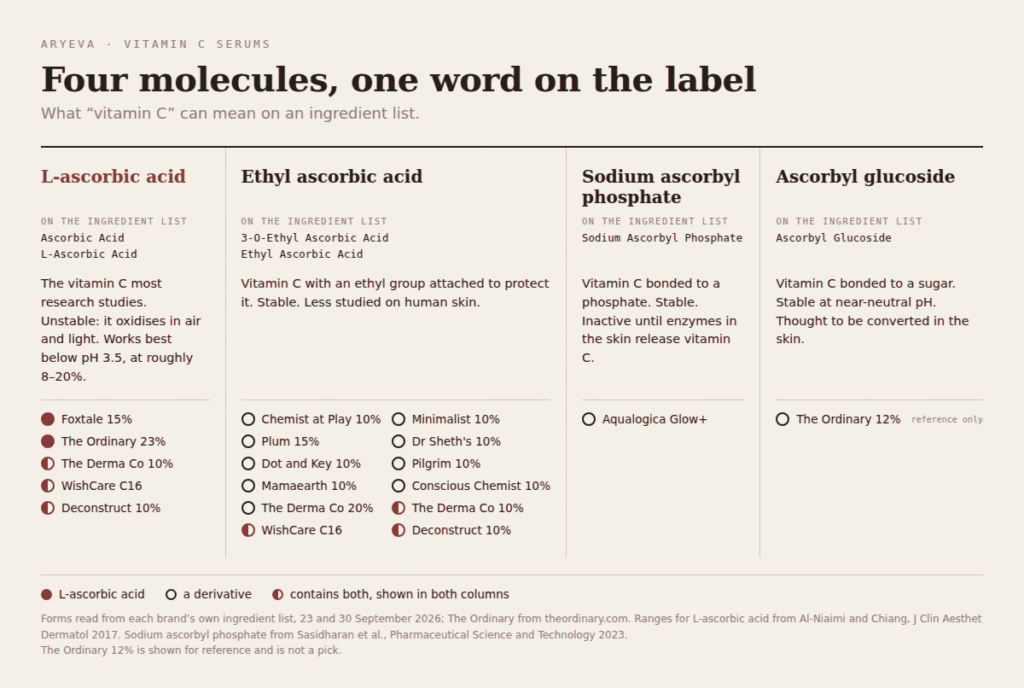
The vitamin C your body uses is L-ascorbic acid. It is also what most of the published skin research studies use, and it has a well-known problem: it doesn’t last. A widely cited 2017 dermatology review describes it as hydrophilic and unstable, and notes that it needs an acidic formula, below pH 3.5, to stay stable and get into the skin. The same review puts the useful range at roughly eight to twenty per cent, with nothing gained above twenty except more irritation.
That instability is why the derivatives exist. A derivative is L-ascorbic acid with something attached to protect it, so it survives longer in the bottle. The one that dominates the Indian shelf is 3-O-ethyl ascorbic acid, which labels usually shorten to ethyl ascorbic acid. Two others appear here: sodium ascorbyl phosphate, which is vitamin C bonded to a phosphate, and ascorbyl glucoside, which is vitamin C bonded to a sugar.
The trade-off is easy to state. L-ascorbic acid has the most evidence and the shortest shelf life. The derivatives last much longer and have far less evidence, especially in people. A 2019 study of ethyl ascorbic acid described itself as the first comprehensive look at how the molecule gets into the skin, and it was done on pig skin in a laboratory. Sodium ascorbyl phosphate, according to a 2023 review, has no antioxidant activity of its own until enzymes in the skin release ascorbic acid from it, and it keeps better in storage than ascorbic acid. For ascorbyl glucoside, a 2019 safety review cites a 1998 study reporting that, when applied in a cream, it was absorbed through the skin and converted to ascorbic acid. That conversion is how it is thought to work.
Neither half of that makes a derivative useless. It means that when a derivative serum promises you the results people associate with vitamin C, it is borrowing evidence that was mostly gathered on a different molecule.
Why the percentage on the front can’t be compared
Fifteen per cent L-ascorbic acid and fifteen per cent ethyl ascorbic acid are not the same amount of vitamin C. They are the same weight of two different molecules, and one of them is partly made of the ethyl group that was attached to protect it.
Minimalist’s product page says this outright, which is to its credit. It describes its ethyl ascorbic acid as containing 86 per cent pure vitamin C. Take that at face value, and a 10% derivative serum is not a 10% vitamin C serum. Nobody else on the shelf volunteers the arithmetic.
So when you compare two bottles, compare the form first and the number second. A higher percentage of a derivative does not beat a lower percentage of the real thing on the number alone, and a higher percentage of anything does not help past the point where it starts to sting.
What each bottle actually contains
Here is every serum in this post with the form of vitamin C it uses and where that sits on the panel.
| Serum | Form of vitamin C | Position | Also worth knowing |
|---|---|---|---|
| Chemist at Play 10% | ethyl ascorbic acid | 2 | fourteen ingredients |
| Minimalist 10% | ethyl ascorbic acid | 2 | publishes its pH |
| Plum 15% | ethyl ascorbic acid | 2 | kakadu plum well down the list |
| Dr Sheth’s 10% | ethyl ascorbic acid | 2 | ceramides at six |
| Dot and Key 10% | ethyl ascorbic acid | 2 | niacinamide and a little alpha arbutin |
| Pilgrim 10% | ethyl ascorbic acid | 2 | niacinamide at three |
| Mamaearth 10% | ethyl ascorbic acid | 2 | thirteen ingredients, contains fragrance |
| Conscious Chemist 10% | ethyl ascorbic acid | 3 | two peptides inside a blend |
| The Derma Co 20% | ethyl ascorbic acid | 2 | ferulic acid at five |
| The Derma Co 10% | ethyl ascorbic acid, plus ascorbic acid | 2 and 10 | niacinamide at five |
| WishCare C16 | ethyl ascorbic acid, plus L-ascorbic acid | 5 and 7 | kojic acid at ten |
| Deconstruct 10% | ethyl ascorbic acid, plus L-ascorbic acid | 2 and 8 | liposomal, publishes its pH |
| Aqualogica Glow+ | sodium ascorbyl phosphate | 6 | glycerin listed twice, no percentage |
| Foxtale 15% | L-ascorbic acid | 2 | cream-like base, contains fragrance |
| The Ordinary 23% | L-ascorbic acid | 1 | no water at all |
Read down the middle column. Among the Indian brands, one bottle leads with L-ascorbic acid. Three more add a smaller amount of it behind the ethyl form. One uses a different derivative altogether, sodium ascorbyl phosphate. Everything else is ethyl ascorbic acid. At this price in India, “vitamin C serum” mostly means “ethyl ascorbic acid serum”, and you would not learn that from a single carton.
That is not a scandal. Ethyl ascorbic acid is a reasonable choice for a hot country where a bottle might sit on a bathroom shelf for months. It is a choice, though, and you are entitled to know it was made.
The one I left out
Garnier’s Bright Complete Vitamin C Serum is the most familiar name on this shelf. I am not recommending it, and I want to be exact about why.
On Garnier’s own ingredient list, ethyl ascorbic acid is the tenth ingredient. Above it sit water, glycerin, alcohol, two glycols, niacinamide and three other ingredients. Below it come a fragrance and five listed fragrance allergens. Garnier does not publish a vitamin C percentage anywhere on the page.
Ingredient lists run in descending order of weight, but only down to one per cent, and below that any order is allowed. So tenth place does not tell me how much vitamin C is in the bottle, and I am not going to guess. What it tells me is that a product sold on vitamin C does not put vitamin C near the top of its own list and does not say how much it contains. Alcohol is third. For a serum aimed at brightening, that is a lot of other things coming first.
Every serum I recommend below lists its vitamin C within the first six ingredients, and none of them puts alcohol ahead of it. That is the whole reason Garnier is not here.
What an ingredient list cannot tell you
Two honest limits.
The first is pH. For L-ascorbic acid, it decides whether the product works at all. For the derivatives, it matters less, which is part of their appeal. Among the Indian brands, only Minimalist and Deconstruct publish a pH. Foxtale, the one Indian serum that leads with L-ascorbic acid, does not, and it is the one where the number would matter most.
The second is freshness. A panel describes the product on the day it was made. It says nothing about the bottle that has been sitting in a warm warehouse, or open on your shelf since March. Which brings us to the bottle.
Why the bottle matters as much as the formula
L-ascorbic acid oxidises readily on contact with air, and light speeds that up. As it breaks down, a serum usually turns from clear or pale yellow to deep yellow and then brown. A brown vitamin C serum has lost much of what you paid for.
Two things slow that down. Opaque or dark glass keeps light out. A pump or an airless bottle lets in less air than a dropper, which pulls a fresh gulp of air into the bottle every time you open it. Many vitamin C serums use droppers, so the thing you control is how long the bottle stays open.
That is the argument for buying small. Several brands here sell a smaller size, and for vitamin C the smaller bottle is often the better buy even when it costs more per millilitre, because you finish it before it turns. The derivatives are more forgiving on this than L-ascorbic acid, which is the main thing they have going for them. Keep any vitamin C serum closed, cool and out of the sun, whichever form it is.
What I looked at
Every vitamin C serum sold in India under ₹800 that publishes a full ingredient list on its own website, plus two imports from The Ordinary and one from Klairs for comparison. I left out low-strength daily serums and sunscreens with vitamin C added, which are different products bought for different reasons. Where a brand sells several, I picked the one I would reach for, with one exception.
Fourteen made the list, from thirteen brands. The Derma Co’s two share an entry, so you will see thirteen headings below. They are not ranked.
Chemist at Play 10% Vitamin C Face Serum
Fourteen ingredients, one of the shortest Indian panels in this post. Water, ethyl ascorbic acid at two, three solvents, acetyl glucosamine, then a small supporting cast ending in rice and konjac ceramides.
Put it next to the Minimalist entry below, and the two are built almost the same way, down to the same two leading solvents and the same acetyl glucosamine. Chemist at Play costs noticeably less. It does not publish a pH, and Minimalist does, which is the main thing the extra money buys.
Who it suits: anyone who wants a plain derivative serum and nothing else in the bottle, at the lowest cost on this list.
Who should skip it: if you want a brand that tells you its pH, buy the Minimalist instead.
Minimalist Vitamin C 10% Face Serum
Centella extract takes the place of water, usually at the top of the list, with ethyl ascorbic acid second, then two solvents, glycerin, acetyl glucosamine, and gluconolactone, a mild acid the front label doesn’t mention. The bottle is opaque black glass with a dropper.
Minimalist is also the only Indian brand that publishes both a pH and the 86 per cent figure mentioned above. That transparency is why you pay a little more than Chemist at Play for a similar formula.
It comes in a very small size as well as the standard one, and for a first vitamin C serum that small bottle is the one I would buy. You find out whether your skin likes it, and you finish it long before it has time to turn.
Who it suits: a first-time vitamin C user who wants the most information about what they are putting on their face.
Who should skip it: anyone who wants L-ascorbic acid specifically.
A note on its sibling. Minimalist also sells a Vitamin C + E + Ferulic 16%. The 16 is a sum: fifteen per cent ethyl ascorbic acid plus one per cent vitamin E and ferulic acid combined. The brand says so on the page if you read down, which is fair, but the number on the front is not a vitamin C figure.
Plum 15% Vitamin C Face Serum
Ethyl ascorbic acid is second, behind water, followed by propanediol, betaine, an emollient, a solvent, and a citrate buffer. The kakadu plum on the front of the bottle sits at position ten. It is there to echo the product’s name, not to supply the vitamin C, which comes from the ethyl ascorbic acid.
Plum’s page says the vitamin C concentration stays at 15 per cent for the whole shelf life. That is the brand’s claim, and the derivative is certainly the right choice if that is the promise you want to make. It comes in a smaller size too.
Who it suits: someone who wants a higher-strength derivative with a short, sensible list.
Who should skip it: if the number on the front is why you are choosing it, reread the section above on percentages first.
Dr Sheth’s Ceramide and 10% Vitamin C Ampoule Serum
Ethyl ascorbic acid second, then two solvents, a pH adjuster, and a ceramide complex at position six, with heartleaf, hyaluronic acid, and ferulic acid behind it. The ceramides are high enough in the list to be doing something, which suits the brand’s “non-irritating” positioning.
Propolis extract is the last ingredient. If you react to bee products, that matters more than its position suggests.
The brand’s salicylic serum was sold out when I wrote the salicylic acid serum roundup. This one was in stock.
Who it suits: skin that gets tight or red when it tries a new active and wants barrier support in the same bottle.
Who should skip it: anyone with a known propolis or bee-product allergy.
Dot and Key 10% Vitamin C + E + 5% Niacinamide Serum
Ethyl ascorbic acid second, niacinamide third, then a run of fruit and pumpkin extracts, ferulic acid, and a ceramide and cholesterol blend near the end. The page says it is fragrance-free.
Two things the name does not quite tell you. The E is tocopheryl acetate at position twelve. And alpha arbutin, a separate brightening ingredient, appears at position eighteen. At that position, it is probably present in a small amount, but it is a second active aimed at the same job as the vitamin C.
Who it suits: someone who wants vitamin C and niacinamide in one step with barrier-friendly extras.
Who should skip it: if you already use a niacinamide serum, you are doubling up.
Pilgrim 10% Vitamin C Face Serum
Ethyl ascorbic acid second and niacinamide third, then a long run of botanical extracts, including orange, lemon and kakadu plum. The page describes a dark, UV-protective glass bottle.
Readers of the salicylic acid serum post will remember Pilgrim as the brand whose headline active sat at position fifteen. Not here. The vitamin C is where it should be, and that is worth saying just as plainly.
One small thing. Salicylic acid is the very last ingredient of thirty-two, not mentioned on the front. At that position it is presumably a small amount, but if you are tracking every acid you use, it is there.
Who it suits: someone who wants vitamin C and niacinamide together and likes a longer, extract-rich formula.
Who should skip it: if you want a short list, or if you react to citrus extracts.
Mamaearth 10% Vitamin C Face Serum
Thirteen ingredients, the shortest Indian panel in this post. Water, ethyl ascorbic acid at two, two solvents, then hyaluronic acid, ferulic acid and niacinamide. Gotu kola, which the brand puts in the product’s name, is the last of the thirteen.
It contains fragrance, listed eighth as “IFRA certified allergen free”. As with Foxtale, that is the brand’s own description, not a regulated term.
Mamaearth is one of the most heavily advertised skincare brands in India, and this is a conventional, sensibly short derivative serum. On the brand’s own site it now sits near the top of this post’s price range.
Who it suits: someone who wants a simple ethyl ascorbic acid serum from a brand they already know, and doesn’t mind fragrance.
Who should skip it: anyone who avoids fragrance. Chemist at Play is similarly short and has none.
Conscious Chemist Vivid C 10% Vitamin C Serum
Ethyl ascorbic acid third, behind water and propylene glycol, at a stated ten per cent. Then a preservative pair, a thickener, a solubiliser and a long run of plant extracts, several of them listed together as blends.
Two peptides, palmitoyl tripeptide-1 and palmitoyl tetrapeptide-7, sit inside one of those blends, and the brand sells the serum on a “pro-collagen” promise. They are on the list. What they do at whatever level they are used is not something a panel can tell you, and the brand publishes no percentage for them.
Bearberry leaf extract appears in the middle of the list. Bearberry is a natural source of arbutin, a separate brightening ingredient, but an extract is not a measured dose of arbutin, so read it as a small extra rather than a second active.
No fragrance is listed, and no pH is published.
Who it suits: someone who wants a derivative serum with a few extras in the same bottle.
Who should skip it: anyone who wants a short list. This is one of the busier panels here.
The Derma Co: 20% for strength, or 10% with niacinamide
On 24 October 2026 the 20% was above this post’s ₹800 band on The Derma Co’s own site, but under it on Amazon. The 10% with niacinamide was inside the band on the brand’s site.
The Derma Co makes two vitamin C serums worth your attention, and which one fits depends on what else you use.
The 20% is the leanest high-strength panel in this post. Ethyl ascorbic acid is second, with two solvents, then ferulic acid at position five, higher than in any other product here. Sixteen ingredients in total. It comes in a smaller bottle than most, which suits a vitamin C serum, but it makes it the most expensive per millilitre of the in-band picks.
The 10% with niacinamide takes a different route. Ethyl ascorbic acid is second, niacinamide fifth, and then a smaller amount of plain ascorbic acid at position ten. That makes it one of three Indian picks that combine the derivative with the real thing.
Who it suits: the 20% suits someone who has used a 10% derivative, liked it, and wants more. The 10% with niacinamide suits someone who would rather keep one bottle than two, and pairs naturally with the niacinamide serums I recommended earlier.
Who should skip it: first-time users should not start at 20%, and anyone already using a niacinamide serum does not need the 10%.
WishCare Super Bright Vitamin C16 Serum
Two things are unusual about this one. It is one of three serums in this post that contain both forms of vitamin C, with ethyl ascorbic acid fifth and L-ascorbic acid seventh. And its vitamin C sits deeper in the list than in any other pick, behind propylene glycol, butylene glycol and glycerin.
The name is the third. “C16” reads like a sixteen per cent vitamin C serum. The brand’s own page describes ten per cent vitamin C and one per cent kojic acid, which does not add up to sixteen either, and the page does not say what the number means. Minimalist explains its “16%”. WishCare does not.
Two brightening ingredients the name leaves out are also on the list: kojic acid at position ten, and 4-n-butylresorcinol as the very last ingredient. Both are used against dark spots. Their positions say nothing precise about how much of each is in the bottle, but they are there.
The brand writes “3-0” with a zero where the chemical name has a letter O, and uses full stops in two places where the list needs commas. Neither changes what is in the bottle.
Who it suits: someone who wants a multi-active brightening serum and is comfortable using several actives at once.
Who should skip it: anyone who wants to know how much vitamin C they are getting, and anyone new to actives.
Deconstruct 10% Vitamin C + 0.5% Ferulic Acid Serum
The most carefully built Indian serum here. Ethyl ascorbic acid at two and L-ascorbic acid at eight, so the pure form is the smaller share of the ten per cent, with sunflower lecithin at position ten forming the liposome that carries it. Ferulic acid is in there too, alongside a stabilising antioxidant.
Deconstruct publishes a pH and names its ferulic acid percentage on the front, which few others here do. It was also the liposomal outlier in the salicylic acid roundup, which suggests a brand that thinks about delivery rather than just the headline number. There is a smaller size.
Who it suits: someone who wants some L-ascorbic acid without committing to a full-strength pure serum.
Who should skip it: if you want to know exactly how much pure vitamin C you are getting, the split is not published.
Aqualogica Glow+ Concentrate Face Serum
The only serum in this post built on sodium ascorbyl phosphate, the fourth molecule described at the start. It is vitamin C bonded to a phosphate, and it does nothing until enzymes in the skin split that bond and release ascorbic acid.
Glycerin appears twice on the list, at positions two and five. That usually means the brand has merged the lists of two ingredient blends, and it means the usual descending order cannot be fully trusted. Read as printed, the vitamin C is sixth. The brand does not publish a percentage.
The rest is short and plain: glyceryl glucoside, a solvent, papaya extract, hyaluronic acid, thickeners, a chelator and preservatives. The brand says it is fragrance-free and colour-free, and nothing on the list contradicts that.
The evidence for this form is thinner than for L-ascorbic acid, but it is not absent. A 2023 review cites a clinical study of 49 people in which a 5% sodium ascorbyl phosphate lotion did better against acne than 5% benzoyl peroxide. That is one small study, and it was about acne, not dark spots or glow.
Who it suits: oily, acne-prone skin that wants a stable vitamin C and doesn’t need the strongest option.
Who should skip it: anyone who wants a known percentage, or the form with the most research behind it.
Foxtale 15% Vitamin C Face Serum
The only Indian serum on this list that leads with L-ascorbic acid, at fifteen per cent. If the published evidence is what you are buying for, this is the Indian bottle that most closely matches it.
It is built differently from everything else here. After the vitamin C comes a run of emollients, among them dicaprylyl carbonate and octyldodecanol, so the base is closer to a light lotion than a watery serum. For oily skin, that is worth knowing before you buy. It also contains fragrance, labelled “allergen free”, which is the brand’s own description rather than a regulated term.
It does not publish a pH. For a product built on L-ascorbic acid, that is the one number I would most like to see.
Who it suits: someone who specifically wants L-ascorbic acid and doesn’t mind a richer texture.
Who should skip it: very oily skin and anyone who avoids fragrance.
Worth the stretch: The Ordinary Vitamin C Suspension 23% + HA Spheres 2%
This sits just above the band and is included deliberately, the way the face wash post and the salicylic acid post each included one out-of-band pick.
L-ascorbic acid is the first ingredient. There is no water anywhere in the list. The base is squalane and a set of emollients, and the word “suspension” in the name is literal: the vitamin C is held in the base rather than dissolved in it. Taking the water out is the most direct answer to the stability problem described at the start of this post, the same idea as The Ordinary’s oil-based salicylic acid in the last post.
Twenty-three per cent is above the twenty per cent ceiling the 2017 review mentions, beyond which the extra strength adds irritation rather than benefit. Expect it to tingle, and start slowly.
Who it suits: someone who wants pure, high-strength L-ascorbic acid in the most stable format available here.
Who should skip it: oily skin that dislikes an emollient base, sensitive skin, and first-time users.
Popular, but not on this list
Four more vitamin C serums came up again and again while I was updating this post. None of them is a pick, and each is left out for a reason you can check yourself.
The True Therapy’s Vitamin C 10% + Ferulic Acid is the one I most wanted to include. It is one of very few Indian serums built on L-ascorbic acid, its ingredient list contains no water at all, and the brand publishes a pH of 3.2 to 4.2. That makes it the nearest Indian equivalent I found to The Ordinary’s suspension above. It was sold out on the brand’s own site when this section was first written. By 24 October 2026 it was back in stock, with the same water-free ingredient list and the same published pH, so it is worth a look. It is not among the numbered picks above only because those were assessed while it was unavailable.
Pond’s Bright Beauty 12% Vit C+E+A Serum was also sold out on the brand’s site in late September. Its page is useful anyway, because it explains the number on the front: the 12% is a combined figure covering nine ingredients, including solvents and glycerin as well as ethyl ascorbic acid. The page does not publish a full ingredient list in order, so I can’t tell you where the vitamin C sits.
Lakmé 9to5 Vitamin C+ Facial Serum and Lotus Herbals WhiteGlow Vitamin C + Gold Radiance Serum come from two of India’s biggest beauty brands, and both sell on vitamin C. Neither brand’s product page publishes a full ingredient list. Lakmé’s names a single ingredient, Kakadu plum. Lotus’s names Kakadu plum, yuzu lemon and 24-carat gold leaves, and promises “100x” vitamin C. Neither says which form of vitamin C is in the bottle, or how much.
Their formulas may be perfectly good. I have no way to tell you, and neither do you, which is why they are here rather than above. It is the Kakadu plum point from the Plum entry again: a fruit on the label is not the same as a form of vitamin C on the list.
What about the famous imports?
Two more deserve a paragraph, because you will see them recommended everywhere.
Klairs Freshly Juiced Vitamin Drop is listed on Nykaa as five per cent pure vitamin C. That is deliberately gentle, and the brand markets it that way. It also contains orange and lavender oils, and it costs roughly twice the top of this band. For sensitive skin that wants a mild L-ascorbic acid, it has a case. As value for money against the list above, it does not.
The Ordinary’s Ascorbyl Glucoside Solution 12% is the third molecule from the start of this post. Its published pH is six to seven, close to neutral, which makes it gentle and stable, and it relies on your skin converting it. It costs more than every Indian pick here, so it is a reference point rather than a recommendation.
How to use vitamin C without wasting it
Use it in the morning, after cleansing and before moisturiser. That is when an antioxidant has the most to do.
It does not replace sunscreen, and nothing in this post should be read as suggesting it does. If you have not sorted sunscreen yet, the sunscreen guide matters more than which serum you pick.
Start every other day if you are new to it, particularly with L-ascorbic acid. Tingling for a minute is common. Stinging that lasts, or redness the next day, means stop.
You can use it with niacinamide. The old advice against combining them has been overtaken, as the niacinamide post explains, and several products in this post put both in the same bottle.
Keep it out of the same routine as a salicylic acid serum until you know how your skin handles each on its own. Two acids at once is how barriers get compromised.
Close the cap every time, keep the bottle out of the sun and out of a steamy bathroom, and throw it away when it goes brown.
Patch-test first. Apply a little behind the ear or along the jaw for a few days before committing your whole face.
If you only want one answer
Buy the smallest Minimalist bottle. It is a well-made derivative serum from the only Indian brand that publishes both its pH and how much of its derivative is actually vitamin C, and the small size means you will finish it fresh.
If you want L-ascorbic acid specifically and your skin is not oily, buy Foxtale. If it is oily and you still want the real thing, Deconstruct gives you some of both.
If you just want the plainest fragrance-free bottle for the least money, buy Chemist at Play.
Common questions
Which percentage should I start with?
Ten per cent of anything. Higher percentages mostly add irritation, and the form of vitamin C matters more than the number next to it.
My serum has turned yellow. Is it ruined?
Pale yellow is often how it started. Deep yellow, orange, or brown means it has oxidised and much of the vitamin C is gone. Replace it, and buy a smaller bottle next time.
Can I use vitamin C and retinol together?
Not in the same routine to begin with. Vitamin C in the morning and a retinoid at night is the usual split, and the beginner’s guide to retinol covers the retinoid side.
Will vitamin C fade dark spots?
It can help, and there is clinical evidence for L-ascorbic acid with pigmentation, though it is slower and more modest than prescription options. Marks take months, not weeks. The dark spot serum guide compares vitamin C with the other ingredients that target them.
Is ethyl ascorbic acid bad?
No. It is stable, well tolerated, and a sensible choice for a hot climate. It is less studied on human skin than L-ascorbic acid, and you deserve to know that before you pay for the promise.
Which vitamin C serum is best for oily skin?
A derivative serum is the easier choice for oily skin, and most of the picks above are built that way. If you still want L-ascorbic acid, the Deconstruct 10% + Ferulic carries some of it alongside ethyl ascorbic acid, which gives you some of both.
Nothing in this post is sponsored, and nothing here was tested on my own skin. Every Indian ingredient list was read from the brand’s own website on 23 September 2026, and the four added later on 30 September 2026, and formulations change without notice. If a panel has moved since, the brand’s page is right, and I am wrong. Sources for the science: Al-Niaimi and Chiang, Journal of Clinical and Aesthetic Dermatology, 2017; Lane and colleagues, International Journal of Pharmaceutics, 2019; Cosmetic Ingredient Review safety assessment of ascorbyl glucoside, 2019; Sasidharan and colleagues, Pharmaceutical Science and Technology, 2023.