
How to Read an Indian Skincare Label
Some links here may be affiliate links. Where they are, a purchase can earn Aryeva a commission at no extra cost to you — it never affects the picks. Prices and formulations change; everything below was checked against the brands’ own ingredient listings at the time of writing.
The short answer. Turn the pack over. The front is advertising, and the back is a legal declaration. Above 1%, ingredients have to be listed from most to least, so find where the ingredient named on the front actually sits, in what form, and what comes before it. On packs of 60 ml or 30 g or less, the list isn’t compulsory.
| Step | What to look at | What it tells you |
|---|---|---|
| 1 | Is there an ingredient list on the pack? | Small packs don’t have to carry one, so a website list may be all you get |
| 2 | Where is the ingredient named on the front? | Near the top means a real share of the formula; near the end means a small one |
| 3 | Is it in the form you’d assume? | Zinc PCA isn’t zinc oxide; tea tree extract isn’t tea tree oil |
| 4 | What does the percentage on the front measure? | One ingredient, a “complex”, or several ingredients added together |
| 5 | Where is the preservative? | Phenoxyethanol is normally used at 1% or less, so whatever follows it is small too |
| 6 | Do the claim words have a test behind them? | “Oil-free”, “non-comedogenic” and “dermatologically tested” have no fixed legal meaning |
How this guide was checked. The labelling rules were read from the Cosmetics Rules, 2020 on 12 November 2026. Every product example comes from a guide already published on this site, and the four lists in the chart below were re-read on each brand’s own page the same day. This explains the rules for reading a label. It isn’t legal advice. The details are under How this guide was put together.
Every guide on this site does the same thing. It reads the ingredient list on the brand’s own page, says what the list can and can’t show, and says plainly when the name on the front promises more than the back delivers. This guide explains how to do that yourself. All the examples come from the ten product guides already published here, so you can check each one in full.
What does Indian law require on a skincare label?
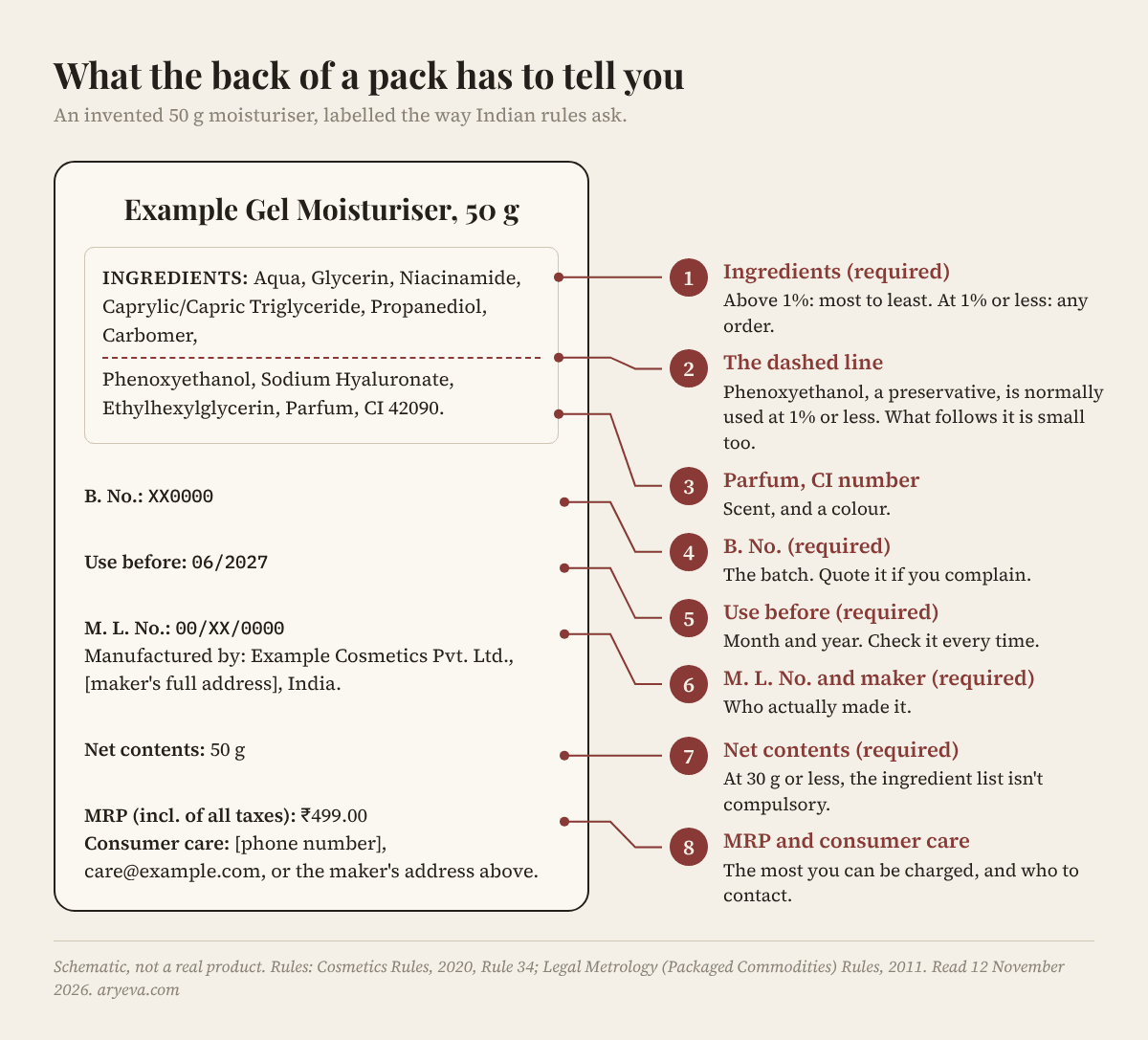
Short answer: a product name, the maker’s name and address, a use-before date, a batch number, a manufacturing licence number, the net contents and, on most packs, a full ingredient list.
These requirements come from Rule 34 of the Cosmetics Rules, 2020, which covers every cosmetic made or sold in India, skincare included. The use-before or expiry date is given as a month and year. The batch or lot number usually starts with “B. No.” or “Lot”, and very small packs (10 g or 25 ml or less) don’t need one. The manufacturing licence number usually starts with “M. L. No.”; imported products can leave it off if their home country doesn’t issue one. Where a product carries a particular hazard, the label also has to give directions for safe use and any warnings.
A second set of rules, the Legal Metrology (Packaged Commodities) Rules, covers the commercial details: the MRP, the net quantity and a consumer-care contact. Between them, the two sets of rules decide what the back of a pack has to say. Nothing comparable controls what the front says, beyond the general rule that claims mustn’t mislead. That’s why the back is the place to start.
Why do some products have no ingredient list on the pack?
Short answer: because the law doesn’t require one on packs of 60 ml or less (liquids) or 30 g or less (creams, gels and solids).
This is the single most useful thing to know about Indian labels, and most guides leave it out. Rule 34(7) of the Cosmetics Rules says the ingredient list “need not appear” on packs of up to 60 ml of liquid or 30 g of solid or semi-solid product. That covers most serums (usually 30 ml), almost every eye cream (usually 15 g to 20 g), and the smaller tubes of sunscreen and moisturiser.
A brand can still choose to print a list on a small pack. But when a small pack has none, the brand’s website is often the only place to find it, and a website list doesn’t have the same standing as a declaration on the box. It can be out of date, in the wrong order, or for a different product. The section on brand websites below gives real examples. This is also why every guide on this site says where and when each list was read.
How is the ingredient list ordered?
Short answer: everything above 1% is listed from the largest amount to the smallest. Everything at 1% or less comes after that, in any order the brand likes.
The rule is the same one used in Europe and the US. It has two consequences that matter more than any single ingredient name.
The first is that position is a clue, not a measurement. An ingredient fifth on the list is present in a larger amount than the sixth, if both are above 1%, but the list doesn’t tell you how much larger. Water is usually first and often makes up most of the bottle. After the first few ingredients, the amounts can be small and close together.
The second is that everything above 1% has to come before everything at 1% or less. So once you reach an ingredient that can’t be above 1%, everything after it is at 1% or less too, as long as the brand has followed the rule. That’s what makes the next section useful.
The salicylic acid serum guide has the clearest example on this site. Pilgrim’s 2% salicylic acid serum lists salicylic acid fifteenth. Position fifteen doesn’t prove anything on its own: it would fit a 2% claim if all fourteen ingredients above it were also at 2% or more. But the box names a 3% glycolic acid complex, and if the glycolic acid is at 3% and the salicylic acid at 2%, the ten ingredients listed between them would each need to be at 2% or more. Eight of the fourteen ingredients above the salicylic acid are plant extracts or ferments. You can decide for yourself how likely that is.
Where is the 1% line?
Short answer: the list won’t say, but common preservatives give you a good idea. Phenoxyethanol is limited to 1% in Europe and normally used at 1% or less, so it makes a useful marker.
Preservatives are the easiest landmark because they work at low concentrations and are used in small amounts. Phenoxyethanol is the most common one in Indian skincare. Parabens such as methylparaben are another, and they’re normally used at well under 1%. When you find one of these, treat everything listed after it as a small amount.
The dark spot serum guide uses exactly this. Pond’s Bright Beauty serum is sold as a “12% Gluta-Niacinamide Complex”. Pond’s doesn’t publish the full ingredient list on its website. The list recorded on the ingredient database incidecoder puts niacinamide fifth, which is plausible for a serum built around it. The ingredients that fit the “gluta” part of the name, cystine and glycine, come sixteenth and seventeenth, after methylparaben. The label can’t tell you how the 12% divides between them.
Fragrance (often listed as “parfum” or “fragrance”) and named essential oils also tend to sit near the end. That’s a pattern, not a rule, but an ingredient named on the front that sits beside the perfume is present in a small amount.
Why isn’t the name on the front in the ingredient list?
Short answer: because the front uses marketing names, and the list uses standard ingredient names. Sometimes the marketing name points to something real, and sometimes to something much weaker.
Ingredient lists normally use INCI names, a standard international naming system, which is why the same ingredient is spelled the same way on a Korean box and an Indian one. The front of the pack can say anything. There are four common gaps between the two.
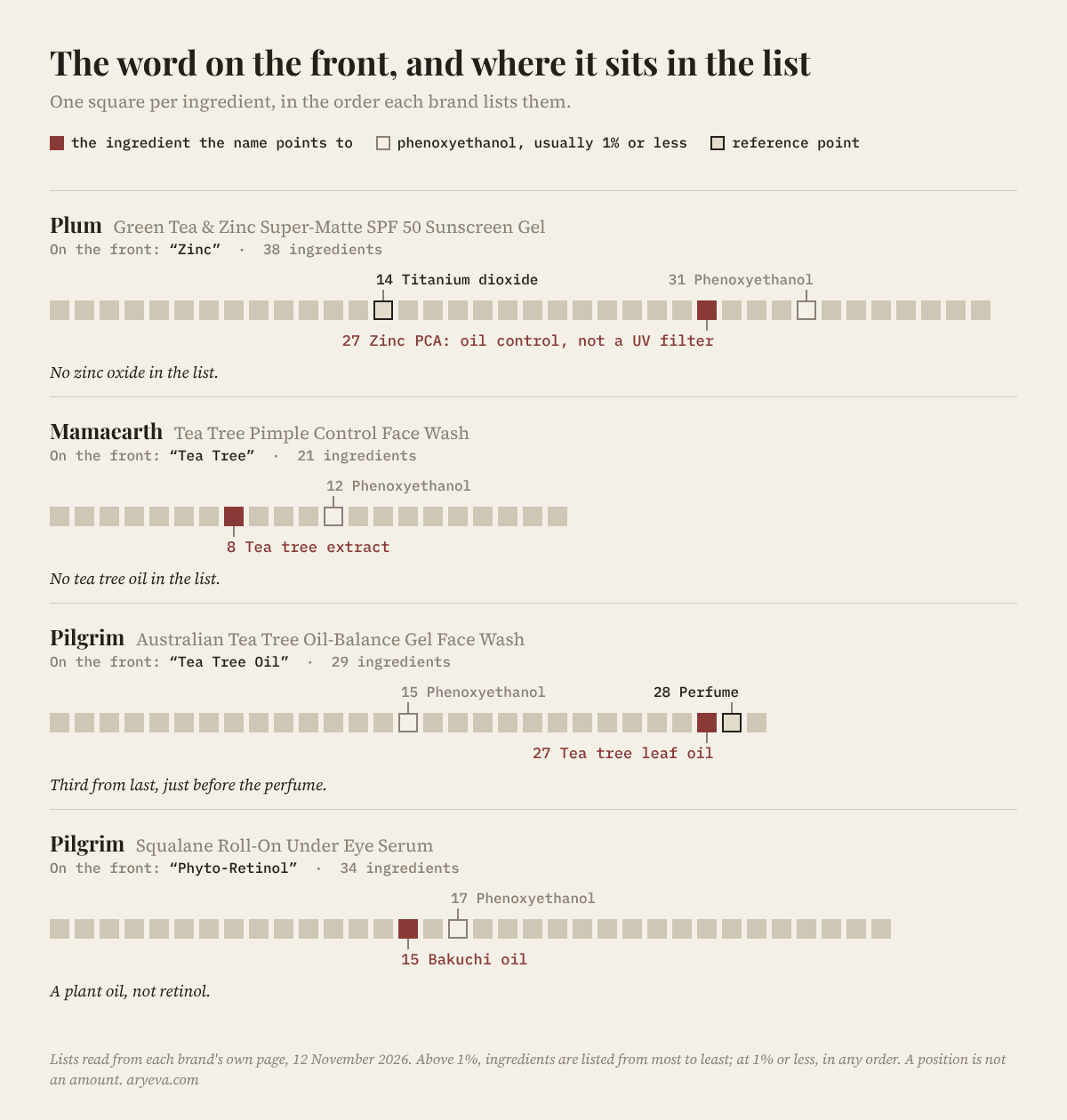
The name word is a different ingredient. The sunscreen guide for oily skin covers Plum’s Green Tea & Zinc Super-Matte sunscreen. The zinc in the name is zinc PCA, twenty-seventh in the list, an ingredient used for oil control. Zinc oxide, the zinc that protects against UV, isn’t in the formula. A shopper who sees “zinc” on a sunscreen and assumes mineral protection has been led somewhere the label never promised.
The name ingredient is there, but in a weaker form. The face wash guide found that Mamaearth’s Tea Tree Face Wash contains tea tree extract, eighth in the list, and doesn’t list tea tree oil at all. The oil is the form the acne studies used.
The name ingredient is there, but right at the end. In the same guide, Pilgrim’s Australian Tea Tree Oil-Balance Gel Face Wash lists tea tree leaf oil third from last, after vitamin E (tocopheryl acetate) and immediately before the perfume. In the under-eye cream guide, Foxtale’s brightening eye cream is sold on vitamin C and caffeine, which sit eighteenth and twenty-second.
The name is a trade name. Pilgrim’s under-eye roll-on says “phyto-retinol” on the front. In the list, that turns out to be bakuchi oil, fifteenth, which the brand itself calls “a natural plant-based alternative to retinol”. It isn’t retinol, and the beginner’s guide to retinol covers the real thing. Chemist at Play’s under-eye cream says “2% Revital Eye”, which isn’t an ingredient name at all, and the brand doesn’t say which ingredients it refers to. Sunscreens do the same with UV filters: Uvinul A Plus is a trade name for the filter listed as diethylamino hydroxybenzoyl hexyl benzoate.
It works the other way too. Products often contain ingredients the name doesn’t mention. Plum’s Green Tea face wash contains glycolic acid, an exfoliating acid, without saying so on the front. That matters if you’re already using an acid.
What does a percentage on the front tell you?
Short answer: only what it says it measures, and that’s often less than it seems. Check whether the number belongs to one ingredient, a “complex”, or several ingredients added together.
A single ingredient with a percentage, such as “10% niacinamide”, is the clearest kind of claim. The ingredient should sit fairly high in the list, and it usually does. The niacinamide serum guide explains what the percentage on those bottles does and doesn’t tell you.
A “complex” with a percentage is harder to read, because the brand decides what goes into the complex. Pond’s “12% Gluta-Niacinamide Complex”, above, is one example.
Some percentages are several ingredients added together. L’Oréal’s Glycolic Bright 8% [Melasyl + Niacinamide] serum is an example: the 8% is the three headline ingredients combined, not 8% glycolic acid.
Even a single-ingredient percentage tells you less than you’d think when the ingredient comes in several forms. The vitamin C serum guide read the labels of eighteen Indian vitamin C serums and found that sixteen rely mainly on ethyl ascorbic acid, a vitamin C derivative, rather than the L-ascorbic acid most of the research is about. “15% vitamin C” on the front doesn’t tell you which one you’re getting. The list does.
Can you trust the ingredient list on a brand’s website?
Short answer: it’s useful, but it isn’t the declaration on the box, and it isn’t always right. Read it, and check the pack when it arrives.
The dark spot serum guide ran into four different problems on brand websites. Pilgrim lists its alpha arbutin serum’s ingredients in alphabetical order, with water near the bottom, so the list can’t tell you anything about amounts. The True Therapy’s tranexamic acid page gives an ingredient glossary, not a declaration, so the order means nothing. The True Therapy’s azelaic acid page gives two different pH figures in two places. L’Oréal India’s page for the Melasyl serum prints an ingredient list with no Melasyl and no niacinamide in it, apparently because two different Glycolic Bright serums are sold in India.
Lists also change. Dot & Key’s own page for its under-eye cream says the ingredient list is “currently undergoing a transition” and may differ from the product you receive. Brands rename products too, sometimes when the formula changes and sometimes not. Pilgrim’s tea tree face wash has been renamed since the face wash guide was first written.
None of this means brand websites are useless. They’re usually the best source available, and every guide here reads them first. But a list with no order, no date and no match to the box is information, not proof. When the box arrives, compare its list with the one you read online.
What do “oil-free”, “non-comedogenic” and “dermatologically tested” mean?
Short answer: none of them has a fixed legal meaning in India or a standard test behind it. A brand using them is expected to have some evidence, but the label doesn’t tell you what it was.
The same is true in the US and the EU. “Non-comedogenic” means the product is supposed to be unlikely to block pores. The evidence behind it might be a study on acne-prone volunteers, or a check of the ingredient list against a chart. “Dermatologically tested” means a dermatologist was involved in some test, but not what the test measured, how many people took part, or what the result was. “Hypoallergenic” means the brand believes allergic reactions are unlikely, which is a different thing from “won’t cause one”. Under Indian rules, a brand is expected to keep evidence for its claims, and the Advertising Standards Council of India takes complaints about misleading ones. But none of that evidence is printed on the pack.
“Oil-free” is the clearest example of a claim word drifting from what’s in the bottle. The gel moisturiser guide found that Aqualogica’s Radiance+ Oil Free Moisturizer lists caprylic/capric triglyceride third and isopropyl myristate fourth, both lipids that do an oil’s job on the skin. Dr. Sheth’s Ceramide & Vitamin C Oil-Free moisturiser lists fractionated coconut oil second. “Oil-free” usually means no ingredient a shopper would recognise as an oil, not no oily ingredients.
The useful habit is to treat these words as a question rather than an answer. If a claim matters to you, look for the evidence on the brand’s page. A study with numbers in it, such as how many people took part and for how long, is worth more than a badge.
How do you read fragrance, essential oils and colours?
Short answer: look for “parfum” or “fragrance”, for named plant oils near the end of the list, and for codes beginning “CI”, which are colours.
“Parfum” or “fragrance” is a single entry that can cover many scent ingredients, and the list doesn’t break it down. If your skin reacts easily, it’s the first word to look for. Some lists name essential oils instead, such as rose, bergamot or lavender oil. These are fragrance too, even in a product sold as fragrance-free or natural. Some forms of bergamot oil can make skin more sensitive to sunlight, and a list doesn’t say which form it contains. The under-eye cream guide flags this for Pilgrim’s roll-on, whose last three ingredients are rose, tuberose and bergamot oils.
Colours are listed by “CI” (Colour Index) numbers, such as CI 19140 or CI 42090. They usually come at the very end. They’re permitted, but they’re there for appearance, not for your skin.
What do SPF and PA mean on an Indian sunscreen?
Short answer: SPF measures protection against UVB, the rays that burn. PA measures protection against UVA, the rays that age and darken skin. You need both.
SPF is tested at a thick layer of 2 mg per square centimetre, about a quarter teaspoon for the face, so using less gives you much less protection than the number on the tube. PA ratings run from PA+ to PA++++, and more plus signs mean more UVA protection. In 2026 the Bureau of Indian Standards published a standard for testing and labelling sunscreens (IS 19685). The two sunscreen guides, for oily skin and for dry skin, cover how to read the UV filters in the list, which tells you more than either number.
What are the batch number, use-before date and licence number for?
Short answer: they let you check that the product is in date, trace a faulty batch, and see who made it.
The use-before date is the one to check every time, especially for products that break down, such as vitamin C serums. The batch number matters if a product causes a reaction or seems wrong: the brand can trace it, and you should quote it when you complain. The manufacturing licence number and the maker’s address tell you who actually made the product, which isn’t always the brand on the front. Many brands use contract manufacturers. The consumer-care contact is the address or number to use if something goes wrong.
Some packs also carry a green or brown dot, which tells you whether the maker says the ingredients are of vegetarian origin. Since September 2026 the dot appears to be optional on cosmetics, so a pack without one tells you nothing. It isn’t a safety or quality mark.
What can’t a label tell you?
Short answer: exact amounts, pH, how stable the formula is, and whether it will suit your skin.
An ingredient list tells you what’s in a product and roughly in what order. It doesn’t give percentages, except where the brand chooses to print them. It doesn’t tell you the pH, which matters for acids and vitamin C. It doesn’t tell you whether an ingredient is in a form your skin can use, or whether the packaging protects it from light and air. And it can’t tell you how your skin will react. Some brands publish more, such as their pH or the amount of active vitamin C in a derivative, and the guides here note it when they do. That openness is worth something in itself.
That’s also the limit of this site. Every guide here is a label reading. The products weren’t tested on anyone’s skin, and the examples in this guide were read from brand websites, not from packs in hand. A label reading can tell you when the name promises more than the list delivers. It can’t tell you a product will work.
There’s a one-page version of these checks you can print or save: the label cheat-sheet (PDF). It’s free to print and share with a link back to this page.
How this guide was put together
The labelling rules were read from the Cosmetics Rules, 2020 (Rule 34) on 12 November 2026. The rules on the green and brown dot come from published readings of the September 2026 amendment to the Legal Metrology (Packaged Commodities) Rules, not from the Gazette text itself. Every product example comes from a guide already published on this site, which says where and when each ingredient list was read. Lists change, so check the box. This guide explains the rules as they apply to reading a label. It isn’t legal advice.
Common questions
Do all skincare products in India have to list their ingredients?
No. Packs of 60 ml or less of a liquid, or 30 g or less of a cream, gel or solid, don’t have to print an ingredient list. Larger packs do, under Rule 34 of the Cosmetics Rules, 2020.
Is the first ingredient always the one there’s most of?
Among ingredients above 1%, yes: they have to be listed from most to least. Water is usually first. Below 1%, ingredients can be listed in any order.
Does a higher percentage on the front mean a better product?
Not on its own. Check what the percentage measures, and whether the ingredient is in the form the evidence is about. A higher percentage of some actives can also mean more irritation.
Is “dermatologically tested” a guarantee?
No. It means a dermatologist was involved in some kind of test. The label doesn’t say what was tested, on how many people, or what the result was.
What does “non-comedogenic” mean?
It means the brand believes the product is unlikely to block pores. There’s no legal definition and no standard test in India, so treat it as the brand’s own assessment.
Can I trust ingredient lists on shopping sites?
Treat them with more caution than the brand’s own page. Marketplace listings and ingredient databases can be out of date. The guides on this site read the brand’s own page first for that reason.
What is the green dot on skincare?
It shows that the maker says the product is of vegetarian origin. A red or brown dot means non-vegetarian origin. It says nothing about safety or quality, and since September 2026 it appears to be optional on cosmetics.
Nothing in this post is sponsored, and nothing here was tested on my own skin. This guide explains labelling rules for shoppers. It isn’t legal advice, and the rules can change. The rules were read on 12 November 2026, and every ingredient list on the date given in the guide it comes from. If a list has changed since then, the box is right, and I am wrong. Sources: Cosmetics Rules, 2020, Rule 34 (Ministry of Health and Family Welfare); Legal Metrology (Packaged Commodities) Rules, 2011, as amended in September 2026; Vendruscolo et al., “The Science Behind the Label: Evaluating Claims in Dermatologist-Recommended Cosmetics”, Dermatological Reviews, 2025.