
Best Face Wash for Oily, Acne-Prone Skin in India Under ₹500
Some links here may be affiliate links. Where they are, a purchase can earn Aryeva a commission at no extra cost to you — it never affects the picks. Prices and formulations change; everything below was checked against the brands’ own ingredient listings at the time of writing.
Short answer: Minimalist Salicylic Acid + LHA 2% Cleanser is the best face wash for oily, acne-prone skin in India under ₹500. It is the best-formulated cleanser in the category at this price, and it discloses what is in it. If your skin is sensitive or you already use a leave-on acid, pick Re’equil Oil Control. If you want the lowest price that still does the job, pick Deconstruct.
How this list was checked. Each ingredient list was read from the brand’s own product page. Every panel was re-checked on 29 September 2026, and prices were re-checked on 24 October 2026. This is a comparison of labels, not a wear test. The full method is under “What I looked at” below.
There is a particular kind of disappointment that comes from finishing a bottle of acne face wash and realising your skin is exactly where it started. It is common enough that most people conclude they picked the wrong one and go buy another.
Usually they didn’t pick the wrong one. They bought a product that was never going to work, because of what it is rather than which brand made it.
If what you want is the best face wash for oily skin in India without spending much, here are eleven of them, read from the ingredient panel rather than the label on the front — all but two under ₹500, and the CeraVe is sometimes discounted below it.
A face wash sits on your skin for somewhere between twenty and sixty seconds and is then rinsed off. Whatever active it contains has that long to do something. Salicylic acid needs time and sustained contact to work its way into a pore and loosen what is in there — that is the entire basis for leave-on BHA products. Give it forty seconds and a stream of water, and most of what you paid for goes down the drain still attached to the surfactant that carried it.
This is not a fringe view, and it is not an argument against washing your face. It is an argument about what you should expect from the act, and therefore what you should be willing to pay for it.
I read the full ingredient panel for every product below from the brand’s own current product listing, not from marketplace copy or press releases. Where the panel contradicts the front of the bottle, I have said so. To be clear about what this is: a formulation comparison based on published ingredient lists, not a review of how these products felt on my skin. Four products were added, and every panel rechecked, on 29 September 2026.
What a face wash can and cannot do for acne
It can do three things well.
It removes sebum, sunscreen, pollution, and the day’s accumulated grime, which matters because none of those should sit on skin overnight. It can do this without stripping you, if the surfactant system is chosen sensibly. And it can deliver a small, genuinely useful amount of surface-level exfoliation over repeated use.
What it cannot do is treat acne on its own. Acne is driven by four things — sebum production, follicular keratinisation, Cutibacterium acnes and inflammation — and a rinse-off product meaningfully touches exactly one of them. If your acne is inflammatory, persistent, or leaving marks, the thing that will change it is a leave-on treatment, a dermatologist, or both — not a better cleanser.
This reframes the question this post is answering. You are not shopping for a cure. You are shopping for the best possible version of a basic, twice-daily step, and the good news is that the best possible version is cheap. Across most of this range, the relationship between price and formulation quality is weak to non-existent, and at the top of it the relationship inverts outright.
What I looked at
For each product: the surfactant system, because that is what determines whether the thing cleans well or strips you; whether the advertised active appears at a position in the ingredient list consistent with the concentration claimed; whether the brand discloses concentrations at all; and whether anything in the panel contradicts the marketing on the front.
Ingredients present at more than 1% must be listed in descending order of quantity. At or below that threshold, they can appear in any order, so position is suggestive rather than conclusive — but a hero ingredient sitting near the very end of a long list is still telling you something.
These eleven are not ranked. The order runs roughly from the best-formulated to the most widely recommended, which turn out not to be the same thing.
One absence is worth explaining. Himalaya Purifying Neem Face Wash is one of the most familiar face washes in India, and it is not here because Himalaya’s own product page does not publish its full ingredient list, only marketing claims. Everything on this page is judged from the panel, and there was no panel to judge.
| Product | Headline active | Percentage disclosed | Cleansing base | Best suited to |
|---|---|---|---|---|
| Minimalist Salicylic + LHA | Salicylic acid, two forms | Yes — 2% | Gentle, sulfate-free | Most people reading this |
| Deconstruct Salicylic Oil Control | Salicylic acid, niacinamide | Stated, but sits oddly in the panel | Gentle, sulfate-free | Budget buyers who don’t mind a tingle |
| Re’equil Oil Control | Zinc PCA — no acid at all | Yes — 0.1–0.5% | Gentle, sulfate-free | Sensitive skin, or anyone already on a leave-on active |
| Dot & Key Cica + Salicylic | Salicylic acid, zinc PCA | Not on the brand’s own page | Gentle, sulfate-free | Oily skin that likes a cooling feel |
| The Derma Co 1% Salicylic Gel | Salicylic acid | Yes — 1% | Harsh (alpha olefin sulfonate) | Robust, very oily skin only |
| Foxtale Oil & Acne Control | Salicylic acid, niacinamide | Yes — 2% and 1% | Gentle | Anyone who doesn’t mind fragrance |
| Mamaearth Tea Tree | Tea tree extract (not oil); salicylic acid | No | Gentle, sulfate-free | A mild daily wash, if fragrance is fine |
| Pilgrim Tea Tree Gel | Tea tree oil (trace); salicylic acid | No | Gentle | Cheap daily cleansing — not tea tree |
| Plum Green Tea | Green tea; glycolic acid not in the name | No | Sulfate-based, fragranced | Robust, very oily skin only |
| CeraVe Foaming Cleanser | Niacinamide, ceramides | Not applicable | Gentle, sulfate-free, fragrance-free | Anyone who wants the pharmacy option |
| Cetaphil Oily Skin Cleanser | None | Not applicable | Sulfate-based, fragranced | Long-time users who don’t want to switch |
Minimalist 2% Salicylic Acid + LHA Cleanser
The best-formulated product in this roundup, and close to the cheapest.
The surfactant system is cocamidopropyl betaine, sodium lauroyl methyl isethionate, and decyl glucoside — a gentle, modern combination that cleans without the tight, squeaky feeling that pushes people into over-washing. There is no sulfate. Around it sit glycerin, propanediol, panthenol, betaine, sodium PCA, oat kernel extract, and zinc PCA, which is a properly considered supporting cast rather than a token sprinkle.
The salicylic acid arrives in two forms: plain salicylic acid, high in the list, and capryloyl salicylic acid — LHA — near the bottom. LHA is more lipophilic and slower to penetrate than salicylic acid, which in a rinse-off product is a mixed blessing. Minimalist states the combined figure as 2% and, unusually for this category, publishes it plainly.
It comes in two sizes. The smaller bottle sits comfortably inside this guide’s ₹500 band. The higher one costs more than that but works out substantially cheaper per millilitre, and is the one to buy once you know the formula suits you.
Who should skip it: anyone whose skin is currently compromised — actively peeling, stinging, or mid-flare from a retinoid. A 2% acid twice daily on top of that is more than you need. And if you are already using a leave-on BHA, adding this is redundant rather than additive.
Deconstruct Salicylic Acid Oil Control Face Wash
Cheaper than the Minimalist, nearly as well put together, and carrying a pricing caveat worth understanding.
The panel is sensible: decyl glucoside, sodium lauroyl sarcosinate, sodium methyl cocoyl taurate and sodium cocoyl isethionate, all mild. Xylitylglucoside and betaine for hydration, aloe and chamomile extracts.
One thing doesn’t quite add up. The brand states 2% salicylic acid and 1.5% niacinamide. Anything present at more than 1% has to be listed in descending order of quantity, so a 1.5% niacinamide should sit fairly high — but it appears fourteenth, behind two plant extracts and a thickener that are almost certainly present at a fraction of that. The salicylic acid at tenth raises the same question. I can’t tell you from the outside whether the percentages are optimistic or the listing is simply careless, and the two possibilities have very different implications. It is worth flagging because Deconstruct is otherwise one of the more transparent brands in this category.
There is menthyl lactate near the end. That is a cooling agent. It makes the wash feel like it is doing something, which is a sensory effect and not a therapeutic one. Worth knowing so you don’t read the tingle as evidence.
The caveat is the price. When this guide was first written, the bottle carried a printed MRP well over twice what it actually sold for. By late October 2026 the brand’s own site had brought the printed MRP much closer to the selling price, which is the better outcome. The habit is still worth keeping: judge the product on what you pay, not on what you appear to be saving.
Who should skip it: if you dislike cooling or tingling sensations on your face, this is not for you. The menthyl lactate is noticeable.
Re’equil Oil Control Face Wash
The most interesting product in the set, because it contains no exfoliating acid at all.
What it has instead is an unusually good surfactant blend — sodium lauroyl methyl isethionate, cocamidopropyl betaine, sodium cocoyl glutamate, coco-glucoside, capryl glucoside — and zinc PCA at a disclosed 0.1–0.5%. Zinc PCA has some evidence for modest sebum regulation. That is the whole proposition: clean your skin properly, nudge oil production slightly, don’t pretend to do more.
For a great many people with oily skin and occasional breakouts, this is a better daily cleanser than anything with an acid in it, precisely because there is nothing in it to overdo. It also comes in a larger bottle than most competitors at a similar price, which quietly makes it one of the better values here.
Two things the marketing doesn’t lead with: it contains fragrance, and it contains CI 19140, a synthetic yellow colourant. Neither is a safety concern for most people, but if you are avoiding fragrance or dyes, this is not the bottle for you.
Who should skip it: anyone with active, inflammatory acne who genuinely wants a salicylic cleanser as part of a structured routine. This is a maintenance product, not a treatment one.
Dot & Key Cica + Salicylic Face Wash
A gentle base with a real acid in it, and two ingredients that explain the tingle.
The surfactant system on Dot & Key‘s own list is cocamidopropyl betaine, decyl glucoside and disodium cocoyl glutamate, as mild a combination as anything here. Salicylic acid sits seventh, with zinc PCA a few places below it. That is a sensible pairing for oily skin, and a sulfate-free one.
The brand’s own page does not state a salicylic acid percentage. Some marketplace listings say 2%. The position in the list is consistent with that, but it is the listing, not Dot & Key, making the claim.
Then come camphor and peppermint oil, fourteenth and sixteenth. There is no declared fragrance, but those two do a similar job for the nose and a sharper one for the skin: they produce the cooling tingle, and both can sting skin that is already sensitised. It is the same point I made about the menthyl lactate in the Deconstruct. The tingle is a sensation, not evidence.
And the cica in the name, centella asiatica, is near the very end of a long list, after a blend of eight plant extracts, green tea and aloe. There are also two dyes, CI 19140 and CI 42090.
Who should skip it: anyone with irritated, peeling or retinoid-sensitised skin. The base is gentle; the camphor and peppermint are not. If you want this kind of formula without them, the Minimalist is the calmer version.
The Derma Co 1% Salicylic Acid Gel Face Wash
Effective at removing oil, and harsher than it needs to be.
The lead surfactant is sodium alpha olefin sulfonate, backed by cocamidopropyl betaine and cocamide MEA. That is one of the two most aggressive cleansing bases under ₹500 in this roundup, alongside the Plum’s, and it is the reason the product produces the dense foam and pronounced clean-stripped feeling that a lot of reviews describe positively. If your skin is robust and very oily, you may like it. If it isn’t, you will find yourself tight afterwards and reaching for moisturiser to correct something the cleanser caused.
The salicylic acid is declared at 1%, half what Minimalist and Deconstruct claim, and is supported by willow bark and witch hazel extracts. Witch hazel is included here as a traditional astringent; the evidence for it doing much in a rinse-off product is thin, and the extract form avoids the alcohol issue that gets raised about witch hazel toners.
Who should skip it: anyone with dry patches, sensitivity, a compromised barrier, or who is using any leave-on active. There is no reason to accept this surfactant base when gentler products at the same price deliver more acid.
Foxtale Oil & Acne Control Face Wash
Mild, properly disclosed, and carrying one phrase worth reading twice.
The cleansing system is mild and well chosen — sodium methyl cocoyl taurate, cocamidopropyl hydroxysultaine, cocamidopropyl betaine, coco-glucoside, sodium cocoyl isethionate and disodium cocoyl glutamate. Centella asiatica and four forms of hyaluronic acid follow, which is a sensible supporting cast for a product aimed at skin that is already irritated.
Foxtale states 2% salicylic acid and 1% niacinamide, which puts it with Minimalist and Deconstruct in the small group here that publishes figures at all. The salicylic acid sits eleventh in a twenty-nine-ingredient list, behind the water, the surfactants and the humectants — which is roughly where a 2% ingredient should sit in a cleanser. The panel and the claim agree.
The phrase worth reading twice sits near the end of the list: allergen free fragrance. That is a fragrance. “Allergen free” means the twenty-six fragrance allergens that EU labelling requires to be declared individually have been left out — not that the product is unscented. Skimming a panel for the word “fragrance”, it would be easy to read that phrase as the opposite of what it says. There is also CI 14720, a red dye.
Who should skip it: anyone avoiding fragrance or synthetic dyes. Neither is a safety problem for most people, but if you are choosing a cleanser precisely because your skin reacts to things, this is the wrong one — the Minimalist carries neither.
Mamaearth Tea Tree Face Wash
A mild, cheap salicylic cleanser, sold on an ingredient it contains in the wrong form.
The base on Mamaearth‘s own list is gentle and sulfate-free: sodium lauroyl sarcosinate, cocamidopropyl betaine and sodium cocoamphoacetate. Salicylic acid sits seventh, niacinamide ninth, with panthenol and betaine further down. No percentage is stated for either active.
The tea tree is the issue, and it is the same issue as the Pilgrim below. What this bottle contains is tea tree extract, eighth in the list. It does not list tea tree oil at all, and the oil is the form the acne studies used, usually at around 5%. Neem extract sits two places lower. The product name leads with tea tree; the formula leans on salicylic acid.
There is also fragrance, listed as “IFRA certified fragrance”, which means it meets the fragrance industry’s safety standard. It does not mean fragrance-free.
Who should skip it: anyone buying it for tea tree, and anyone avoiding fragrance. As a mild daily salicylic wash at a low price, it is perfectly reasonable.
Pilgrim Australian Tea Tree Oil-Balance Gel Face Wash
Pilgrim now sells this as the Australian Tea Tree Oil-Balance Gel Face Wash. It was called the Tea Tree Purifying Gel Face Wash when this guide was first written. The ingredient list on Pilgrim’s own page was re-read on 24 October 2026 and is unchanged.
The clearest example in this roundup of the gap between the front of a bottle and the back of it.
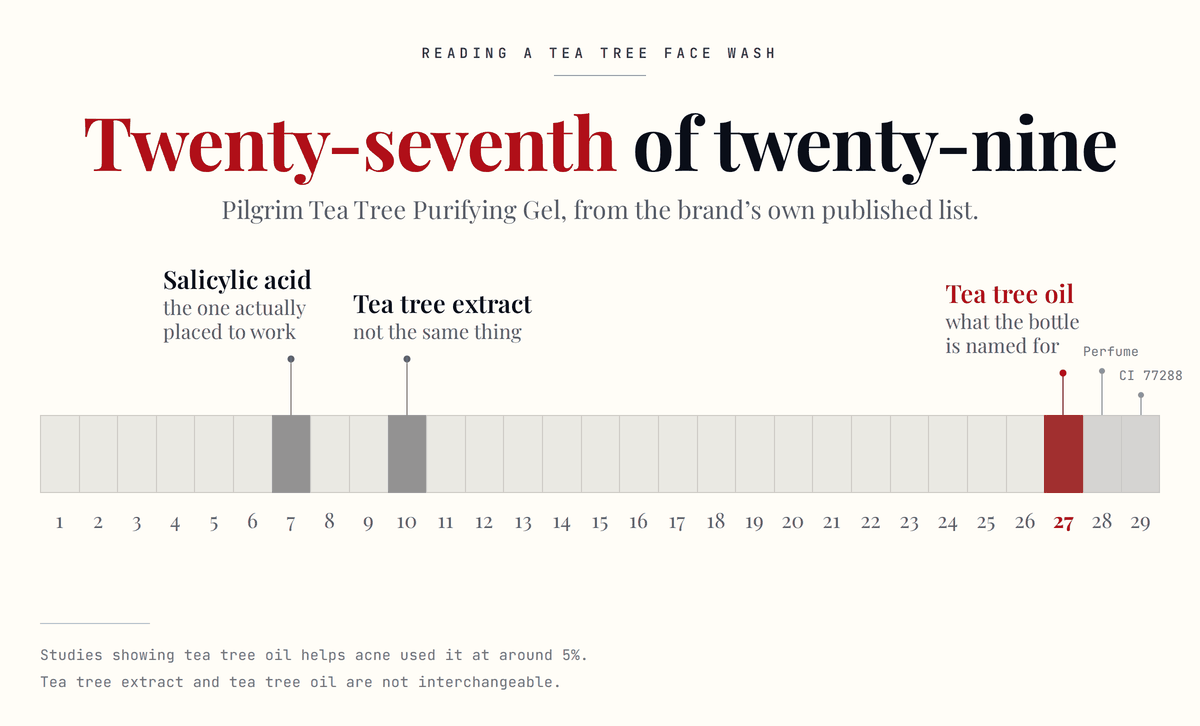
This product is named for tea tree, branded around tea tree, and sold on tea tree. Melaleuca alternifolia leaf oil — the actual active form, the one with published evidence behind it — appears third from last in the ingredient list, after tocopheryl acetate and immediately before the perfume. A separate tea tree leaf extract appears higher up, around position ten, but extract and oil are not interchangeable; the studies showing benefit in acne used the oil at meaningful concentrations, most commonly 5%.
Whatever is in this bottle is not that. And notably, the ingredient actually positioned to do something is the salicylic acid at position seven, which the packaging barely mentions.
The rest of the formula is unobjectionable — sodium lauroyl sarcosinate and cocamidopropyl betaine, centella asiatica, aloe, green tea, panthenol, allantoin. As a cheap, mild, mildly exfoliating cleanser, it is perfectly decent, and it is priced like one. The objection is not to the product. It is that the bottle is sold on an ingredient the formula contains only a trace of.
Who should skip it: anyone buying it specifically for tea tree. If that is what you want, you want a product that declares a percentage. Also contains perfume and CI 77288, a green colourant that exists to make the gel look herbal.
Plum Green Tea Pore Cleansing Face Wash
The biggest surprise on this page is in the first two ingredients.
Plum‘s own list opens with water and then sodium laureth sulfate, followed by cocamidopropyl betaine and cocamide DEA. That is a sulfate-led base, the same family as the Cetaphil below, and of the products under ₹500 only The Derma Co’s is in the same league for cleansing strength. Sulfates are not dangerous, as I say in the Cetaphil section, but a sulfate base is the opposite of what most people expect from this brand, and it matters on skin that already feels tight after washing.
The green tea in the name sits eighth, after the pH adjuster. Just behind it is glycolic acid, which the product name does not mention, and cellulose beads, a physical scrub (plant-based, not plastic microbeads). So this is an acid wash and a bead scrub at once, on a sulfate base. That is a lot of cleaning for a product used twice a day.
It ends with fragrance and two dyes, CI 19140 and CI 42090, which is where the green colour comes from.
Who should skip it: anyone with sensitive, dry-patched or acne-treated skin, and anyone already using an exfoliating acid. Robust, very oily skin may like the squeaky finish. Everyone else has gentler options on this page for the same money.
CeraVe Foaming Cleanser
Also above the ₹500 band, though its smallest bottle is only just over it. I’ve included it because it is the obvious alternative to the Cetaphil below, and the comparison is the point.
What a pharmacy-brand cleanser should look like, and the reason the Cetaphil below is hard to defend.
The base on CeraVe India‘s own list is cocamidopropyl hydroxysultaine, sodium lauroyl sarcosinate and sodium methyl cocoyl taurate: gentle and sulfate-free. Niacinamide sits sixth. Further down come three ceramides (NP, AP and EOP), cholesterol and phytosphingosine, the combination CeraVe is known for, plus hydrolysed hyaluronic acid. No fragrance and no dyes. It is preserved with parabens, which, as I say in the Cetaphil section, are among the better-studied preservatives in cosmetics.
Hold the ceramides and niacinamide to the same standard as every active on this page. They are in a rinse-off product, so most of them go down the drain, and they are not the reason to buy it. The reason is the base: it cleans gently and leaves nothing behind that you would rather not have.
Who should skip it: anyone who wants an acid in their cleanser, and anyone who does not want to pay a pharmacy price. The Minimalist and the Re’equil get you most of the way for less. But if you want the pharmacy-brand option, this is the one to buy.
Cetaphil Oily Skin Cleanser
This one sits above the ₹500 band — comfortably so. I’ve included it anyway because it is the product most people in this category are told to buy, and leaving it out would dodge the question.
The most widely recommended product in this category, and the one I would think hardest about.
Cetaphil has genuine standing. It is widely stocked, it gets recommended across dermatology clinics, and the brand’s reputation for gentleness was earned over decades. So it is worth reading the panel for this particular product carefully, because it is not the one that built the reputation.
From the Indian listing: purified water, PEG-200 hydrogenated glyceryl palmate and PEG-7 glyceryl cocoate, sodium lauroyl sarcosinate, an acrylates copolymer, glycerin, sodium laureth sulfate, butylene glycol, phenoxyethanol, dexpanthenol, methyl parahydroxybenzoate, PEG-60 hydrogenated castor oil, fragrance, disodium EDTA.
That is a sulfate-containing, fragranced, paraben-preserved detergent cleanser. None of those three things is dangerous — sulfates are not the villain the internet made them, parabens are among the better-studied preservatives in cosmetics, and fragrance is only a problem if you react to it. It also contains no acne active at all, which, by the argument of this post, barely counts against it; a cleanser was never going to treat your acne anyway.
The objection is narrower than that, and harder to answer. For well over twice the price of the Minimalist, you get a harsher cleansing base, added fragrance, and nothing else on top. Take the actives out of the comparison entirely — which is roughly where this post started — and Cetaphil still loses on the thing that actually matters in a rinse-off product: how gently it cleans and what it leaves behind.
You are paying for the pharmacy shelf and the name.
Who should skip it: most people reading this. It remains a defensible choice if you have used it for years, it suits you, and you do not want to experiment — that is a real reason, and I would not talk anyone out of it. But nobody should start here.
If you only want one answer
Buy the Minimalist. It is the best-formulated cleanser in the category at any price near this one; it discloses what is in it, and it sits comfortably inside the ₹500 band.
If your skin is sensitive, or you are already running a leave-on active and don’t want a second acid, buy the Re’equil instead and don’t feel you are settling — for daily maintenance it may well be the better product.
If money is the binding constraint, the Deconstruct does the job for less, as long as the cooling sensation doesn’t bother you.
And if you want a pharmacy brand regardless, buy the CeraVe, not the Cetaphil.
And whichever you choose, the cleanser is not the part of your routine that will clear your skin. If you are only going to spend properly on one product, spend it on sunscreen — post-acne marks darken and persist with UV exposure, and no face wash will outrun that. The step after cleansing that actually moves the needle on marks and texture is a leave-on serum, where the contact time exists for an active to do its work. The step after that is a gel moisturiser — oily skin still needs water, and the tight feeling after washing is the short-of-water kind. And if it was the salicylic acid on the front of the bottle you were counting on, it only earns its keep in a salicylic acid serum, where it stays on the skin long enough to get into the pore.
Common questions
Should I wash my face twice a day, or more?
Twice — morning and night — plus after heavy sweating. More than that, particularly with an acid cleanser, tends to produce the tight-then-oily cycle people mistake for their skin “needing” more washing.
Does a higher salicylic percentage in a face wash work better?
Not reliably, and not proportionally. Contact time is the limiting factor, not concentration. A 2% rinse-off cleanser is not twice a 1% one in any meaningful sense, and neither approaches a 2% leave-on serum.
Is “dermatologically tested” a meaningful claim?
Close to meaningless as a guide to whether a product will suit you. There is no published standard specifying what the testing must involve, how many people it must cover, or what result it must produce — so two products carrying the identical phrase may have been through entirely different processes. It tells you a dermatologist was involved somewhere in the product’s development. It does not tell you the product is gentle, effective, or right for your skin.
Can I use a salicylic face wash with a retinoid?
Usually yes, but not on the same night when you are starting out. Introduce one at a time, and if your skin is stinging or flaking, the cleanser is the easier of the two to switch to something plain.
Do I need a separate acne face wash at all?
Probably not. If you have a good leave-on treatment, a plain gentle cleanser is entirely sufficient, and arguably preferable — it leaves the active work to the product that can actually do it.
What is the best face wash for oily skin that isn’t acne-prone?
You don’t need an acid at all. Oily skin that isn’t breaking out is better served by a mild, well-built cleanser used twice a day. The Re’equil is the pick for that here, and the CeraVe if you want a pharmacy brand.
Prices and formulations were verified against the brands’ own product listings at the time of writing and change frequently. Nothing here is medical advice; persistent or scarring acne warrants a dermatologist.