Best Salicylic Acid Serum for Acne in India Under ₹700
Some links here may be affiliate links. Where they are, a purchase can earn Aryeva a commission at no extra cost to you — it never affects the picks. Prices and formulations change; everything below was checked against the brands’ own ingredient listings at the time of writing.
Short answer: The Derma Co 2% Salicylic Acid Face Serum is the best salicylic acid serum for acne in India under ₹700. It is the plainest formula here, it is well made, and it does exactly the one thing it says on the bottle. If plain acids are too harsh for your skin, pick Plum 2% Encapsulated Salicylic Acid. If you want the shortest ingredient list from an Indian brand, pick Suganda BHA Exfoliating Serum, knowing the brand does not print its percentage.
How this list was checked. Each ingredient list was read from the brand’s own product page, not a marketplace listing. Prices were re-checked on 24 October 2026, on the brands’ own sites, or on Amazon or Nykaa where the brand site does not show one. This is a reading of labels, not a wear test. The full method is under “What I looked at” below.
Every bottle in this post says 2% on the front. That number is close to the least useful thing on the label.
Salicylic acid is a beta hydroxy acid, and unlike niacinamide or glycerin, it barely dissolves in water. Getting two per cent of it into a 30ml bottle and keeping it dissolved there takes real formulation work, and the different ways brands do that work produce products that feel different, sting differently, and suit different people. The ingredient list tells you which route a brand took. The front of the bottle never does.
So this post does what the last four did. It reads the panel. Every product here was checked against the brand’s own current page, not a marketplace listing and not an ingredient decoder, because those go stale and this category has been moving fast.
Ten serums under ₹700 came out of that worth recommending, plus one that costs considerably more and earns its place for a reason that will make sense by the end. One popular product did not make the list, and the reason is sitting in its own ingredient list.
Why salicylic acid is harder to bottle than niacinamide
Niacinamide dissolves in water. You can put ten per cent of it in a bottle with almost nothing else, and it stays there. That is why the niacinamide serums I looked at earlier look so similar to one another.
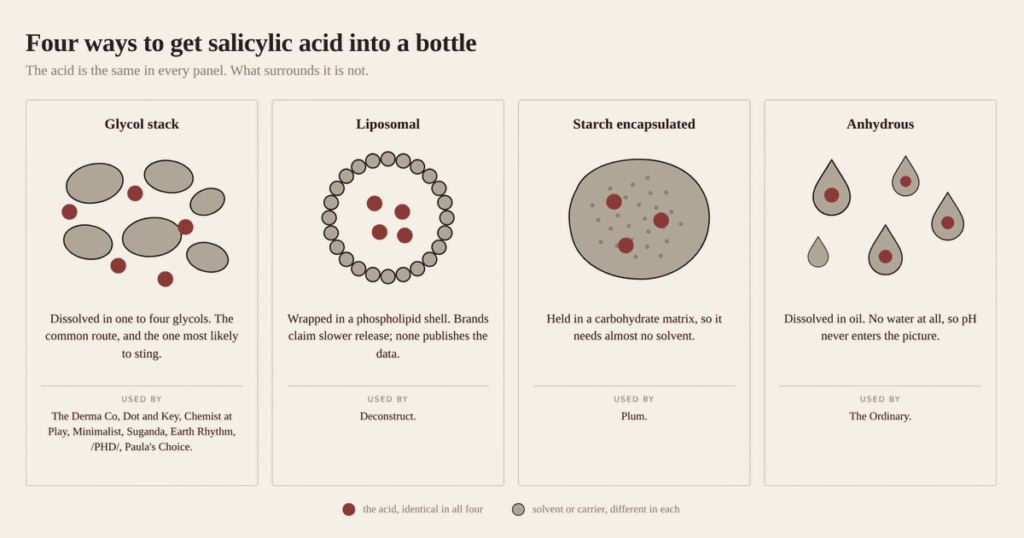
Salicylic acid does not behave that way. At room temperature, water will hold well under one per cent of it. To get to two per cent and keep it stable for two years on a shelf in an Indian summer, a formulator has to do one of four things, and each one leaves a signature you can read.
The most common route is to add solvents. Propanediol, propylene glycol, dimethyl isosorbide, ethoxydiglycol, butylene glycol. These are the glycols, and they are there to hold the acid in solution. When you see two or three of them stacked at the top of an ingredient list, above the salicylic acid itself, that is not filler. That is the machinery.
The second route is to encapsulate the acid, wrapping it so it does not need to be dissolved at all. The third is a variation on the second using fat-based shells rather than sugars. The fourth is to skip water altogether and dissolve the acid in oil, which it likes far better than water.
Four routes, four quite different products, and the same “2%” on every carton.
What sits above the acid, and why it matters
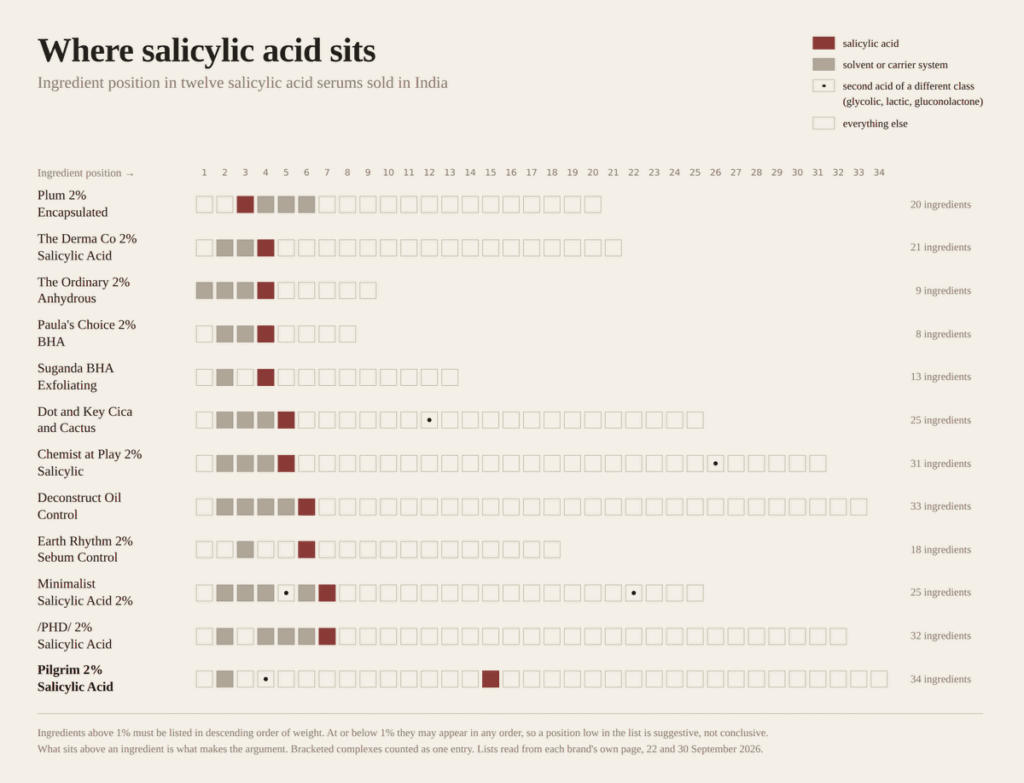
Here is the top of each panel, in order, with the position salicylic acid occupies. The chart below the table extends the same reading to all twelve products I looked at, including the one I left out.
| Serum | What sits above the acid | Acid at position |
|---|---|---|
| Plum | glycerin | 3 |
| Suganda | one glycol | 4 |
| The Derma Co | two glycols | 4 |
| The Ordinary | squalane, fractionated coconut, one glycol | 4 |
| Dot and Key | three glycols | 5 |
| Chemist at Play | three glycols | 5 |
| Deconstruct | phospholipids, PEG-20, glycerides | 6 |
| Earth Rhythm | aloe, one glycol | 6 |
| Minimalist | four glycols and glycolic acid | 7 |
| PHD | four glycols | 7 |
Read down that column and the four routes separate cleanly. Plum sits high because its acid is wrapped in a starch matrix and does not need a solvent load. Deconstruct sits behind the phospholipids because those phospholipids form the liposome wall that does the wrapping. The Ordinary sits behind two oils because the whole product is oil. Everyone else is running the glycol stack, and the spread inside that stack is wider than it looks: Suganda runs one glycol above the acid, PHD runs four.
None of this makes any of them bad. It makes them different, and it means the phrase “2% salicylic serum” describes a category about as precisely as “a car with four wheels”.
Two of these contain an acid the front label does not name
This is the part worth reading twice.
Minimalist’s serum is sold as Salicylic Acid 2%. On its panel, glycolic acid sits at position five and salicylic acid at position seven. Glycolic acid is an AHA, a different acid with a different job and a different irritation profile, and it is ahead of the acid the product is named after. Lactic acid appears further down as well. It is a well-built AHA and BHA blend. It is not sold as one.
Dot and Key’s serum includes gluconolactone, a PHA, at position twelve. Low enough that it is probably doing little, but it is a third acid class in a bottle whose front label names one.
Chemist at Play also blends, with lactic acid near the end of its list. The difference is that Chemist at Play prints “with Lactic Acid” on the bottle. That is the whole distinction, and it is why this section is not an accusation. Combining acids is good formulation. Not saying so is a labelling choice.
If you have been avoiding AHAs because they sting, or because you are also using a retinoid, this matters to you, and the front of the bottle will not tell you.
The one I left out
Pilgrim’s 2% Salicylic Acid Anti-Acne Face Serum is the cheapest serious option in this category, and it is on a permanent discount that makes it cheaper still. I am not recommending it, and I want to be exact about why.
On Pilgrim’s own ingredient list, salicylic acid appears at position fifteen. Above it sit glycolic acid at position four and eight plant ingredients: seven extracts and a ferment filtrate.
Here is the rule that makes that interesting. Ingredient lists run in descending order of weight, but only down to one per cent. Below one per cent, a brand may list ingredients in any order it likes. So an ingredient present at two per cent should normally appear above everything present at less than two per cent.
Position fifteen does not prove anything on its own. It would be consistent with a two per cent claim if all fourteen ingredients above it were also present at two per cent or more, and I cannot rule that out, because Pilgrim publishes no breakdown. What I can say is that fourteen ingredients above the acid, eight of them plant extracts or ferments, is hard to square with the number on the front of the bottle. The box does name the second acid, as a 3% glycolic acid complex, so that part is not hidden. But if the glycolic acid is at 3% and the salicylic acid at 2%, the ten ingredients listed between them would each need to be at 2% or more.
Draw your own conclusion. I have drawn mine, which is that there are seven products in this post I would reach for first.
What an ingredient list cannot tell you
Two honest limits, because a post that only tells you what it can prove is more useful than one that pretends.
The first is pH. For any water-based salicylic acid, pH governs how much of the acid is in the free form that actually does the exfoliating. A 2% BHA at pH 3.5 and a 2% BHA at pH 5 are meaningfully different products. Not one Indian brand in this post publishes its pH. Encapsulated and anhydrous products sidestep the question because the acid is not sitting in water waiting to be ionised, which is a quiet advantage for Plum, Deconstruct and The Ordinary that none of them advertises.
The second is that a panel shows order, not dose, once you drop below one per cent. It tells you what a formulator prioritised. It does not tell you how much of anything is in the bottle unless the brand chooses to say, and most do not. Deconstruct publishes both its percentages. That is worth something.
A longer piece on how to read an Indian skincare label is coming. Until it lands, the paragraph above is the short version.
What I looked at
Every leave-on salicylic serum sold in India under ₹700 that publishes a full ingredient list on its own website. That last clause now excludes five of them. Dermatouch names three actives and prints no list at all. Fixderma’s Acne Defence serum puts salicylic, azelaic and mandelic acid on the front, and I went through its product page, its tabs, its collection page and a site search without finding an ingredient list anywhere. Plix’s Jamun serum tells you to read the pack or contact customer care. Bombay Shaving Company’s two-in-one serum names salicylic acid without a percentage. mCaffeine’s coffee BHA lists its actives and stops. Their formulas may be excellent. I have no way to tell you, and neither do you, so none of them is here.
I also excluded rinse-off products entirely. A face wash with salicylic acid in it is a face wash, and the acne face wash roundup explains why the acid in it is doing much less than the bottle implies. Spot treatments and peeling solutions are a different use pattern and a different post.
Two products qualified on every count but were sold out on their own sites when this guide was first written. Dr Sheth’s Neem and 2% Salicylic Acid ampoule was still sold out on 24 October 2026, nearly a month later, so it stays out: I am not recommending something you cannot buy. Hyphen’s anti-acne serum was back in stock by then. It leads on 10% azelaic acid, and salicylic acid sits ninth of sixteen on its panel, behind the azelaic and three solvents, so treat it as an azelaic acid serum with some salicylic rather than a salicylic serum. It is worth a look if azelaic acid is what you are after.
These ten are not ranked.
The Derma Co 2% Salicylic Acid Face Serum
The plainest serum here, and that is a compliment. Water, two glycols, the acid at position four, and then twenty-odd ingredients of support. Witch hazel and willow bark both appear, but far enough down that they are marketing echoes of the active rather than a second source of it.
There is nothing clever happening. There does not need to be. This is the formulation textbook answer to the question of how to get 2% salicylic acid into a stable bottle, executed without ornament.
Who it suits: anyone starting out who wants a BHA and nothing else in the bottle. If you are already using a niacinamide serum, this keeps the two separate, so you control the dose of each.
Who should skip it: if glycols sting you, and for some people they do, this has two of them high on the list, and you will feel them.
Dot and Key Cica and Cactus 2% Salicylic and Zinc
The acid sits at position five behind three glycols, followed by a seven-botanical ferment complex, cica, zinc PCA, and niacinamide. Busy, but coherently busy, and everything in it pointing in the same direction.
Two things to note. The gluconolactone at position twelve is a third acid, as described above. And unlike the Dot and Key moisturiser I looked at in the gel moisturiser roundup, this panel carries no colourant and no fragrance, which is a genuine improvement.
Who it suits: oily, reactive skin that wants soothing ingredients in the same bottle as the acid rather than layered on after.
Who should skip it: anyone patch-testing their way through a reaction. Thirty ingredients is thirty suspects.
Chemist at Play 2% Salicylic Acid with Lactic Acid
Three solvents above the acid at position five, then zinc PCA, a run of extracts, and rice phytoceramides, konjac ceramide, and sphingolipids in the back half. The ceramides fit the brand’s whole positioning, and they are a sensible thing to put alongside an exfoliant, since the complaint people have about BHAs is a compromised barrier.
The lactic acid sits near the end of the list, so it is a low-level addition rather than a co-star. The brand says so on the bottle anyway. After the section above, you will understand why that earns it a mention.
Who it suits: people whose skin gets tight and flaky the moment they start exfoliating.
Who should skip it: if you are already layering a separate ceramide moisturiser, you are paying for an overlap.
Minimalist Salicylic Acid 2% Face Serum
A four-glycol stack, glycolic acid at position five, salicylic at seven, lactic further down. Read purely as a formula, this is the most sophisticated thing in the list, a properly built multi-acid exfoliant with a peptide and a green tea derivative along for the ride.
Read as a label, it is the product I have the most trouble with, because nothing on the front says AHA. Someone buying it to avoid glycolic acid is buying glycolic acid.
It is still a recommendation, because the formula is good and the brand publishes the full list, which is how I was able to tell you this at all. Buy it knowing what it is.
Who it suits: skin that has used acids before and wants both classes in one step. The smallest size is the cheapest honest way to test this whole category on your own face.
Who should skip it: first-time exfoliators, anyone on a retinoid, and anyone whose skin has told them AHAs are not for them.
Suganda BHA Exfoliating Serum
Thirteen ingredients. Water, propylene glycol, betaine, and then the acid at position four. After that it is olive leaf, green tea, centella, a preservative pair, a thickener and a chelator, and that is the entire product.
One solvent sits above the acid. That is the lightest load of any water-based serum here, and it is the closest thing the Indian market offers to what Paula’s Choice is doing further down this page, at a fraction of the price.
One thing to know, and it cuts both ways. Suganda does not print a percentage on its own product page. The 2% figure attached to this serum across the internet comes from marketplace listings, not from the brand. A panel this short is unusually easy to read, and the brand still leaves out the single number most people want.
Who it suits: anyone who wants the fewest possible ingredients on their face and does not need a stated strength to feel confident.
Who should skip it: if you want the percentage on the label, or if propylene glycol is the solvent that stings you, this is not the one.
Earth Rhythm 2% Salicylic Acid Sebum Control Serum
The only serum in this post that does not begin with water. Aloe leaf extract is first, water second, propanediol third, green tea fourth, willow bark fifth, and the acid sixth of eighteen.
Willow bark is worth a sentence, because it turns up on a lot of these labels. It contains salicin, a relative of salicylic acid, and in a product that already declares salicylic acid separately it is doing very little except making the front of the bottle sound more botanical. The Derma Co carries it too, equally far down.
What makes this one worth having in the list is the single glycol. One solvent above the acid, against four in the serum immediately below, with the same strength claimed on both bottles. That is the argument of this whole post in two products.
Who it suits: people who react to heavy glycol loads but still want a plain water-based BHA rather than an encapsulated or oil-based one.
Who should skip it: the smaller size has been out of stock on the brand’s own site, so check what is actually available before you plan a routine around it.
PHD 2% Salicylic Acid Anti-Acne Serum
Four glycols above the acid, which is the deepest solvent stack in this post. Butylene glycol at two, pentylene glycol at four, methyl gluceth-20 at five and propylene glycol at six, with niacinamide at three, and salicylic acid seventh of thirty-two.
That is not a criticism on its own. The acid has to be dissolved in something, and a brand that wants it to stay dissolved and stay comfortable will reach for more than one solvent. Put this panel next to Earth Rhythm’s above and you have the clearest illustration this post can offer of how far apart two serums can be while printing the same number on the front.
Something else is worth pointing out, because I did not expect it. Read this panel alongside Chemist at Play’s and the back halves are close to identical: the same seaweed extract, the same centella, green tea, coffee, bergamot leaf and red pine, the same polylysine, the same two gums. Two brands do not usually arrive at that combination independently, and the ordinary explanation is a shared contract manufacturer. They are not the same product. The solvents differ, and Chemist at Play carries lactic acid where this one does not. But if you have tried one and it did not suit you, the other is a smaller change than the two labels suggest.
Who it suits: anyone who has used a plainer BHA and found it drying rather than stinging, since a heavier solvent system usually feels more cushioned on the skin.
Who should skip it: if glycols are the thing that irritates you, this has more of them than anything else here.
Plum 2% Encapsulated Salicylic Acid Face Serum
The acid is third, followed immediately by dextrin, polydextrose, and amylopectin. Those three carbohydrates are the capsule. The only glycol in the product is at position sixteen, which is the clearest possible demonstration of what encapsulation buys you: the acid does not need a heavy solvent load because it is not being asked to stay dissolved.
Encapsulation is usually sold as gentler, and the mechanism is real, though how much gentler depends on the specific system and no brand publishes release data.
Who it suits: people who have tried a plain BHA and found it too much. This is the obvious next thing to try before giving up on the ingredient.
Who should skip it: if a plain BHA already works for you, this is a more expensive way to get less sting you do not need.
Deconstruct Oil Control Serum with 3% Niacinamide and 2% Salicylic Acid
Phospholipids at position two are the liposome wall, with PEG-20 and glycerides completing the carrier before the acid at six. A different encapsulation route from Plum’s, sold under the same consumer-facing word, and the panel is how you tell them apart.
Deconstruct publishes both percentages, which almost nobody else here does. The serum was renamed from Pore Control Serum and the old link still resolves, so if you are comparing it against a review written last year, check you are looking at the same product.
Who it suits: anyone who wants the niacinamide and the BHA in one step and trusts the brand to have balanced them.
Who should skip it: if you already own a niacinamide serum, you are doubling up, and this is the most expensive of the Indian picks.
The Ordinary Salicylic Acid 2% Anhydrous Solution
Nine ingredients, and not one of them is water. The vehicle is squalane and fractionated coconut oil, with the acid at position four.
An oil-based product for oily, acne-prone skin sounds wrong, and it is worth sitting with why it is not. The same fractionated coconut turned up in the gel moisturiser roundup inside a product marketed as oil-free, which tells you how loosely that word is used. Squalane is well tolerated by most oily skin. And because there is no water, the pH question that hangs over every other serum in this post simply does not arise.
In India, it is sold through Nykaa rather than a storefront of The Ordinary’s own, so buy there or from another authorised seller rather than an open marketplace listing.
Who it suits: oily skin that has made peace with facial oils, and anyone whose skin reacts to glycols.
Who should skip it: if the texture of oil on your face bothers you, nothing else about this will win you over.
Worth the stretch: Paula’s Choice Skin Perfecting 2% BHA
This one sits well above the band and is included deliberately, as the acne face wash roundup did with its one out-of-band pick.
The entire ingredient list is eight items. Water, two glycol solvents, salicylic acid, a solubiliser, green tea, a pH adjuster, and a chelator. That is the whole product.
Now look back at The Derma Co entry. Water, two glycol solvents, the acid. It is the same architecture. The most recommended BHA in the world and a mid-priced Indian serum are built on the same principle, and the Indian one costs a fraction as much.
I am including Paula’s Choice because it is the benchmark, because it has two decades of use behind it, because the large size lasts most people the better part of a year, and because its own website prints the function of every single ingredient in brackets next to it, which is a standard I wish the rest of this list met. I am telling you it is the same architecture because that is true, and you should know it before you spend the money.
Who it suits: anyone who wants the reference product and will use the large size.
Who should skip it: anyone on a budget, which is most of the reason this site exists.
How to use a BHA without wrecking your skin
Patch test before you put it anywhere near your face. A little on the inner forearm or behind the jaw, once a day for three days, tells you whether your skin objects to the formula before you find that out across your whole face. It is a dull step, and almost nobody does it, which is part of why people conclude an ingredient does not suit them when what they reacted to was the vehicle.
Start twice a week at night. Not daily. The most common way people conclude that salicylic acid does not work for them is by using it every day from day one, inflaming their skin, and blaming the acid.
Build up over four to six weeks. Most people land somewhere between three nights a week and daily, and there is no prize for reaching daily.
Do not use it the same night as a retinoid. That is the single most reliable way to end up with a compromised barrier, and the beginner’s guide to retinol says the same thing from the other direction.
Wear sunscreen. BHAs increase sun sensitivity, and in Indian daylight that is not a theoretical problem. If you have not sorted that out yet, the sunscreen roundup is the place to start, and it matters more than which serum you pick.
Follow with a moisturiser. Exfoliating and then leaving skin bare is how the flaking starts, and the gel moisturiser roundup covers what to use if your skin is oily.
If you are pregnant or breastfeeding, ask a doctor. Advice on topical salicylates differs from advice on oral ones, and it is not my call to make for you.
If you only want one answer
Buy The Derma Co’s. It is the plainest, it is well made, it sits mid-pack on price, and it does exactly the one thing it says on the bottle with nothing else going on.
If your skin has already told you that plain acids are too harsh, buy Plum’s instead.
If you want to spend the least possible while finding out whether this ingredient suits you at all, buy the smallest size Minimalist sells, and read the section above so you know it has glycolic acid in it too.
If you want the shortest ingredient list any Indian brand here sells, buy Suganda’s, and go in knowing they do not print the percentage.
Common questions
Is 2% the strongest salicylic acid I can buy?
For a leave-on product sold over the counter, yes, and that is a regulatory ceiling rather than a formulation limit. Anything claiming more in a daily serum is either a rinse-off, a professional peel, or mislabelled. More is not better here.
Can I use salicylic acid with niacinamide?
Yes. Three of the products in this post contain both in the same bottle, which settles the question fairly conclusively.
Why does my salicylic serum sting?
Usually the solvents rather than the acid. Products with three or four glycols stacked above the acid deliver more of that sensation than encapsulated or oil-based ones. If a plain BHA stings and an encapsulated one does not, the acid was never the problem.
Is this purging or is it breaking me out?
Purging is less well evidenced than the internet suggests, so treat what follows as a rule of thumb rather than a fact. It tends to appear where you already break out and to settle within four to six weeks; a reaction tends to show up somewhere new, or to arrive with stinging and redness. Either way, if things are still getting worse after six weeks, stop.
Salicylic acid or benzoyl peroxide?
Different jobs. Salicylic acid is oil-soluble, gets into the pore and clears the blockage, so it works on blackheads, whiteheads, and congestion. Benzoyl peroxide kills the bacteria involved in inflamed acne. Persistent inflamed acne is a dermatologist visit, not a serum purchase.
How long before I see anything?
Texture and congestion: two to four weeks. Marks left behind by old spots take considerably longer, and salicylic acid is not really the right tool for those. The dark spot serum guide covers the ingredients that are.
Which salicylic acid serum is gentlest?
The Plum 2% Encapsulated. Encapsulation is usually sold as gentler, and the mechanism is real, but no brand publishes release data, so nobody outside the lab can say how much gentler. It is the one to try if plain acid serums have stung or flaked your skin before.
Nothing in this post is sponsored, and nothing here was tested on my own skin. Every ingredient list was read from the brand’s own website on 22 September 2026, and formulations change without notice. If a panel has changed since then, the brand’s page is right, and I am wrong. Corrected 28 September 2026: an earlier version said Pilgrim’s front label names only salicylic acid. The box also names a 3% glycolic acid complex. It also said ten botanical extracts sit above the salicylic acid; the correct count is eight, seven extracts and a ferment filtrate.