Best Sunscreen for Oily Skin in India Under ₹500
Some links here are affiliate links — if you buy through one, Aryeva may earn a commission. It never affects the picks.
In a hurry — the five, ranked:
- Deconstruct Gel Sunscreen — best overall for oily, acne-prone skin
- Dot & Key Watermelon Cooling — the strongest UVA line-up here
- Minimalist Multi-Vitamin SPF 50 — the most transparent testing
- Re’equil Ultra Matte Dry Touch — the truest matte finish
- Re’equil Oxybenzone & OMC Free — for skin the Ultra Matte left tight
All five were under ₹500 at the time of writing. The reasoning for each is below.
What “for oily skin” actually means on a sunscreen label
Almost nothing, legally. “Non-comedogenic,” “oil-free,” and “matte” aren’t regulated claims in India or anywhere else — a brand can print them on a formula that breaks you out within a week. They’re marketing, not specification.
What actually determines how a sunscreen behaves on oily skin is three things, none of which appear on the front of the bottle.
The filter system
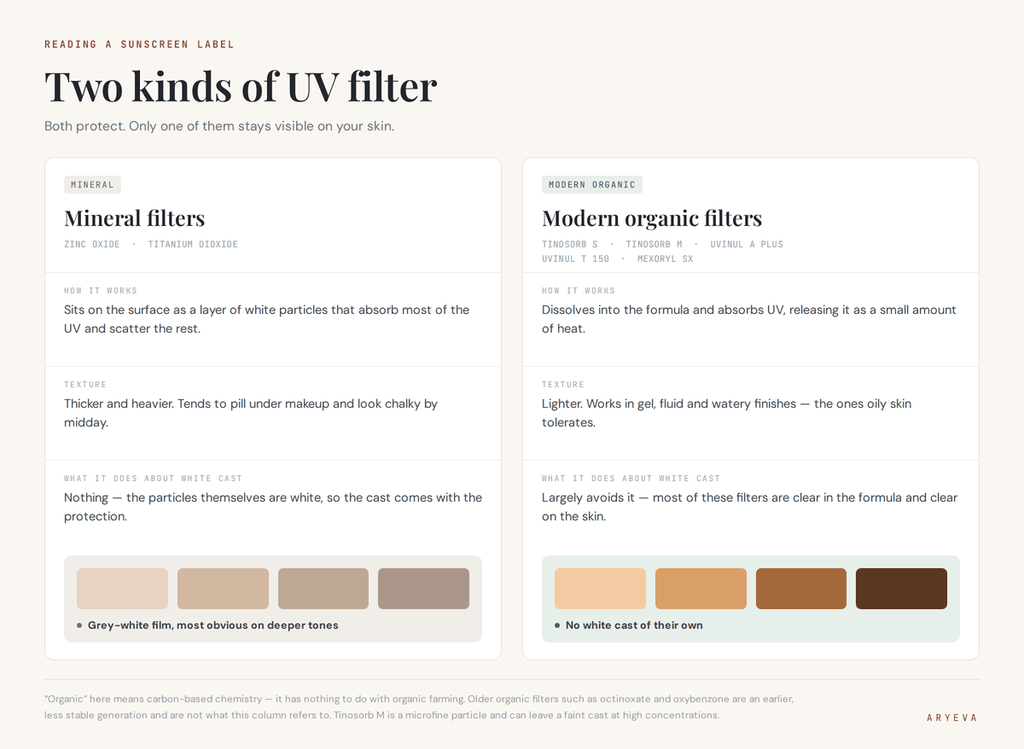
Sunscreen filters fall into two broad families.
Mineral filters — zinc oxide and titanium dioxide — sit mostly on the skin’s surface, where they absorb most of the UV that hits them and scatter the rest. The “they reflect light like a mirror” line you’ll see repeated everywhere isn’t accurate.
They’re gentle and stable, which is why dermatologists like them for sensitive skin. They’re also the reason for the white cast: they’re white powders, and on medium- to deep-toned skin, that shows.
Newer ones, which you’ll see on Indian labels as Tinosorb S, Tinosorb M, Uvinul A Plus, Uvinul T 150, and Mexoryl SX, are photostable, cosmetically elegant, and leave little to no cast.
If white cast is your main complaint, a formula built on the newer organic filters will almost always solve it.
SPF is only half the rating
SPF measures protection from UVB — the wavelength that burns. It says nothing about UVA, which penetrates deeper, drives pigmentation and photoageing, and passes straight through window glass.
UVA protection is shown as the PA rating. More plus signs, more protection, up to PA++++.
In India, where pigmentation and tanning are the complaints people actually bring to dermatologists more often than sunburn, the PA rating arguably matters more than the SPF number. SPF 50 PA++++ is the standard to look for. An SPF 50 with only PA++ is doing half the job.
What’s carrying the filters
Two sunscreens with identical filters can feel completely different depending on the base. For oily skin, the things to look for:
- Gel or fluid textures rather than creams or lotions.
- Silicones (dimethicone, cyclopentasiloxane) high in the list — they give that dry, smooth finish and help control shine.
- Silica or similar powders that absorb oil throughout the day.
- Alcohol denat in the first few ingredients — this is the trade-off. It’s what makes many gel sunscreens feel weightless and dry down fast. It also stings compromised skin and can be drying with daily use. Worth knowing before you buy, not after.
How I ranked them
Ranked for an oily-to-combination, acne-prone reader in Indian sun — change that reader and the order changes.
The criteria, in the order they mattered:
- Filter system and photostability — which filters, and whether any pairing degrades under UV.
- UVA protection — PA++++ versus PA+++, because pigmentation and tanning are why most Indian readers buy sunscreen at all.
- Irritant load — fragrance, cooling agents, anything that inflames skin already inflamed.
- Base and finish — silicone film versus water-based gel versus richer emulsion, and what removal each demands.
- Published evidence — whether the brand prints an in-vivo number anyone can check.
No product’s position here reflects commission.
The filter decks at a glance
Not one of these five contains alcohol denat. Worth noting, because “sunscreens are full of drying alcohol” is one of the most repeated lines in Indian beauty content, and it doesn’t survive contact with these five labels.
I haven’t used all five of these myself. What follows is a reading of the published ingredient lists and test data, cross-checked against a second source where one exists. Ingredient order tells you a great deal about a formula and nothing about how it behaves on one particular face.
| Product | UV filters | Alcohol denat. | Silica | Fragrance |
|---|---|---|---|---|
| Deconstruct Gel | Uvinul A Plus, Uvinul T 150, Tinosorb S, Tinosorb M, Octisalate | None | Hydrated silica, late | None |
| Dot & Key Watermelon | Uvinul A Plus, Uvinul T 150, Tinosorb S, Tinosorb M, Mexoryl SX, Titanium Dioxide | None | Yes, mid-list | None |
| Minimalist Multi-Vitamin | Uvinul T 150, Avobenzone, Octocrylene, Titanium Dioxide | None | Yes, late | None |
| Re’equil Ultra Matte | Octinoxate, Uvasorb HEB, Uvinul A Plus, Tinosorb S, Zinc Oxide, Titanium Dioxide | None | Alumina, polymethylsilsesquioxane | Parfum |
| Re’equil OMC-Free | Octocrylene, Octisalate, Tinosorb S, Tinosorb M, Tinosorb A2B | None | Silica silylate | Yes |
1. Deconstruct Gel Sunscreen for Oily Skin
On the label alone, this is the one I’d point a friend with oily, acne-prone skin towards first.
What it is. A water-based gel built on four new-generation UV filters.
What the label tells you. Five UV filters: Uvinul A Plus (DHHB), Uvinul T 150 (ethylhexyl triazone), Tinosorb S, Tinosorb M, and octisalate. Deconstruct builds the formula around the first four and describes the result as photostable. SPF 50 PA++++, tested in vivo. No fragrance. The emollients are squalane and coco-caprylate rather than heavy esters, and hydrated silica sits late in the list — mattifying without being the point of the product.
Who it suits. Oily and combination skin that breaks out, especially anyone who struggles to wash off the heavier, silicone-forward textures common at this price.
Who should skip it. Anyone dealing with malassezia folliculitis — the phospholipids, polysorbate 80, and sorbitan olivate are all on the caution lists for it.
One honest demerit. Deconstruct says the product is tested in vivo and in vitro but does not publish the number, which puts it a step behind Minimalist and Dot & Key on transparency.
2. Dot & Key Watermelon Cooling
On filters alone, this is the most comprehensive UV-filter lineup on the list. One ingredient keeps it out of first place.
What it is. SPF 50+ PA++++, six UV filters, lightweight water-based gel.
What the label tells you. DHHB, ethylhexyl triazone, Tinosorb S, Tinosorb M, Mexoryl SX, and titanium dioxide — each of these is a photostable filter, and there’s no octinoxate, no avobenzone, no octocrylene. Dot & Key also publishes its actual test results rather than just the rounded claim: in-vivo SPF 63, UVA-PF 21.5, critical wavelength 378 nm. Very few brands in this bracket do. Despite the name, there is no parfum: the watermelon is an extract. What does appear is menthyl lactate, which is what produces the cooling sensation. It’s worth avoiding if your skin is already irritated or highly reactive.
Who it suits. Oily, acne-prone skin, and anyone who wants the strongest UVA deck in this bracket.
Who should skip it. Anyone whose skin is currently irritated — including anyone using tretinoin, adapalene or benzoyl peroxide — because the menthyl lactate will sting. And anyone managing malassezia folliculitis: lecithin sits high in this formula, so the same caution applies here as to the Deconstruct gel.
Don’t confuse it with the Barrier Repair variant — they’re sold under the same SPF 50+ PA++++ headline and are not interchangeable.
3. Minimalist Multi-Vitamin SPF 50
The most honest label of the five, attached to the weakest filter deck in the top three.
What it is. SPF 50 PA++++, four UV filters, lotion-textured emulsion.
What the label tells you. Minimalist reports an in-vivo SPF of 56.6, tested to ISO 24444:2019, where anyone can check it — no other brand here is that direct. The supporting cast is well matched to acne-prone skin: niacinamide, panthenol, and linoleic acid, which matters because linoleic acid deficiency in sebum is part of how comedones form.
The filters are the problem. Avobenzone stabilised with octocrylene is older filter technology. Octocrylene is the main compromise here, and it has a longer track record of reported sensitivity than the newer filters. It’s also the second ingredient in the formula, behind only water — this isn’t a trace amount. So it’s worth noting if you’ve reacted to a sunscreen before. The glyceryl stearate, PEG-100 stearate, and behenyl alcohol base is also a richer emulsion than the two products above it.
Who it suits. Acne-prone skin that is not especially oily, and anyone who wants published numbers over marketing claims.
Who should skip it. Anyone who wants a true matte finish, and anyone who has ever reacted to octocrylene.
If filters are criterion one, you may wonder how this outranks a six-filter product. Irritant load and removability broke the tie: a sunscreen you wash off badly is a sunscreen you will skip.
The trap to avoid. Minimalist’s “Multi-Vitamin SPF 50” and their “SPF 50 PA++++” carry identical ingredient lists on Minimalist’s own site as of September 2026 — the multi-vitamin is niacinamide, panthenol, tocopheryl acetate, and linoleic/linolenic acid, not a separate formula. Several competing posts review them as two products.
4. Re’equil Ultra Matte Dry Touch
This is where the label and the consensus recommendation pull in different directions.
What it is. SPF 50 PA++++, six UV filters, anhydrous silicone gel.
What the label tells you. Octinoxate sits third in the INCI. The six-filter system is octinoxate, Uvasorb HEB (diethylhexyl butamido triazone), zinc oxide, DHHB, titanium dioxide, and Tinosorb S. There is no avobenzone in the formula, so the usual objection to octinoxate — that it degrades avobenzone — does not apply here. Octinoxate is not especially photostable on its own, though, so having no partner to destabilise is not quite a clean bill of health. There’s a second wrinkle, too: zinc oxide can destabilise octinoxate, and this formula contains both. “No avobenzone” removes one objection, not all of them.
The problem is everything after the filters. This is a silicone film — cyclopentasiloxane, dimethicone crosspolymer, caprylyl methicone, simethicone, polymethylsilsesquioxane — plus tapioca starch and alumina. That is why the matte finish is so convincing, and it is also a film that does not come off with a face wash. It carries parfum as well, which matters more in a leave-on product you are meant to reapply throughout the day.
Who it suits. Very oily skin that wants a genuinely matte finish and already double-cleanses every night.
Who should skip it. Anyone who does not double-cleanse, anyone with known fragrance sensitivity, and anyone with dry or dehydrated skin — this may make dryness more noticeable.
The matte finish is real, and so is the cleanup.
5. Re’equil Oxybenzone & OMC Free
A sound formula with one number that decides its place.
What it is. SPF 50 PA+++, five UV filters, cetyl/stearyl alcohol emulsion.
What the label tells you. Re’equil’s own page says PA+++, and that is the whole story. PA+++ corresponds to a PPD of 8–15; PA++++ is 16 or higher. For a reader whose actual reason for buying sunscreen is pigmentation, melasma, and tanning, that is the number that matters most, and this is the only product on the list that does not clear the top band.
The rest of the formula is genuinely good: octocrylene, octisalate, Tinosorb S, Tinosorb M, and Tinosorb A2B, with no avobenzone and a filter system built around photostable modern filters. It does carry fragrance — Re’equil’s own page describes “a mild and soothing fragrance” — and the cetyl/stearyl alcohol base makes it the richer sibling.
Who it suits. Anyone whose skin the Ultra Matte left tight and flaking; drier skin that still wants broad-spectrum cover.
Who should skip it. Anyone whose primary concern is pigmentation or tanning — send them up the list. Anyone with known fragrance sensitivity, since this one is scented. And octocrylene is in this one too, so the same caveat applies if you’ve reacted to it before.
The PA+++ point is a clean differentiator. It is printed on the brand’s own page, and almost every competing roundup reports this product as a straight PA++++ alternative to the Ultra Matte.
The part almost everyone gets wrong
You can buy the best sunscreen on this list and still get only a fraction of the protection printed on the bottle, because SPF is measured at an application density most people never come close to achieving.
The lab standard is 2 mg per square centimetre of skin. For a face, that works out to roughly a quarter teaspoon — add a little more if you’re covering your neck too — or, the version that’s easier to remember, two full finger-lengths of product squeezed onto your index and middle fingers.
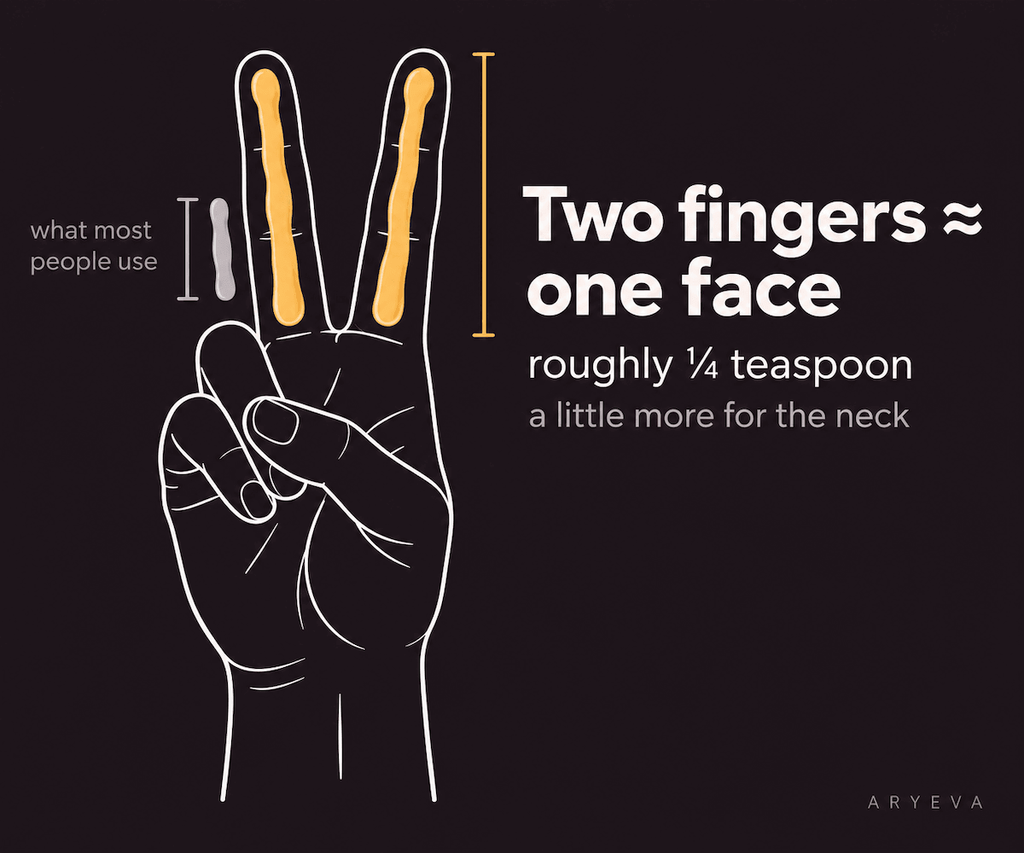
It will feel like far too much the first time. It isn’t. Applying half that amount gives you meaningfully less than half the protection.
Two things that matter as much as quantity:
- Reapply every two to three hours if you’re outdoors. No sunscreen lasts a full day, whatever the bottle implies.
- Don’t skip it indoors. UVA passes through window glass. If you sit near a window for hours, you’re being exposed.
If applying enough of a product makes it unwearable — too greasy, too heavy, too much cast — that’s not a discipline problem. That’s the wrong sunscreen, and you should change it rather than under-apply the one you have.
Questions people actually ask
Does oily skin need moisturiser under sunscreen?
Often, yes. Oily skin can still be dehydrated, and skipping moisturiser tends to make the skin produce more oil rather than less. A light gel moisturiser under a gel sunscreen usually works better than sunscreen alone.
Is SPF 50 much better than SPF 30?
Marginally, in terms of UVB filtering. But SPF 50 gives you more room for the under-application almost everyone is guilty of, so it’s the sensible default.
Can I rely on the SPF in my moisturiser or foundation?
No. You would need to apply far more of either than anyone does for the stated SPF to mean anything. Treat it as a small bonus, never as your protection.
Do I need sunscreen during the monsoon?
Yes. Cloud cover reduces UVB — which is why you don’t burn — but UVA is far less affected and UVA is what drives tanning and pigmentation.
What’s the difference between SPF 50 and SPF 50+?
A labelling convention. Testing doesn’t reliably differentiate above 50, so many regions cap the printed number and use “50+” for anything higher.
The short version
Look for SPF 50 with PA++++, built on modern organic filters if white cast is your issue, in a gel or fluid base. Check where alcohol sits in the ingredient list before you commit. Apply two fingers’ worth. Reapply.
Everything else — the brand, the packaging, the claims on the front — matters far less than those five things.
And if pigmentation is what brought you here, sunscreen is only half of it — the other half is what you use on the marks already there. I went through those labels in the niacinamide serum guide.
Prices move. Everything here sat under ₹500 at the time of writing — check the current price before you buy.
This is a guide to reading sunscreen labels, not medical advice. If you’re treating acne, melasma, or any other skin condition, your dermatologist’s advice comes first.