
Best Retinol for Beginners in India Under ₹800
Some links here may be affiliate links. Where they are, a purchase can earn Aryeva a commission at no extra cost to you — it never affects the picks. Prices and formulations change; everything below was checked against the brands’ own ingredient listings at the time of writing.
Short answer: if you have never used a retinoid, start with The Derma Co 0.1% Retinol Serum, and move to its 0.3% when the bottle is finished. For the lightest texture on oily skin, pick Deconstruct Retinol and Peptide Serum (0.2%). For the gentlest possible start, pick Foxtale 0.15% and follow its slow directions. Use any of them at night only, wear sunscreen every morning, and don’t use a retinoid at all if you are pregnant or trying to be.
How this list was checked. Each ingredient list was read from the brand’s own product page, not a marketplace listing. Prices and stock were re-checked on 24 October 2026, on the brands’ own sites, or on Amazon or Nykaa where the brand site does not sell the product. This is a reading of labels, not a wear test, and not medical advice. The full method is under “What I looked at” below.
Retinol is the one ingredient in this series where buying the strongest bottle is the wrong decision.
Everything else on the budget shelf is forgiving. Too much niacinamide mostly wastes money. The wrong vitamin C mostly disappoints. Too much retinol, too soon, gives you a red, flaking, stinging face for a fortnight, and on darker skin that irritation can leave marks that outlast the product. So this post is not a ranking of the most powerful retinol you can buy. It is a list of the ones a beginner should actually start on.
As in the last six posts, every product here was checked against the brand’s own current ingredient list. That turned up three things the front of the bottle won’t tell you. One serum sold as “1% retinol” contains no retinol at all. One sold as a single retinoid contains two. And several brands quietly admit, in their own directions, that their stronger bottle is not for beginners, while other brands sell the same strength as beginner-friendly.
Seven made the list, all under ₹800. One more sits just above the band, with a warning attached.
Retinol is one step on a ladder
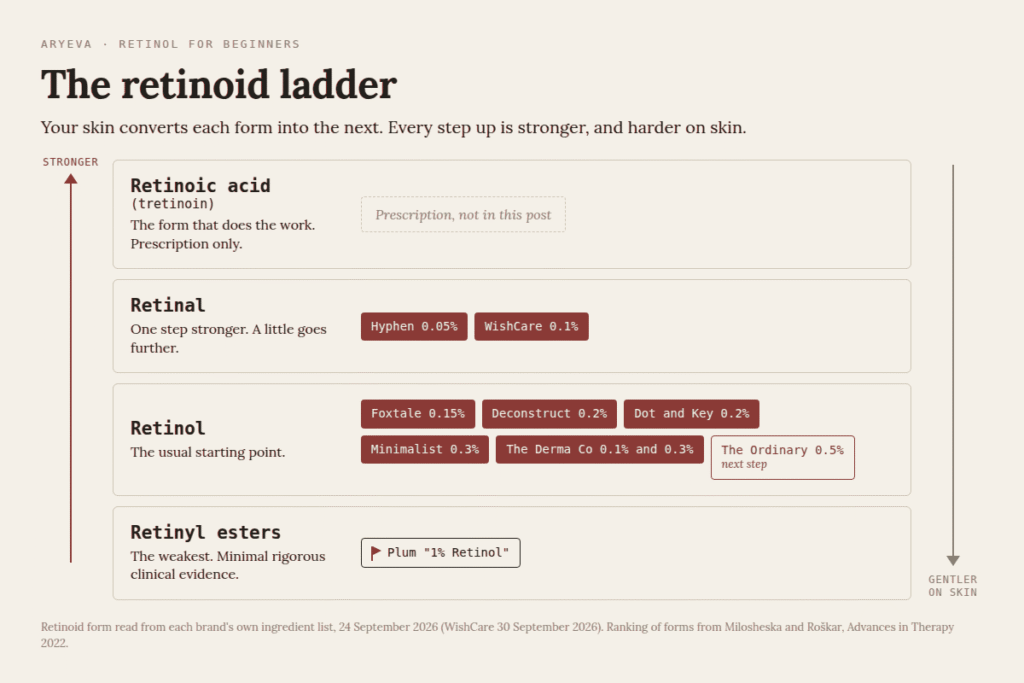
Your skin doesn’t use retinol directly. It converts it. A 2022 review of the clinical evidence sets out the chain: retinyl esters, such as retinyl palmitate, are broken down into retinol; retinol is converted into retinaldehyde (usually shortened to retinal); and retinal is converted into retinoic acid, the form that does the work. Retinoic acid is tretinoin, the prescription cream.
Each step closer to retinoic acid is stronger, and each step closer is also harder on the skin. The review ranks them in exactly that order: retinyl esters are by far the weakest, then retinol, then retinal, then retinoic acid. Tolerability runs the other way.
That ladder is the whole idea of a beginner product. You start low, let your skin adjust, and move up only if you want to. The products below sit on two rungs: low-strength retinol and low-strength retinal. They are different starting points on the same ladder, not rival products.
The evidence is also less tidy than the marketing. The same review describes retinol trials as mixed, with concerns about how stable commercial products are and whether they contain what they declare. Retinal has fewer trials still, though one head-to-head study found a low-strength retinal worked comparably to tretinoin with less irritation. Retinyl palmitate and the other esters have what the review calls minimal rigorous clinical evidence. Keep that last point in mind for later.
What “beginner strength” actually means
The American Academy of Dermatology’s advice to new users is short: use the least intense retinoid formula you can find, every other night to start, and build up slowly. It adds that in skin of colour, irritation can trigger dark marks, and that starting slowly with a moisturiser helps prevent them. For most readers of this site, that is the most important sentence in the post.
The brands mostly agree when you read their small print. Minimalist says its 0.6% retinol is not for beginners and tells you to start on its 0.3%. Hyphen calls its stronger retinal serum “advanced”. The Ordinary tells you to start on its 0.2% and work up to 0.5% and then 1%. Those are the brands’ own words, and they are worth more than any “beginner-friendly” sticker.
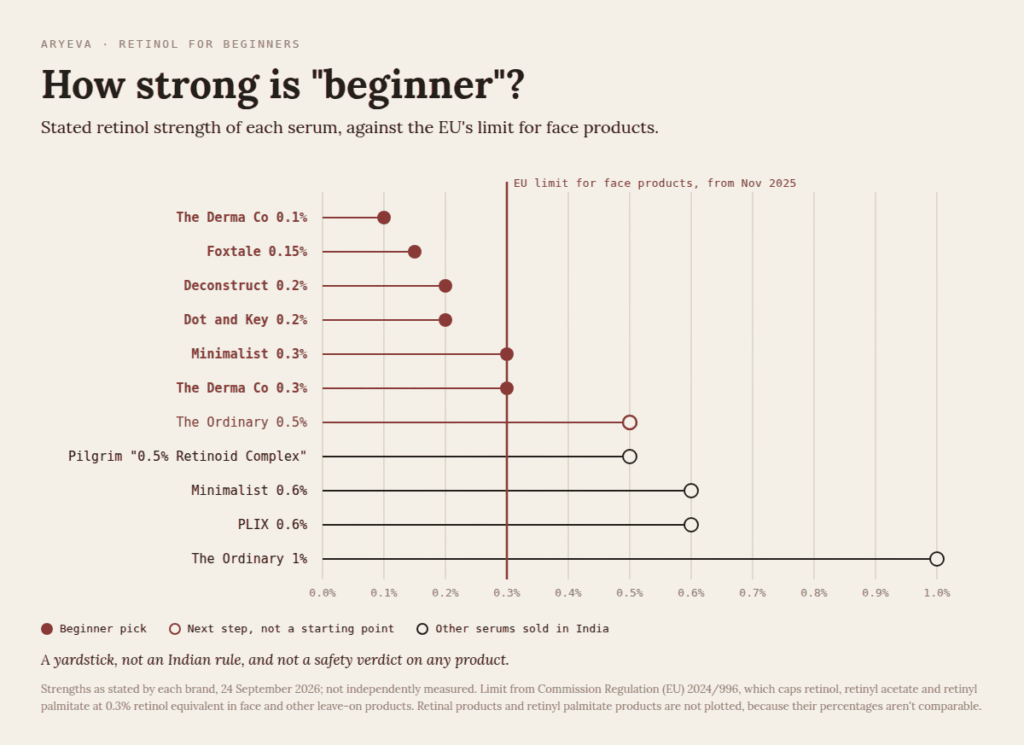
There is also a useful outside yardstick. From November 2025, the European Union capped retinol and its esters at 0.3% in face products newly placed on its market. That limit was set because of total vitamin A exposure, not irritation, and it has nothing to do with Indian law. But it’s a sensible marker for a beginner. Every retinol pick below is at or under 0.3%. Several bottles sold in India as beginner products are not.
What each bottle actually contains
Here is every serum in this post, what kind of retinoid it uses, and what the base feels like, which matters for oily skin.
| Serum | Retinoid | Stated strength | Base | Also worth knowing |
|---|---|---|---|---|
| Foxtale Encapsulated Retinol | retinol | 0.15% | light cream | the gentlest directions here, contains fragrance |
| Deconstruct Retinol and Peptide | retinol | 0.2% | watery serum | lightest texture on the list |
| Dot and Key Retinol Complex | retinol | 0.2% | light cream | niacinamide in the same bottle |
| Minimalist Retinol + Q10 | retinol | 0.3% | oil, no water | the shortest panel, small trial size |
| The Derma Co Retinol | retinol | 0.1% and 0.3% | light cream | two steps from one brand |
| Hyphen Retinal Reset | retinal | 0.05% | light cream | contains sweet almond oil |
| WishCare Retinal Shot | retinal | 0.1% | light cream | vitamin C and niacinamide in the same bottle |
| The Ordinary Retinol in Squalane | retinol | 0.5% | oil, no water | above the band, and not a starting strength |
Two things stand out. Every Indian pick is at 0.3% or below. And the textures vary more than the actives do. If your skin is oily, the base will decide whether you keep using the product long before the retinol has time to do anything.
The “1% retinol” that isn’t retinol
Plum’s 1% Retinol Face Serum with Bakuchiol is one of the most visible retinol serums in India, and the name promises a strength higher than anything on my list. I am not recommending it, and I want to be exact about why.
Plum’s own ingredient list does not contain retinol. The retinoid it lists, seventh, is retinyl palmitate. That is the ester at the bottom of the ladder described above, the one the 2022 review ranks weakest and describes as having minimal rigorous clinical evidence.
I am not saying the product does nothing, and I can’t tell you how much retinyl palmitate is in the bottle. What I can say is that the name on the front says retinol and the brand’s own ingredient list says something else. If you bought it for the number, you bought the percentage of a different molecule. In fairness to Plum, its directions are cautious: two or three nights a week with sunscreen the next day, which is more than some brands manage.
Two more labels worth reading twice
Minimalist’s Retinal 0.1% Face Serum is a nine-ingredient formula with retinal as the last ingredient. Above it, in seventh place, is oleyl adapalenate. That is a derivative of adapalene, a separate retinoid, sold to cosmetic formulators under its own trade name. Minimalist does list it, which is more than a front label would tell you, but the product name mentions only retinal. For a beginner, that is two retinoids in one bottle, and it comes in a smaller bottle than most, so it is also the most expensive per millilitre of anything here. It is a product for someone who has already finished a bottle of retinol and wants to move up, not someone starting out.
Pilgrim’s 0.5% Retinol and Hyaluronic Acid serum is sold as beginner-friendly. At 0.5%, it is above the European yardstick, and it contains perfume. More unusually, the ingredient list on Pilgrim’s page is in alphabetical order, so purified water appears fifteenth. That means the list can’t tell you anything about how much of each ingredient is present. The body copy also describes it as a “0.5% Retinoid Complex”, which is not quite the same thing as 0.5% retinol. I have left it out.
What I looked at
Every retinoid serum sold in India under ₹800 that I could find with a full ingredient list on the brand’s own website, plus The Ordinary for comparison. I left out creams and eye products, which are different purchases, and I left out anything the brand itself describes as advanced or not for beginners. Eye creams, including the retinoid ones, are covered in the under-eye cream guide.
Seven made the list, from seven brands, with The Derma Co’s two strengths sharing an entry. They are not ranked. The order below runs roughly from gentlest to strongest.
Foxtale 0.15% Encapsulated Retinol Night Serum
The lowest retinol strength on the list and the most cautious directions on the shelf. Foxtale tells you to start once or twice a week and move to alternate nights only after three or four weeks. For a genuine first retinol, that pace is right.
The base is a light cream: water, propylene glycol, and a run of emollients before the retinol at eleventh place. The encapsulation on the front is meant to release the retinol gradually. The 2022 review notes that clinical studies of encapsulated retinol are lacking, so treat that as a plausible idea rather than a proven advantage.
Two things in the panel are easy to misread. The “BHA” listed about halfway down is butylated hydroxyanisole, an antioxidant that protects the formula, not the beta hydroxy acid in a salicylic acid serum. And diethylamino hydroxybenzoyl hexyl benzoate, a UV filter you may recognise from the sunscreen guide, appears further down. The page doesn’t say what it is doing there. Whatever it is, it is not sun protection for your face.
It contains fragrance, labelled “allergen free”, which is the brand’s own description rather than a regulated term.
Who it suits: someone who has never used a retinoid and wants the slowest possible start.
Who should skip it: anyone who avoids fragrance.
Deconstruct Retinol and Peptide Serum (0.2%)
The lightest texture on this list. It is a water-based serum, with the retinol carried in a blend of lecithin and a little alcohol that forms a liposome. Deconstruct has now been the liposome brand in three posts running, which suggests a company that thinks about delivery rather than just the headline number.
The rest of the panel is short: pea extract, glycerin, seaweed extract, a mineral blend, hyaluronic acid, and vitamin E.
Deconstruct’s own page is clear about what not to do. It says not to combine it with vitamin C, AHAs, BHAs, or peels, not to use it in pregnancy, and to start two or three times a week. It also warns that new users may see some purging for four to six weeks. Whatever you call it, stinging or redness that doesn’t settle means you should use it less often.
Who it suits: oily skin that hates anything oily, and anyone who wants a serum that disappears.
Who should skip it: very dry skin, which will want a richer base.
Dot and Key 0.2% Retinol Complex Face Serum
Two retinol blends, one free and one encapsulated, which is what the “complex” in the name refers to. Niacinamide sits sixth, above both of them, and peptides and a pomegranate extract follow.
A small confession about the research for this one. A roundup I read while putting this post together listed its retinoid as retinyl palmitate, which would have put it next to Plum. The brand’s own ingredient list says retinol, twice. The likely confusion is cetyl palmitate at fourth place, which is a wax, not a retinoid. That is why every product in this series is checked against the brand’s own page.
Like Foxtale, it lists “BHA”, and again it is the antioxidant, not the acid.
The directions say three or four pumps. For a first retinol, I would use less than that. The AAD’s least-intense-first advice applies to how much you use as well as which bottle you buy.
Who it suits: someone who wants retinol and niacinamide in one step.
Who should skip it: if you already use a niacinamide serum, you are doubling up.
Minimalist Retinol 0.3% + Q10 Face Serum
Eleven ingredients and no water, the shortest panel here. The base is caprylic and capric triglyceride, a light solvent, squalane, and two more emollients, then vitamin E, bakuchiol, retinol, and coenzyme Q10. Leaving the water out is the stability route for retinol, and the brand describes the bottle as UV-protective.
Bakuchiol is seventh, above the retinol, and isn’t in the product name. It is a plant extract often marketed as a gentle retinol alternative. Here, it is a supporting ingredient.
This is the top of the beginner range, at the European yardstick, so it is not where I would start if you have never used a retinoid. But Minimalist sells it in a very small bottle as well as the standard one, and that small bottle is the cheapest way on this list to find out how your skin handles retinol. The directions are sensible: alternate days for two weeks, then daily if your skin is comfortable.
Because the base is all oil, oily skin should expect a slick finish. Use it as the last step at night, under or instead of a light moisturiser.
Who it suits: someone who has tried a gentler retinol, or has resilient skin, and wants a clean, stable formula.
Who should skip it: very oily skin that dislikes oils, and anyone starting from zero who would rather begin lower.
The Derma Co 0.1% and 0.3% Retinol Serums
The Derma Co is the only brand in this post with two steps at or below the European yardstick, which is exactly what a beginner needs. Start on the 0.1%, finish the bottle, and move to the 0.3% if your skin has been comfortable.
The 0.3% has a light cream base. Its second ingredient, ethylhexyl methoxycrylene, is a photostabiliser used in sunscreens. Sixth is tetrahexyldecyl ascorbate, an oil-soluble form of vitamin C and a cousin of the molecules in the vitamin C serum roundup. The retinol comes near the end, which is normal for a product at this strength.
The 0.1% uses the same ingredient list as the 0.3%, entry for entry, according to The Derma Co’s own page. The difference is the amount of retinol, which is exactly what the list can’t show you.
The warnings on The Derma Co’s pages are the clearest on the shelf. Do not use it if pregnant or breastfeeding. Do not combine it with AHAs, BHAs, or benzoyl peroxide. Start two or three times a week, and wear sunscreen during the day.
Who it suits: a true beginner who wants a clear path from a first bottle to a second.
Who should skip it: anyone who wants the lightest possible texture, who should look at Deconstruct.
Hyphen 0.05% Retinal Reset Serum
One of two beginner-strength retinals on the list, and the second route onto the ladder. Retinal is one step stronger than retinol, so Hyphen uses very little of it. It sits fifteenth, in a light cream base led by centella and aloe, with bakuchiol right behind it.
Hyphen’s directions start at twice a week and build to three or four times. For sensitive skin, its page suggests the “sandwich” method: moisturiser, then serum, then moisturiser again. That is a reasonable way to soften any retinoid.
Two allergy notes. Sweet almond oil is twelfth, which matters if you have a nut allergy. Chamomile extract is ninth, which matters if you react to plants in the daisy family.
Hyphen also sells a 0.1% version, which the brand itself describes as advanced. Start with the 0.05%. WishCare, below, sells the same 0.1% strength as beginner-friendly, which tells you how loosely the word is used.
Who it suits: someone who wants to try retinal rather than retinol, at a genuinely low strength.
Who should skip it: anyone with a nut allergy.
WishCare Cellular Reset 0.1% Retinal Shot
The second retinal on the list, and the strongest pick here. At 0.1% it sits at the top of the beginner range for retinal, and the brands do not agree on whether that still counts as a beginner strength. WishCare sells it as beginner-friendly and says its encapsulated formula releases the retinal gradually. Hyphen describes its own 0.1% retinal as advanced, and Minimalist’s 0.1% retinal is not a beginner product either. If you have never used a retinoid, start lower, with Hyphen’s 0.05% or one of the retinol picks above.
The base is a light cream: water, a fatty alcohol, emollients and silicones. The retinal comes near the end, 24th of 26 ingredients, which is normal at this strength. As with Foxtale, treat the encapsulation as a plausible idea rather than a proven advantage, because clinical studies of encapsulated retinoids are lacking.
Three things in the list are not in the name. Ascorbic acid, the pure form of vitamin C from the vitamin C serum roundup, sits 15th, and niacinamide 17th. That puts vitamin C in the same bottle as the retinoid, the pairing this post otherwise suggests keeping apart while you start, so introduce this one slowly. And methylene bis-benzotriazolyl tetramethylbutylphenol, another UV filter, sits just above the retinal. As with Foxtale, the page does not say what it is doing there, and it is not sun protection for your face.
WishCare’s directions are sensible: two or three nights a week at first, moisturiser after, and sunscreen every morning. Its page does not carry a pregnancy warning, but the advice further down applies to this one exactly as it does to the others.
Who it suits: someone who has finished a gentle retinol, or Hyphen’s 0.05%, without irritation and wants to try retinal.
Who should skip it: first-time users, and anyone keeping vitamin C and retinoids apart while they start.
Worth the stretch, with a warning: The Ordinary Retinol 0.5% in Squalane
This sits just above the band, and it is here for a different reason from the other stretch picks in this series. It is not a better beginner product. It is the next step once you have finished one of the bottles above.
The panel is eight ingredients: squalane, a triglyceride, jojoba oil, retinol, then tomato and rosemary extracts, and two antioxidants. There is no water. It is a well-made, stable formula, and it is oil through and through.
The Ordinary’s own guidance is the clearest statement from any brand in this post. Start on its 0.2%, and slowly work your way up to 0.5% and then 1%. The 0.2% is the one I would recommend to a beginner, but I could not find it sold in India at a verified official price, and marketplace listings vary wildly. Buy The Ordinary only from an authorised seller. Counterfeit and grey-imported skincare is a real problem on Indian marketplaces.
The Ordinary also says to refrigerate it after opening and use it within three months.
Who it suits: someone who has used a 0.3% retinol for a couple of months without irritation.
Who should skip it: first-time users and oily skin that dislikes an oil base.
How to start without regretting it
Use it at night only. Retinoids can make skin more sensitive to the sun, which is why the AAD and every brand here say night only.
Wear sunscreen every morning, without exception. If you are going to use a retinoid and you have not sorted sunscreen yet, sort that first. The sunscreen guide covers oily skin, and the dry-skin sunscreen guide covers dry skin.
Start two or three nights a week. Use a pea-sized amount for the whole face, not a palmful. Apply it to dry skin after cleansing, and follow with moisturiser. Keep it away from the corners of your eyes and mouth, which get irritated first.
Don’t start two new actives at once. Keep your retinoid nights separate from a salicylic acid serum and from vitamin C until you know how your skin handles each on its own. The usual split is vitamin C in the morning and the retinoid at night.
Expect some dryness in the first few weeks. Stinging that lasts, redness the next morning, or skin that starts to peel means use it less often, not more. On darker skin, pushing through irritation is how you end up with the dark marks you were trying to avoid.
Patch-test first. Apply a little along the jaw for a few nights before committing your whole face.
If you are pregnant or trying to be
Don’t use any of these. Most of the brands’ own pages say so, and the AAD says retinoids should not be used during pregnancy. The 2022 review is careful here: studies have not confirmed harm from topical retinoids in early pregnancy, but it concludes their use cannot be advised because there isn’t the evidence to show they are safe. Several of the brands extend the same warning to breastfeeding. Speak to your doctor about alternatives.
If you only want one answer
If you have never used a retinoid, buy The Derma Co 0.1%, and move to its 0.3% when the bottle is finished.
If your skin is oily and you want the lightest texture, buy Deconstruct. If you want the gentlest possible start, buy Foxtale and follow its slow directions. If you want to try the smallest bottle before committing, buy Minimalist’s trial size, knowing it sits at the top of the beginner range.
And if you are choosing between two bottles, choose the lower strength.
Common questions
Which strength should I start with?
The lowest you can find, used two or three nights a week. For retinol, that means something between 0.1% and 0.3%. Strength is the one thing in this post where more is not better for a beginner.
Is retinal better than retinol?
It is one step closer to the form your skin uses, so a small amount goes further. That also means it can irritate more. It is a different starting point, not an upgrade.
Can I use retinol with niacinamide?
Generally yes, and one of the picks here puts them in the same bottle. Introduce them one at a time so you know which is responsible if your skin reacts.
Is bakuchiol the same as retinol?
No. It is a plant extract that is often marketed as a gentle alternative. Several products here contain it alongside retinol, but it is not a retinoid.
How long before I see results?
Longer than the first bottle. Retinoids work over months, not weeks. If the first few weeks bring anything, it is usually dryness, which is why the slow start matters.
Does retinol help acne?
Retinoids are used to treat acne, but mostly as prescription treatments. If acne is your main concern, a dermatologist is the better first stop, and the salicylic acid serum post covers the over-the-counter option.
How often should a beginner use retinol?
Two or three nights a week to start, with a pea-sized amount for the whole face, on dry skin after cleansing and followed by moisturiser. Use it at night only, wear sunscreen every morning, and build up only while your skin stays comfortable. The section on starting, above, covers what to do if it stings or peels.
Nothing in this post is sponsored, and nothing here was tested on my own skin. This is not medical advice. If you have a skin condition, are pregnant, or are using prescription treatment, speak to a doctor before starting a retinoid. Every Indian ingredient list was read from the brand’s own website on 24 September 2026 (WishCare on 30 September), and formulations change without notice. If a panel has moved since, the brand’s page is right, and I am wrong. Sources: Milosheska and Roškar, Advances in Therapy, 2022; American Academy of Dermatology, “Retinoid or retinol?”; Commission Regulation (EU) 2024/996.