
Best Serum for Dark Spots in India Under ₹700
Some links here may be affiliate links. Where they are, a purchase can earn Aryeva a commission at no extra cost to you — it never affects the picks. Prices and formulations change; everything below was checked against the brands’ own ingredient listings at the time of writing.
Short answer: if your skin is oily and acne-prone and you have marks, the best serum for dark spots in India under ₹700 is The True Therapy Azelaic Acid 10%, the one serum here aimed at both the breakouts and the marks they leave. If you want a single, simple active to test, pick The True Therapy Tranexamic Acid 3%. For the best-studied named ingredient at the lowest price on oily skin, pick Nivea Luminous630. Whichever you choose, start wearing sunscreen every morning first.
How this list was checked. Each ingredient list was read from the brand’s own product page, not a marketplace listing. Prices and stock were re-checked on 24 October 2026, on the brands’ own sites, or on Nykaa where the brand site does not sell the product. This is a reading of labels, not a wear test. The full method is under “What I looked at” below.
Dark spots are where skincare marketing is at its most confident and the evidence is at its least tidy.
Every brand on the Indian shelf now sells a serum for them. Most promise visible results in a week or two. The labels name one hero ingredient in large type: tranexamic acid, alpha arbutin, kojic acid, a percentage, and a fruit. What those labels rarely tell you is what else is in the bottle, and on this shelf, what else is in the bottle turns out to matter a lot.
As in every post in this series, each product here was checked against its brand’s own current ingredient list, and then checked a second time. That turned up a pattern I didn’t expect. Three of the serums below contain a second pigment-targeting ingredient that none of them names on the front. One sold on the strength of a fruit extract lists tranexamic acid second, right after water. One sold as “kesar and kojic” carries five ingredients aimed at pigment. And one well-known serum sells a “12% complex” whose headline ingredients sit below a preservative.
Nine made the list, all under ₹700, from eight brands, several of them new to this site. One more sits just above the band, with a warning about its name.
Start with sunscreen, and be patient
Before any serum, the unglamorous part. The American Academy of Dermatology’s guidance on dark spots in darker skin tones begins with one line: effective treatment for dark spots and patches begins with sunscreen. Every morning, SPF 30 or higher, reapplied throughout the day. Without it, a dark-spot serum is working against a daily top-up of new pigment, and it will lose.
The same guidance is honest about time. A spot a few shades darker than your skin, it says, will usually fade within six to twelve months. Deeper marks can take longer. No serum in this post will change that timeline by much, and anything that promises visible results in seven days is describing a brighter complexion, not a faded mark.
If you haven’t settled on a sunscreen, do that first. The sunscreen guide for oily skin covers oily skin, and the sunscreen guide for dry skin covers dry skin.
Most of the research is on melasma, not acne marks
One more piece of honesty, because it shapes everything below.
The best recent summary I could find is a 2023 systematic review in the Indian Dermatology Online Journal, which graded the evidence for the main dark-spot ingredients. It is useful, and it rates several of the ingredients in this post well. But it is a review of melasma, the hormonal, patchy pigmentation that usually appears on the cheeks and forehead. Most readers of this site are dealing with something different: the marks left behind after a pimple heals. The two overlap, and the same ingredients are used for both, but you can’t simply transfer the melasma results onto acne marks.
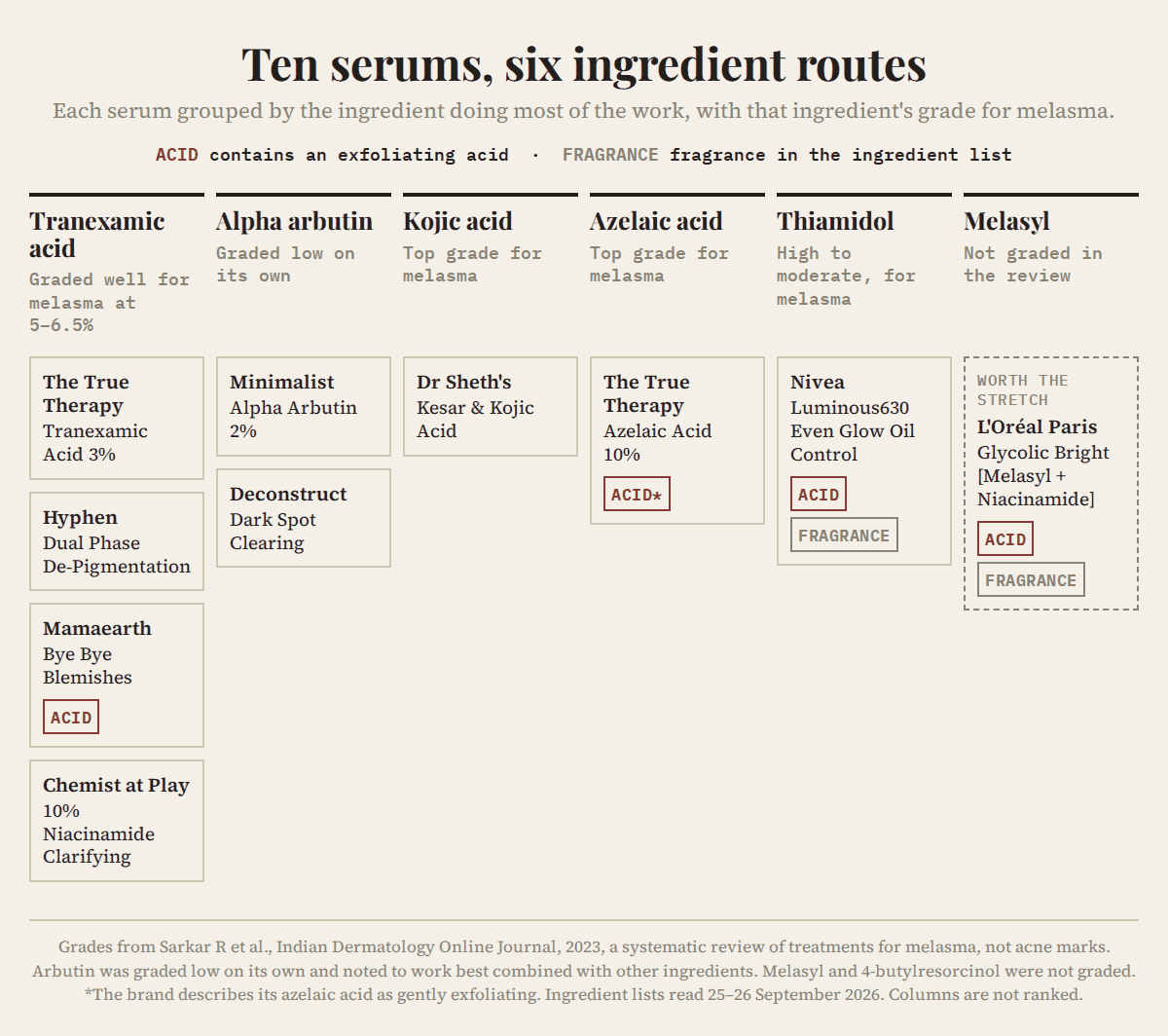
With that caveat, here is what the review says. Tranexamic acid applied to the skin, at 5% to 6.5%, did better than a placebo and roughly as well as hydroquinone, the prescription standard, in people without a history of blood clots. Azelaic acid and kojic acid both got the review’s top grade. Thiamidol, a newer ingredient you will meet below, was rated as having high to moderate efficacy. Arbutin got a low grade, and the review notes it works best combined with other ingredients such as niacinamide, vitamin C, and tranexamic acid.
Two things follow for shopping. Most tranexamic acid serums sold in India are 3% or 4%, below the strengths in those trials. That doesn’t mean they do nothing. It means the trials don’t tell us how well they work. And an alpha arbutin serum that contains nothing else is the weakest-evidenced choice on the shelf, which is worth remembering when you read what is actually in the bottles.
What each serum actually contains
Here is every serum in this post, its lead ingredients, and the two things that matter most in daily use: whether it contains an exfoliating acid, and whether it contains fragrance.
| Serum | Lead ingredients | Exfoliating acid | Fragrance |
|---|---|---|---|
| Nivea Luminous630 Even Glow Oil Control | Thiamidol, salicylic acid | yes, salicylic | yes |
| Mamaearth Bye Bye Blemishes | tranexamic acid, alpha arbutin, vitamin C | yes, glycolic and lactic | no |
| The True Therapy Tranexamic Acid 3% | tranexamic acid | no | no |
| Hyphen Dual Phase De-Pigmentation | niacinamide, tranexamic acid, 4-butylresorcinol | no | no |
| Minimalist Alpha Arbutin 2% | alpha arbutin, 4-butylresorcinol | no | no |
| Deconstruct Dark Spot Clearing | niacinamide, alpha arbutin, vitamin C | no | no |
| Dr Sheth’s Kesar and Kojic Acid | niacinamide, kojic acid, alpha arbutin, 4-butylresorcinol | no | no |
| Chemist at Play Niacinamide Clarifying | niacinamide, tranexamic acid, alpha arbutin | no | no |
| The True Therapy Azelaic Acid 10% | azelaic acid | the brand says gently exfoliating | no |
| L’Oréal Glycolic Bright (Melasyl) | Melasyl, niacinamide, glycolic acid | yes, glycolic | yes |
Two things stand out. Most of these serums are not single-ingredient products, whatever the name says. And the ones with exfoliating acids need more care, which the section on using them covers.
What the front of the bottle leaves out
The most useful thing I found in these ingredient lists is how often the name undersells the formula.
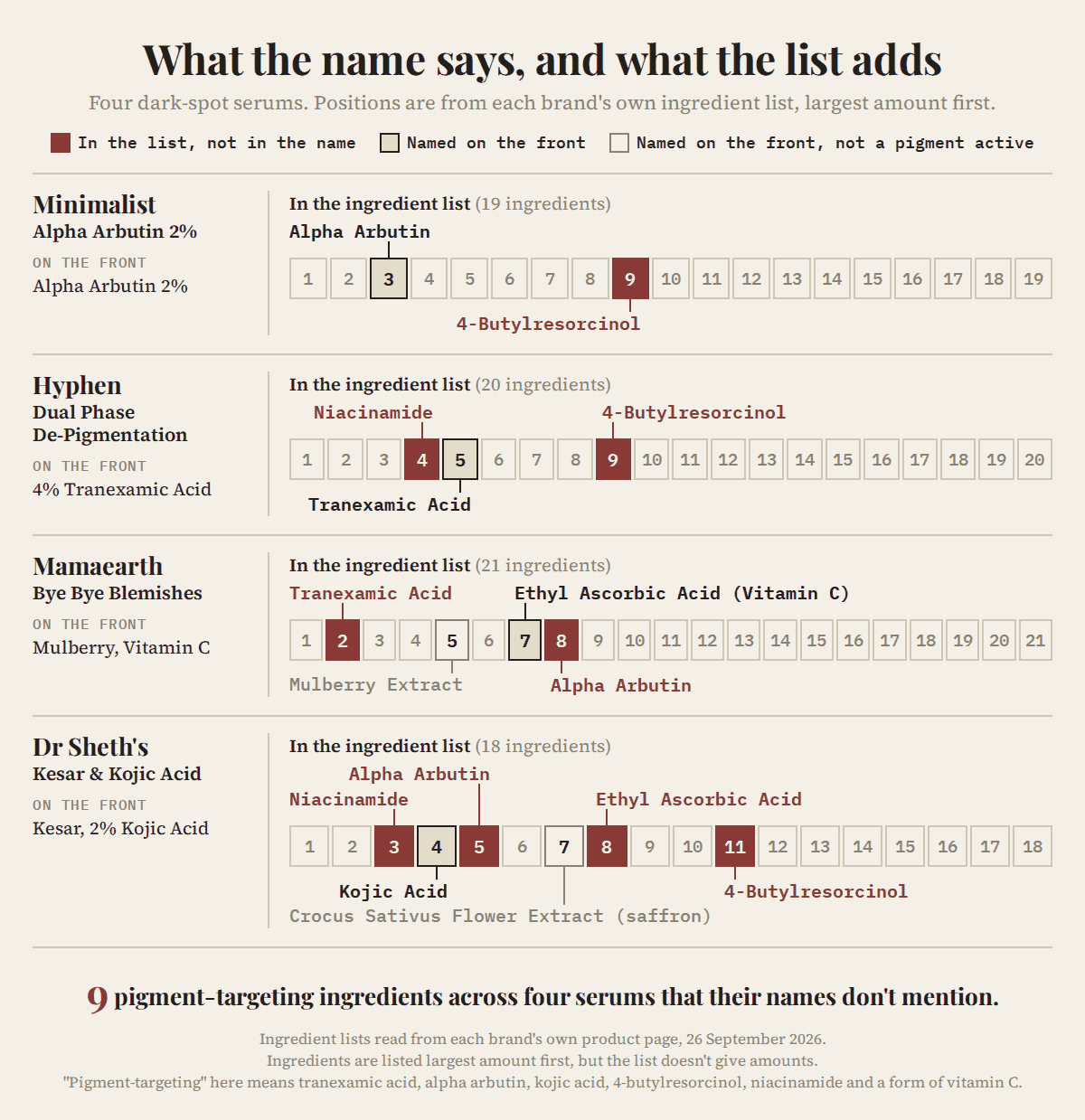
Minimalist’s Alpha Arbutin 2%, Hyphen’s Dual Phase De-Pigmentation serum, and Dr Sheth’s Kesar and Kojic serum all contain 4-butylresorcinol. It is an ingredient used specifically to target pigment, and in each case it sits within the first dozen ingredients. None of the three mentions it in the product name. All three do list it, which is to their credit, but you would only know if you read the back.
Mamaearth’s Bye Bye Blemishes serum is sold on mulberry and vitamin C. Its ingredient list starts with water, then tranexamic acid. Mulberry extract is fifth, and a form of vitamin C, alpha arbutin, and two exfoliating acids follow it. This is the reverse of the usual problem: a label that promises less than the bottle contains.
Dr. Sheth calls its serum Kesar and Kojic. The list has niacinamide third, kojic acid fourth, alpha arbutin fifth, a form of vitamin C eighth, and 4-butylresorcinol eleventh, with saffron seventh. That is five pigment-targeting ingredients in a serum named for two.
Undersold isn’t a fault. But it does mean that if you are layering serums, you may be doubling up on an ingredient without knowing it.
A smaller point, for anyone who likes to read labels. Ingredients are normally listed in order of amount, largest first, so position tells you something. Two brands here make that impossible. Pilgrim, which I left out of this post, lists its alpha arbutin serum’s ingredients in alphabetical order on its website, with purified water near the bottom. The True Therapy’s tranexamic acid page gives an ingredient glossary, not a declaration, ending with water. For those two, the list tells you what is in the bottle but not how much.
The “12% complex”
Pond’s Bright Beauty Anti-Pigmentation Serum is one of the most visible dark-spot serums in India, and its front label promises a “12% Gluta-Niacinamide Complex”. I am not recommending it, and I want to be exact about why.
Pond’s doesn’t publish the full ingredient list on its website. The list recorded on the ingredient database incidecoder puts niacinamide fifth, which is plausible for a serum built around it. The “gluta” part of the name refers to glutathione, and Pond’s page mentions a “glutathione precursor”. The ingredients in the list that fit that description are cystine and glycine, two amino acids that the body uses to build glutathione. They sit sixteenth and seventeenth, after methylparaben, a preservative normally used at well under one per cent.
I can’t tell you how the 12% divides between niacinamide and everything else, and neither can the label. Pond’s doesn’t say. What I can say is that the part of the name that sounds new sits near the bottom of the list, below a preservative, according to the only full ingredient list I could find. The same list shows two parabens and six fragrance allergens. If you like it, that is fine. But if you bought it for the “gluta”, you bought mostly a niacinamide serum, and there are niacinamide serums with far clearer labels in the niacinamide serum roundup.
What I looked at
I checked every serum I could find sold in India for dark spots or pigmentation under ₹700, from the large mass-market brands as well as the online ones, including Nivea, Pond’s, Garnier, Himalaya, Lakmé, Biotique, and Lotus, as well as the brands this site usually covers. I left out products that don’t publish enough of their ingredients to judge, products whose only relevant ingredient is niacinamide (those belong in the niacinamide post), and vitamin C serums, which have a post of their own. Dark circles under the eyes are a separate problem, often not pigment at all, and the under-eye cream guide covers them.
Nine made the list. They are not ranked. They are grouped by the ingredient doing most of the work.
Nivea Luminous630 Even Glow Oil Control Serum
The only serum here built around Thiamidol, and the find of this post. Thiamidol is Nivea’s own trademarked ingredient, listed under its chemical name, isobutylamido thiazolyl resorcinol, in seventh place. It is the ingredient the 2023 review rated as having high to moderate efficacy. Nivea sells it at a mass-market price, in a slightly larger bottle than most here.
This version is made for oily and combination skin. Alcohol is second on the list, and salicylic acid is fifth, alongside hyaluronic acid, green tea, and licorice extracts. That makes it a light, quick-drying serum with a mild exfoliant built in. It contains fragrance and two colourants.
Nivea’s page claims 100% “reported” dark spot reduction from a twelve-week study. Reported means the participants assessed themselves. Treat it as a satisfaction figure, not a measurement.
A note on sourcing. Nivea’s own product page doesn’t show the ingredient list, so the list above is from a large pharmacy’s listing, checked twice.
Who it suits: oily or combination skin that wants a named, studied ingredient at a low price.
Who should skip it: dry or sensitive skin, anyone who avoids fragrance or alcohol, and anyone already using a salicylic acid serum.
Mamaearth Bye Bye Blemishes Face Serum
Out of stock: on 24 October 2026 Mamaearth’s own site listed this serum as out of stock, as it was when this guide was first published, and I could not find it on Amazon either. The reading below still stands, but check that it is back before you buy.
The most undersold label on the list. Sold on mulberry and vitamin C, it lists tranexamic acid second, then two solvents, mulberry extract, lactic acid, a form of vitamin C, alpha arbutin, and glycolic acid. That is three pigment-targeting ingredients and two exfoliating acids in one bottle, plus licorice and two other plant extracts further down. There is no fragrance in the list.
The two acids are what you need to plan around. They make this a stronger product than the name suggests, so introduce it slowly, and wear sunscreen every morning you use it.
Mamaearth is owned by Honasa Consumer, which also owns Dr Sheth’s, further down this list. They are separate formulas, but it’s the same parent company.
Who it suits: someone who wants several ingredients in one step and doesn’t mind a gentle acid.
Who should skip it: sensitive skin, and anyone using a retinoid who hasn’t yet worked out how their skin handles acids.
The True Therapy Tranexamic Acid 3% Serum
The simplest tranexamic acid serum here. The brand states 3% tranexamic acid with 1.5% succinic acid, supported by niacinamide, hyaluronic acid, and raspberry leaf extract. It is fragrance-free, and the brand suggests using it morning and night.
The one limitation is the label. The True Therapy’s page gives an ingredient glossary rather than a declaration, so you can’t read the order, and I haven’t guessed at it. The percentages above are the brand’s own.
The True Therapy is a smaller brand than most on this list, and that simplicity is the point. If you want to find out whether tranexamic acid does anything for your marks, this is the cleanest way to test it on its own.
Who it suits: anyone who wants one active, not five.
Who should skip it: anyone who wants the label to show them exactly how much of each ingredient is in the bottle.
Hyphen Dual Phase De-Pigmentation Serum
Sold as a 4% tranexamic acid serum, and it is, but niacinamide sits fourth, above the tranexamic acid in fifth, and 4-butylresorcinol is ninth. It is a two-layer formula, oil and water, so you shake it before every use. Licorice oil and sea buckthorn oil are in the list, and the brand notes that its natural ingredients may shift the colour over time.
Hyphen’s directions are some of the most useful on the shelf. It tells you not to use it on the same day as retinol, vitamin C, or exfoliating acids. That is stricter than some brands, but for anyone building a routine, it’s a clear rule.
Who it suits: someone who wants tranexamic acid and niacinamide in one step, and likes a slightly richer texture.
Who should skip it: anyone who already uses a niacinamide serum, and anyone who wants to use retinol or vitamin C on the same day.
Minimalist Alpha Arbutin 2% Face Serum
Alpha arbutin is third, but the more interesting ingredient is further down. 4-butylresorcinol is ninth, and ferulic acid, an antioxidant, is seventh. That matters, because the 2023 review gave arbutin on its own a low grade and noted it works best combined with other ingredients. This isn’t an arbutin-only serum, even if the name suggests it is.
It is fragrance-free, and Minimalist suggests morning and night use with sunscreen. Minimalist sells a small trial size as well as the standard bottle, which is a cheap way to see how your skin reacts before committing.
Who it suits: someone who wants a short, fragrance-free formula with more going on than the name suggests.
Who should skip it: anyone looking specifically for tranexamic acid.
Deconstruct Dark Spot Clearing Serum
The shortest panel among the multi-ingredient picks: fourteen ingredients, with niacinamide second, alpha arbutin third, and a form of vitamin C fourth. Vitamin E and a seaweed extract follow. It is fragrance-free.
Deconstruct’s product name mentions “liposomal technology”. Unlike the retinol serum in the last post, where the ingredient list showed how the liposome was built, I can’t see it from this list, so I’m not going to explain it for them.
Deconstruct’s page suggests it for over-18s, recommends a patch test and daily sunscreen, and advises discretion in pregnancy.
Who it suits: oily skin that wants a light serum with three well-known ingredients and nothing it doesn’t need.
Who should skip it: anyone already using a niacinamide serum, which this would double up on.
Dr Sheth’s Kesar and Kojic Acid Ampoule Serum
Five pigment-targeting ingredients under a two-ingredient name. Niacinamide is third, kojic acid fourth, alpha arbutin fifth, a form of vitamin C eighth, and 4-butylresorcinol eleventh. Saffron, the “kesar”, is seventh. Kojic acid is one of the ingredients the 2023 review graded highest.
It is fragrance-free. Dr Sheth’s suggests it morning or night, with sunscreen in the day, and gives the most specific patch-test instructions on the shelf: a small patch under the ear or along the jaw, for twenty-four hours. The brand also warns the serum may change colour slightly over time.
As noted above, Dr Sheth’s shares a parent company with Mamaearth.
Who it suits: someone who wants kojic acid, or the widest mix of ingredients in one bottle.
Who should skip it: anyone already using a niacinamide or vitamin C serum.
Chemist at Play 10% Niacinamide Clarifying Face Serum
Chemist at Play sells this for hyperpigmentation and dark spots, and it is built on 10% niacinamide, second in the list, with 3% tranexamic acid fifth and alpha arbutin seventh. What sets it apart is five named ceramides near the end, which are there to support the skin barrier. There is no fragrance in the list.
A note on the name. Some shops still list an older Chemist at Play “Hyperpigmentation Control” serum. The one here is the serum the brand currently sells on its own store, and that is the ingredient list I’ve used.
Who it suits: someone who wants niacinamide and tranexamic acid with barrier support, especially if their skin gets irritated easily.
Who should skip it: anyone already using a niacinamide serum. This one is mostly niacinamide.
The True Therapy Azelaic Acid 10% Serum
The only azelaic acid serum on this list, and azelaic acid got the 2023 review’s top grade. It has a useful second life for oily and acne-prone skin: The True Therapy describes it as working on breakouts and oil as well as on pigmentation.
The brand discloses four ingredients and their strengths: 10% azelaic acid, 1% witch hazel extract, 1% panthenol, and 0.5% allantoin. It doesn’t publish a full ingredient list, so that is all I can tell you. The page also gives two different pH figures in two places. It is marked fragrance-free.
Witch hazel is included as an astringent, which suits oily skin but can sting sensitive skin. The brand suggests morning or night, with sunscreen if you use it in the day, and recommends a patch test first.
Who it suits: oily, acne-prone skin with marks, which is exactly the reader this site is written for.
Who should skip it: anyone who wants to see the full ingredient list before buying, and very sensitive skin.
Worth the stretch, with a warning about the name: L’Oréal Paris Glycolic Bright 8% [Melasyl + Niacinamide] Serum
This sits around the top of the band, just under it at some shops and just over it at others, so I’ve treated it as a stretch pick rather than guessing which price you’ll find.
It is here because of one ingredient. Melasyl is L’Oréal’s own molecule, which the company says it developed over eighteen years of research. On an ingredient list, it appears as 2-mercaptonicotinoyl glycine. It is the same molecule that appears in La Roche-Posay’s Mela B3 serum, which is also a L’Oréal brand and costs several times as much for a much smaller bottle. The two formulas are different, and neither brand discloses how much Melasyl it uses. But if you want to try the ingredient, this is the affordable route.
The international ingredient list shows niacinamide third, alcohol fourth, glycolic acid eleventh, and Melasyl twelfth, with fragrance and several fragrance allergens. The “8%” on the front is the three headline ingredients combined, not 8% glycolic acid. L’Oréal India’s page claims a 77% visible reduction in spots, from a study of 126 spots on 63 women over eight weeks. That is the brand’s claim, measured by the brand.
Now the warning. Two different L’Oréal Glycolic Bright serums are sold in India. The older one is sold as an “Instant Glowing Serum” with 8% glycolic acid. At the time of writing, L’Oréal India’s own product page describes the Melasyl serum but prints an ingredient list with no Melasyl and no niacinamide in it. Before you buy, check that the box says “[Melasyl + Niacinamide]”. If it doesn’t, it isn’t the product I’m describing.
Who it suits: someone who wants to try Melasyl without paying La Roche-Posay prices, and whose skin is used to acids.
Who should skip it: sensitive skin, anyone who avoids fragrance, and anyone who can’t check the box before buying.
How to use a dark-spot serum without making things worse
Sunscreen every morning comes first, again. Several of these serums contain exfoliating acids, and all of them are working against new pigment. Skipping sunscreen undoes both.
Introduce one new serum at a time, and give it at least a few weeks before judging it. Patch-test first, on the jaw or behind the ear, for a day or two.
Watch the acids. Nivea, Mamaearth, and L’Oréal contain exfoliating acids, and The True Therapy describes its azelaic acid as gently exfoliating. Don’t layer them with a salicylic acid serum, and don’t start them in the same week as a retinoid. If you use a retinoid, keep it and any acid serum on separate nights until you know how your skin handles each.
Check for doubling up. Hyphen, Deconstruct, Dr Sheth’s, and Chemist at Play all contain niacinamide, some of them a lot. If you already use a niacinamide serum, you probably don’t need both.
Stop if it stings. The AAD’s advice is simple: if a product burns or stings when you apply it, stop using it. On darker skin, irritation can itself leave dark marks, which is the opposite of what you are trying to do.
If you have a history of blood clots, ask your doctor before using a tranexamic acid serum. The 2023 review’s positive findings were in people without that history. And if you are pregnant or breastfeeding, check with your doctor before starting any of these. Several brands say so on their own pages.
If you only want one answer
If your skin is oily and acne-prone and you have marks, buy The True Therapy Azelaic Acid 10%. It is the one serum here aimed at both the breakouts and the marks they leave, though you are trusting the brand’s short list of four ingredients.
If you want a single, simple active to test, buy The True Therapy Tranexamic Acid 3%. If you want the best-studied named ingredient at the lowest price and your skin is oily, buy Nivea Luminous630. If you want the most ingredients in one bottle, buy Dr Sheth’s, and don’t pair it with another serum.
And whichever you buy, buy a sunscreen first.
Common questions
What is the difference between dark spots, pigmentation and acne marks?
They overlap. Dark spots and pigmentation are general terms for patches darker than your skin. Acne marks are a specific kind, left behind after a pimple heals. Melasma is another kind, usually hormonal and patchy. The same ingredients are used for all of them, but most of the research is on melasma.
Which ingredient works best?
There isn’t one answer. In the 2023 review, azelaic acid and kojic acid got the top grade for melasma, and tranexamic acid and Thiamidol did well. Arbutin on its own was rated lowest. Several serums here combine ingredients, which may matter more than which one is on the label.
How long does it take?
Months. The AAD says a mild dark spot usually fades within six to twelve months. A serum can help, but it can’t skip that timeline, and daily sunscreen matters as much as the serum.
Can I use a dark-spot serum with vitamin C?
Several of these already contain a form of vitamin C. If you use a separate vitamin C serum, check for overlap, and introduce one at a time. Hyphen specifically says not to use its serum on the same day as vitamin C.
Can I use it with retinol?
Carefully, and not on the same night at first, especially with serums with exfoliating acids. The beginner’s guide to retinol covers how to start a retinoid.
Is 4-butylresorcinol safe?
It is a common cosmetic ingredient used to target pigment, and all three brands that use it list it openly. As with any active, patch-test first, and stop if your skin reacts.
What is the best serum for acne marks?
For the brown marks left behind on oily, acne-prone skin, The True Therapy Azelaic Acid 10% is the pick here, because it is the one serum on this list aimed at both the breakouts and the marks. Whatever you use, daily sunscreen matters as much as the serum, because UV keeps marks dark for longer.
Nothing in this post is sponsored, and nothing here was tested on my own skin. This is not medical advice. If you have a skin condition, are pregnant or breastfeeding, or are using prescription treatment, speak to a doctor before starting a new active. Every ingredient list was read on 25 and 26 September 2026, from the brand’s own website except where stated, and formulations change without notice. If a list has changed since then, the brand’s page is right, and I am wrong. Sources: Sarkar R et al., Indian Dermatology Online Journal, 2023; American Academy of Dermatology, “How to fade dark spots in darker skin tones”.